Ishiyama-dera Temple: A Historic Shingon Buddhist Temple in Japan


Site at a Glance
- Rating
- 4.3
- Popularity
- Medium
- Country
- Japan
- Primary era
- Medieval
- External website
- Open
- Eras represented
- Medieval, Early Modern
- Civilizations
- Unclassified
- Site type
- Religious
- Remains
- Monastery
On this page17 sections
History
Ishiyama-dera Temple is a Buddhist temple in Otsu, Japan, traditionally founded in 747 during the Nara period. It is a head temple of the Tōji-ha branch of Shingon Buddhism, an esoteric tradition centered on ritual practice, sacred diagrams, and mantras. Its principal image is Nyōirin Kannon, a manifestation of Kannon associated with wish-fulfilling power, and the temple is the 13th stop on the Saigoku Kannon Pilgrimage.
Origins and Nara-period development
The site was used as a quarry in the 660s, during the reign of Emperor Tenji. After the Jinshin War of 672, Prince Ōtomo was traditionally buried east of the present pagoda site. The temple’s foundation is associated with Emperor Shōmu’s imperial prayer and Rōben, the eighth-century monk traditionally regarded as the founder and first chief priest of Tōdai-ji, the Nara temple responsible for the Great Buddha project. Tradition holds that Rōben enshrined a six-inch gilt-bronze Nyōirin Kannon at Ishiyama-dera. The image was believed to have been Prince Shōtoku’s personal Buddha.
The foundation tradition, preserved in the Ishiyama-dera Engi Emaki, also connects Rōben with a dream of Zaō Gongen, a syncretic mountain deity associated with ascetic traditions in Yoshino and Kinpusen. In the story, Rōben was guided by an incarnation of Hira Myōjin, a sacred figure linked with the Hira region and Lake Biwa. Gold was discovered in Mutsu Province two years later, and the image was said to have attached itself miraculously to the rock. A hall was then built over it.
Records from the Shōsōin Repository show that the site also stored timber felled in Kōka, Takashima, and other parts of Ōmi Province for the construction of Tōdai-ji. These records point to an early institutional relationship between Ishiyama-dera, Tōdai-ji, and Rōben. Between December 761 and August 762, the Construction Office of Ishiyama-dera, a department of the Tōdai-ji Construction Office, expanded the temple and organized its precinct. The complex grew from roughly 11 buildings to more than 20, with Buddhist sculptors and other personnel sent from Tōdai-ji.
This building campaign was treated as a national project associated with the nearby Hora Palace of Emperor Junnin and Empress Kōken, as well as with the relocation project led by Fujiwara no Nakamaro. Ishiyama-dera was initially organized as a Kegon temple, a foundation of the Buddhist school historically centered on the Avatamsaka Sutra. During the same work, from 761 to 762, a new clay Nyōirin Kannon was made, and the earlier six-inch image was placed inside it.
Transition to Shingon Buddhism
The temple’s history through the early Heian period remains uncertain. Temple tradition states that Shōbō became its first abbot and that Ishiyama-dera later changed from Kegon Buddhism to Shingon Buddhism. The temple developed close ties with Daigo-ji, and the prominent monks Shōbō and Kangen, both associated with Daigo-ji, served as abbots.
Jun’yu Naigu, the third abbot and a grandson of Sugawara no Michizane, is regarded as the temple’s revival founder. He served as abbot from the tenth century and produced a large body of writings. Many of his handwritten religious manuscripts remain at Ishiyama-dera and are collectively designated a National Treasure. The title Naigu referred to a monk of the Inner Ten Zen Masters who attended the emperor and performed protective rites for the imperial body.
By Jun’yu’s time, pilgrimages to Ishiyama-dera had become popular among court women. The temple is described in Kagerō Nikki and Sarashina Nikki, and it appears in The Pillow Book and The Izumi Shikibu Diary. Its literary associations later extended to the tradition surrounding Murasaki Shikibu. According to that tradition, she stayed at the temple in 1004 and conceived the “Suma” and “Akashi” chapters of The Tale of Genji while viewing the full moon. Her diary and poetry collection do not record a pilgrimage there, so the episode remains a tradition rather than a securely documented event.
Fire, rebuilding, and medieval patronage
Lightning partially burned the Main Hall on 2 January 1078 and damaged the clay Nyōirin Kannon. The hall was rebuilt in 1096, and a new seated Nyōirin Kannon was installed. The present principal image is generally thought to date from the late Heian period, around the time of this rebuilding.
During the early Kamakura period, Ishiyama-dera acquired much of the appearance associated with the present complex. The East Gate, Tahōtō Pagoda, and Shōnan-in Bishamon-dō are traditionally connected with donations by Minamoto no Yoritomo, the founder and first shōgun of the Kamakura shogunate.
In February 1573, Kōjō-in Senkei supported Ashikaga Yoshiaki, the fifteenth shōgun of the Muromachi shogunate, and occupied Ishiyama Castle south of the temple in opposition to Oda Nobunaga. Shibata Katsuie attacked the castle, and its defenders surrendered. Several temple buildings were damaged during the fighting. Nobunaga then confiscated estates yielding 5,000 koku, a premodern measure of land-tax yield based conventionally on the rice needed to support one person for a year. After Nobunaga’s death, Toyotomi Hideyoshi returned some of these estates in 1596.
Early modern restoration and later continuity
Tokugawa Ieyasu granted Ishiyama-dera estates yielding 579 koku in 1613. During the Keichō era, Yodo-dono, Toyotomi Hideyoshi’s consort and the mother of Toyotomi Hideyori, sponsored restoration at the temple. This work included the remodeling of the Main Hall’s intermediate section and worship hall in 1602.
Many historic buildings, Buddhist images, scriptures, and documents survived and continue to express the temple’s long development. Since 1910, when the predecessor of the Washio family became abbot, the abbacy has been inherited within that family, formerly a baronial family. When the 52nd abbot died in 2021, his eldest daughter became the 53rd abbot, the first woman to hold the office since the temple’s traditional foundation in 747.
Ishiyama-dera became a component cultural property in the 2015 Japan Heritage designation “Lake Biwa and Its Waterside Landscapes: Water Heritage of Prayer and Life.” Its continuing religious importance is also reflected in its place within several regional Kannon and pilgrimage circuits. The temple is associated with “The Autumn Moon at Ishiyama,” one of the Eight Views of Ōmi, and has received extensive literary and artistic treatment by figures including Sei Shōnagon, Izumi Shikibu, Jun’ichirō Tanizaki, Shimazaki Tōson, Ujō Noguchi, Kōdō Okamoto, and Yumeji Takehisa.
Remains
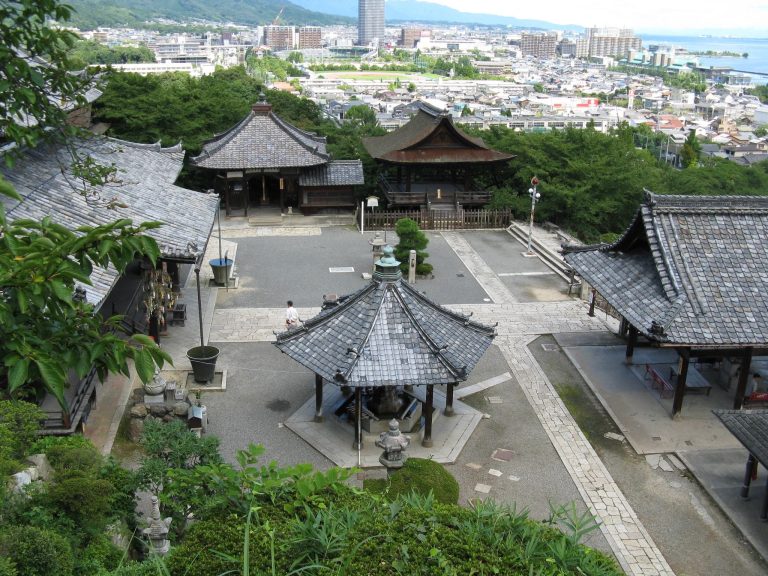
Ishiyama-dera stands on the right bank of the Seta River near the southern end of Lake Biwa. Its precinct occupies a slope marked by unusually shaped rocks, and the buildings are supported by a wooden framework over the incline. The Main Hall stands on a large outcrop of wollastonite-bearing skarn known as Ishiyama-dera wollastonite rock. This geological formation is a National Natural Monument and is included among Japan’s notable geological sites. The rock is also the traditional explanation for the temple’s name.
Main Hall and principal image
Main Hall
The Main Hall is a National Treasure rebuilt in 1096 after the lightning fire of 1078. Its intermediate section and worship hall were remodeled in 1602. The building contains the principal image in a large cabinet at the rear, with the hall’s structure rising above the rocky outcrop that forms the physical focus of the temple.
Nyōirin Kannon
The principal image is a secret wooden half-kneeling Nyōirin Kannon approximately 3 meters high. A secret image, or hibutsu, is a Buddhist image normally kept from public view. Unlike the more common six-armed form, this Kannon has two arms and sits directly on the bedrock. The statue is thought to date from the late Heian period. It is normally opened once every 33 years and in the year after an emperor’s accession, with limited exceptions. An imperial envoy conducts the opening, and the temple presents the image as the “only imperial-sealed Kannon in Japan.”
Four Nara-period gilt-bronze Buddhist images and a crystal five-element stupa were found inside the Nyōirin Kannon. These interior deposits were added to the statue’s Important Cultural Property designation in 2003. The principal image’s associated sculptures include clay figures of Zaō Gongen and Fudō Myōō. The Zaō Gongen figure dates from the Edo period, while its internal wooden core dates from the temple’s Nara-period foundation. The core was found with clay fragments, a halo, a wooden five-element stupa, a wooden reliquary, and a Heart Sutra written in ink on paper.
Pagoda, gates, and precinct buildings
Tahōtō Pagoda
The Tahōtō Pagoda is a National Treasure dating from the early Kamakura period, around 1194. It is traditionally associated with Minamoto no Yoritomo’s patronage and is counted among Japan’s three celebrated pagodas. A wooden seated Dainichi Nyorai made by the sculptor Kaikei is enshrined inside. Another wooden Dainichi Nyorai, formerly regarded as the pagoda’s principal image, is preserved as a separate work.
East Gate
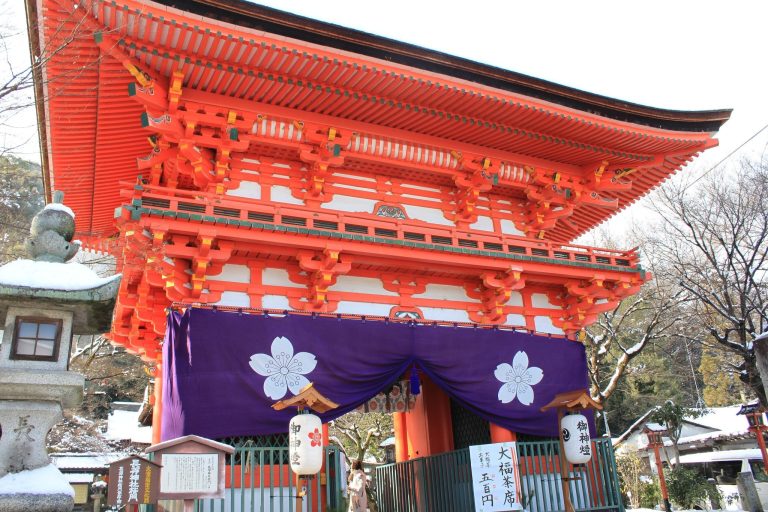
The East Gate, or Higashi Daimon, is an Important Cultural Property traditionally associated with the temple’s early Kamakura-period development and Yoritomo’s patronage. Together with the Tahōtō Pagoda, it belongs to the group of structures that shaped much of the medieval appearance of the precinct.
Other precinct buildings
The grounds also contain the Important Cultural Property Bell Tower, the Mikage-dō, Rennyō-dō, the main sanctuary of the Sanjūhachi-sho Gongen Shrine, and the Sutra Repository. A sanjūhachi-sho gongen shrine is dedicated to a group of thirty-eight sacred manifestations. Shōnan-in Bishamon-dō is associated with the early Kamakura period, while a Bishamon-dō carrying a Shiga Prefecture cultural-property designation is dated to 1773. The precinct includes the Hōkyōintō, a Buddhist memorial tower identified as the memorial tower of Kamegai Zenni.
Sculpture and devotional remains
Ishiyama-dera preserves a Nara-period gilt-bronze standing Kannon, a late Nara-period bronze seated Shaka Nyorai measuring 13 centimeters, wooden standing figures of Jikokuten, Zōchōten, and Bishamonten, an early Heian wooden seated Vimalakirti measuring 49.5 centimeters, a 172.5-centimeter wooden standing Bishamonten, and a wooden seated Fudō Myōō.
The gilt-bronze standing Kannon was stolen in 1947. The body below the neck was later recovered, while the severed head remains missing. Its earlier history is unknown, and temple tradition attributes its donation to Keishōin. The bronze seated Shaka Nyorai is traditionally regarded as the principal image of the Sutra Repository. Its earlier provenance is unknown, and the figure was cast in one piece from the top of the head to the draped garment.
Mikage-dō image of Jun’yu Naigu
A clay seated image of Jun’yu Naigu is enshrined in the Mikage-dō. Its interior contains a printed Buddhist image of Jizō from 1390, a wooden memorial tablet from 1391, devotional writings, and sutras. An inscription on the underside of the pedestal records an eye-opening ceremony conducted in 1408 under Abbot Shukai.
Manuscripts and illustrated traditions
The temple’s National Treasure holdings include Nara- and Heian-period remnants of the Book of Han, Records of the Historian, Yupian, and commentaries on the Spring and Autumn Annals. They also include Shaku-Maka-en Ron, the Enryaku Transition Ceremony, government warehouse and household-register records, and other Buddhist and administrative manuscripts.
Jun’yu Naigu’s handwritten sacred teachings comprise 83 scrolls and one volume, accompanied by a manuscript catalogue. The temple also preserves a complete sutra collection of 4,644 volumes dating from the Nara to Muromachi periods and the Ishiyama-dera Arakura sacred-text collection of 1,926 volumes in 30 sutra boxes. Other works include biographies of major Buddhist teachers, Vinaya and Prajnaparamita texts, an ink-written travel record, a Kamakura-period land-survey register, and the picture-scroll tradition of the Ishiyama-dera Engi.
The Ishiyama-dera Engi consists of seven illustrated scrolls concerning the temple’s construction and devotional history. Its scenes include the discovery of a ritual bell during the foundation, Murasaki Shikibu’s traditional retreat and inspiration from the moon over the lake, and the pilgrimage of Sugawara no Takasue’s daughter through the snowy Aisaka Pass.
Moon-viewing landscape
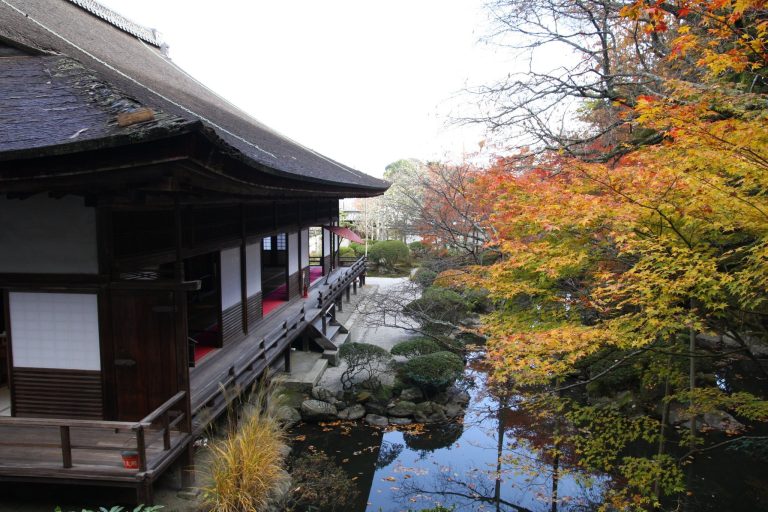
Tsukimi-tei, or the Moon-Viewing Pavilion, stands on the upper slope overlooking Lake Biwa. Its view of the autumn moon over the lake became the subject of “The Autumn Moon at Ishiyama,” one of the Eight Views of Ōmi, although the temple itself stands beside the Seta River rather than directly on Lake Biwa. The temple is also known for autumn foliage and nighttime illumination, and its autumn nightscape received recognition as a Japanese Nightscape Heritage site in 2015. Ishiyama-dera owns the Kansai Art Academy, donated by the Western-style painter Mitani.