Kokawa-dera Temple: A Buddhist Pilgrimage Temple in Japan


Site at a Glance
- Rating
- 4.3
- Popularity
- Medium
- Country
- Japan
- Primary era
- Early Modern
- External website
- Open
- Eras represented
- Early Modern
- Civilizations
- Tokugawa
- Site type
- Religious
- Remains
- Temple
On this page20 sections
History
Kokawa-dera Temple is a Buddhist temple in Japan, located in Kokawa, Kinokawa, Wakayama Prefecture. Its formal name is Kazaragi-san Kokawa-dera, and it is affiliated with the Tendai tradition, a major Japanese Buddhist school centered on the Lotus Sutra. The temple serves as the head temple of the Kokawa Kannon sect and is the third station of the Saigoku Kannon Pilgrimage, a circuit of thirty-three temples in western Japan devoted to Kannon, the bodhisattva associated with compassion.
Foundation traditions and the Heian period
The earliest historical mention of Kokawa-dera dates to 1054, while tradition places its foundation in 770. The foundation story attributes the temple to Otomo Kōshikō, a hunter from Kii Province. According to the legend, Kōshikō saw a mysterious light in the mountains and built a small hermitage there. A young ascetic later gave him a golden statue of thousand-armed Kannon, carved over seven days. Kōshikō then abandoned hunting and began worshipping Kannon. The traditional account remains uncertain as history, but it explains the temple’s enduring association with its principal image.
A second legend concerns a wealthy man from Kawachi Province whose seriously ill daughter recovered after a young ascetic prayed to Kannon. The ascetic accepted only the girl’s small sword and scarlet hakama, a traditional divided skirt. When the family later found these objects in the hands of the Kannon image at the hermitage in Naka County, they recognized the ascetic as an incarnation of Kannon. The family entered religious life and helped promote Kokawa-dera. This story, like the account of Kōshikō, belongs to the temple’s foundation tradition rather than to securely established history.
Kokawa-dera flourished during the Heian period under the patronage of the imperial court and aristocracy. References in The Pillow Book, Ryōjin Hishō, works by Saigyō, and the fictional narratives Utsubo Monogatari and Sagoromo Monogatari show that it was recognized as a sacred Kannon site by the middle of the Heian period, by the tenth century at the latest. During the late Heian period, it became one of the temples included in the Saigoku Kannon Pilgrimage, whose formation began around that time.
Medieval expansion and destruction
By the Kamakura period, Kokawa-dera had become a large Tendai institution. It possessed seven halls, approximately 550 subsidiary temples, many warrior monks, and extensive shōen estates, medieval landholdings often controlled by temples or aristocratic families. These estates were said to total about 40,000 koku, a historical measure of agricultural production and landholding. In scale and influence, the temple was comparable to Negoro-ji and Kongōbu-ji.
Military conflict transformed the complex in the sixteenth century. Saruokayama Castle was built in 1573 on Mount Saruokayama, now called Mount Akihayama, south of the temple grounds to strengthen its defenses. In 1585, during Toyotomi Hideyoshi’s conquest of Kii Province, Kokawa-dera resisted alongside Negoro-ji and the Saika forces. Hideyoshi was the late-sixteenth-century military ruler whose campaigns brought much of Japan under his control. The entire mountain was burned, the castle fell, and the Kokawa-dera Engi picture scroll was damaged.
Temple records also report fires in 935, 1394, 1460, 1467, 1616, and 1713. The fire of 1713 destroyed almost all the buildings except the Great Gate. Most of the present complex was rebuilt afterward, with the Main Hall reconstructed in 1720 and the Great Gate retained as an earlier survivor.
Later religious and institutional changes
Jūzen-in was founded as a subtemple in 990. In 1800, Tokugawa Harutomi, the tenth lord of the Kishu Domain, made it an independent temple of the Anraku Ritsuin branch of the Tendai tradition. It thereafter became known as Jūzen Ritsuin.
During the Meiji period, the government’s separation of Buddhism and Shinto made Kokawa Ubusuna Shrine independent from Kokawa-dera. The shrine had formerly served as the temple’s guardian shrine and was traditionally said to have been founded in 783. On May 28, 1876, more than 1,000 residents of Naka District gathered at Kokawa-dera and caused a disturbance.
The Muroto Typhoon of September 21, 1934, felled many trees at the temple. Fallen timber crushed the bell tower and caused it to collapse. After the Pacific War, Kokawa-dera became independent from the Tendai sect and continued as the head temple of the Kokawa Kannon sect.
The temple’s place in Japanese religious history is reflected in its continuing position as the third station of the Saigoku Kannon Pilgrimage and in the veneration of its concealed principal image. The Kokawa-dera Engi, which preserves the temple’s foundation legends, was designated a National Treasure in 1953. Kokawa-dera Garden received designation as a National Place of Scenic Beauty in 1970, while the Main Hall, Senju Hall, Middle Gate, and Great Gate were collectively designated National Important Cultural Properties in 1996.
Remains
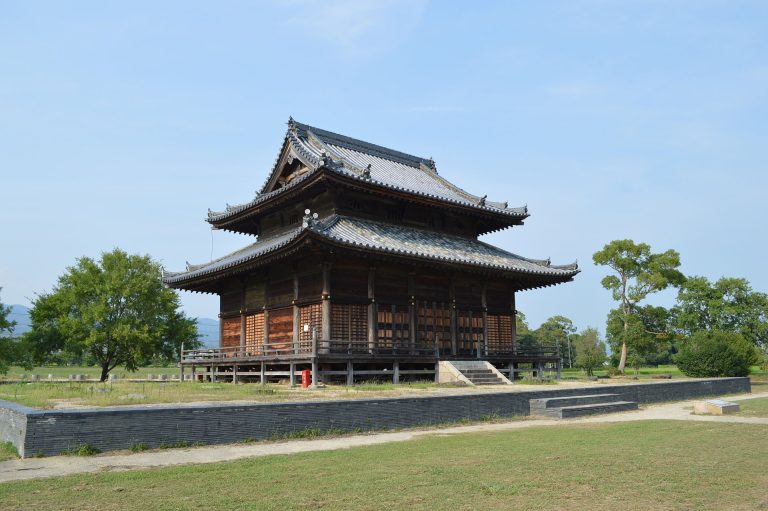
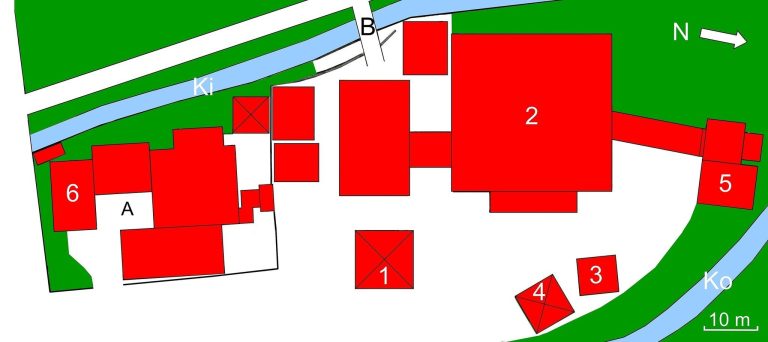
The approach to Kokawa-dera begins at the Great Gate and extends for approximately one kilometer southward toward the former temple-front settlement. Inside the grounds, the route bends right after the gate, with a river on the right and the principal temple buildings, including the head priest’s quarters, on the left. Farther along stands the Middle Gate. Beyond it, the Main Hall, Senju Hall, and other buildings occupy a level area set one step above the approach.
Gates and principal halls
Great Gate
The Great Gate dates from 1754 and forms one of the main surviving elements of the approach. It was the only major building to survive the fire of 1713, making it an important physical link between the earlier complex and the buildings reconstructed afterward.
Middle Gate
The Middle Gate was rebuilt in 1832. An associated ridge tablet survives with it, providing a material record connected with the gate’s reconstruction.
Main Hall
The Main Hall was rebuilt in 1720 during the Edo period and is traditionally associated with the patronage of Tokugawa Yoshimune, the eighth shogun of the Tokugawa shogunate. It forms part of the complex rebuilt after the 1713 fire and is accompanied by architectural plans and a related document.
Senju Hall
Senju Hall was built in 1760 beside the Main Hall. It houses a thousand-armed Kannon image. Senju Kannon represents the ability to respond to suffering in many ways. This image was specially opened in October 2008, rather than the temple’s permanently concealed principal image.
Dōnan Hall
Dōnan Hall was built in 1679 during the Edo period. It venerates the young ascetic whom the foundation legend identifies as the creator of the temple’s principal Kannon image, connecting the hall to the narrative preserved in Kokawa-dera’s religious tradition.
Garden and religious images
Kokawa-dera Garden
In front of the Main Hall, the slope contains Kokawa-dera Garden, a stone garden associated with the Momoyama period. Its large stones and arranged rock formations create a dry-landscape garden, a design that evokes landscape through rocks and other elements rather than flowing water. The garden was designated a National Place of Scenic Beauty in 1970.
Concealed and visible Kannon images
The principal image is a thousand-armed, thousand-eyed Kannon statue regarded as a completely hidden Buddhist image. It is said to be kept in a container buried underground beneath the Main Hall to protect it from fire. The substitute image, or omaetachi, placed before a concealed principal image, is also hidden at Kokawa-dera. Monks connected with the temple open it once a year, on December 31, for cleaning, and lay visitors do not view it.
A standing thousand-armed Kannon known as the Rear Kannon is installed at the back of the Main Hall’s inner sanctuary and can be viewed. It was publicly exhibited at the Wakayama Prefectural Museum in 2016 and was scheduled for exhibition at the Kyoto National Museum in 2020.
Other religious images
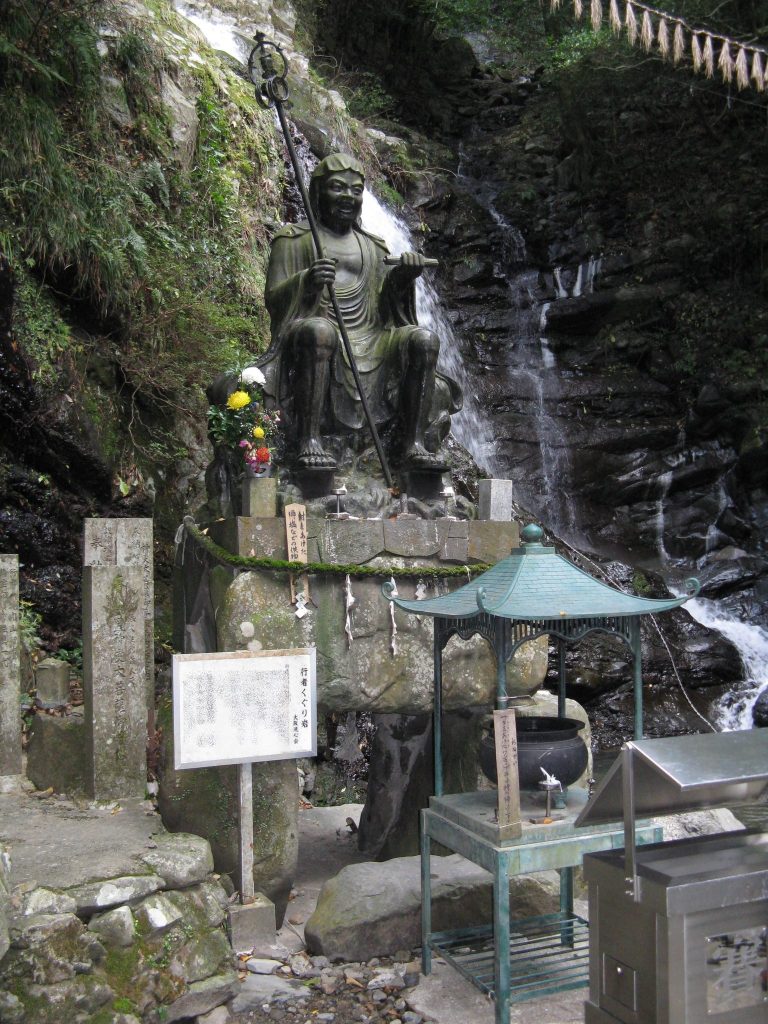
The temple possesses a wooden bodhisattva head approximately 33 centimeters high, probably dating from around the eleventh century. Tradition identifies it as the head of an earlier principal image. The grounds also contain a stone standing statue of Jizō Bosatsu. An outdoor statue of Amida Nyorai, made in 1862, stands 210 centimeters high overall, with the image itself measuring 144 centimeters. Tokugawa Shigenori and others donated it.
Objects and surviving records
Great Gate Bridge
The Great Gate Bridge retains balustrade finials with jeweled ornaments dating from 1605, during the Azuchi-Momoyama period. These elements preserve an earlier detail within the approach to the later gate.
Lotus-leaf washbasin
A washbasin shaped like a lotus-leaf bowl was cast in 1775 by Gen Masakatsu, the fifth-generation Hachiya Satsuma no Jō, a metalworker from Kokawa. It measures 240 centimeters high and 185 centimeters wide.
Kokawa-dera Engi
The Kokawa-dera Engi is a Kamakura-period illustrated handscroll, or emaki, combining painted scenes with written narrative on paper. Its scenes provide evidence of contemporary daily life. Fire damage remains along the upper and lower edges of the entire scroll, while parts of the paintings and inscriptions are missing. The scroll is deposited at the Kyoto National Museum.
Temple plan
The temple preserves a plan showing the stone intervals between its various halls, known as Kokawa-dera Shogaran Ishinoma no Zu. This diagram provides a record of the spatial arrangement of the complex.