Raiden Shrine: A Principal Thunder Shrine in Japan


Site at a Glance
- Rating
- 4.1
- Popularity
- Low
- Country
- Japan
- Primary era
- Early Modern
- External website
- Open
- Eras represented
- Medieval, Early Modern, Modern
- Civilizations
- Ashikaga shogunate, Japanese
- Site type
- Religious
- Remains
- Sanctuary
On this page12 sections
History
Raiden Shrine, also called Itakura Raiden Shrine, is a Shinto shrine in Japan associated with the worship of thunder and lightning. Tradition places its foundation in 598 and attributes it to Prince Shotoku, an imperial prince associated with the promotion of Buddhism and the establishment of religious institutions. The shrine is regarded as the de facto head shrine of the Raiden shrines found mainly across the Kanto region and is counted among the Three Principal Thunder Shrines of Kanto.
Early traditions and medieval rebuilding
The tradition preserved in the Engi of Hasama-san Ryuzoji gives the shrine’s foundation date as 598. Sakanoue no Tamuramaro, an early ninth-century imperial military commander associated with campaigns in northeastern Japan, is traditionally said to have built shrine structures during the Enryaku period, between 782 and 806. The “Hono no Ikazuchi Shrine” of Oura District listed in the Register of Shrine Names of Kozuke Province is identified with Raiden Shrine.
In 1547, Shinozaki Mikawanokami, a retainer of the Akai family of Sanuki Estate, constructed the shrine buildings. Nagao Akinaga undertook another building project in 1573, the final year of the Muromachi period, the era of the Ashikaga shogunate.
Tokugawa patronage and later status
The land between the Watarase and Tone rivers was repeatedly affected by lightning, fires, floods, and shifting river courses. In 1674, Tokugawa Tsunayoshi, then lord of Tatebayashi Domain, rebuilt the shrine buildings and authorized the use of the Tokugawa family hollyhock crest. After he became the fifth shogun of the Tokugawa shogunate, the military government that ruled Japan during the Edo period, the shrine gradually prospered.
The shrine’s three principal kami, sacred beings or powers venerated at Shinto shrines, have names associated with fire thunder, great thunder, and separate thunder. Worship at Raiden Shrine has traditionally sought protection from lightning and ice storms, good harvests, relief from misfortune, and general safety. Prayers for safety during electrical and other construction work are especially associated with the shrine, while corporate visitors also request safety and business-prosperity prayers during the thunderstorm season from around mid-May to early autumn.
The annual festival takes place from May 1 to May 5. Traditions connected with the shrine include a story associated with Sakanoue no Tamuramaro’s construction in 801, when a light was said to rise from a pond and illuminate the darkness during the festival that night. The story is linked to the Dragon-Lantern Cedar, whose dead trunk and lower section remain in the eastern part of the precinct.
The shrine was ranked as a village shrine in 1872 and became a religious corporation after the Second World War. Its precinct and adjoining woodland form part of a Gunma Prefecture green-environment conservation area. The Hachiman and Inari subsidiary-shrine building received protection under the Ancient Shrines and Temples Preservation Law on August 1, 1908. On August 29, 1950, it was redesignated an Important Cultural Property under the postwar cultural-property law, which replaced its former status as an old National Treasure.
Remains
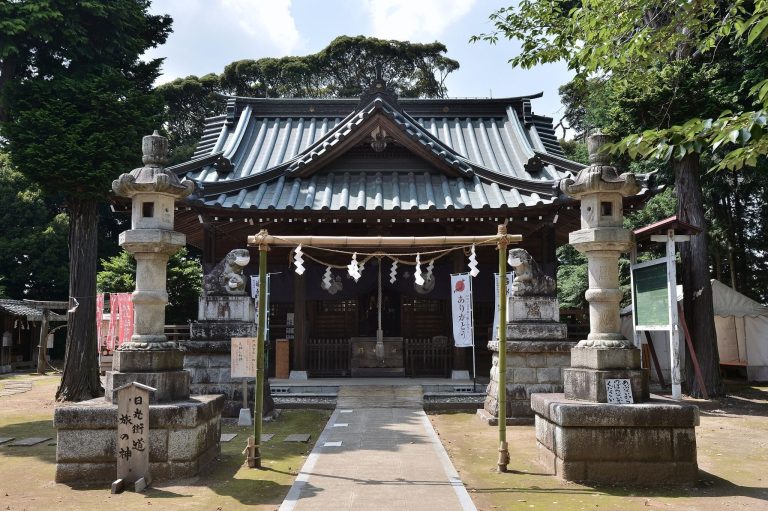
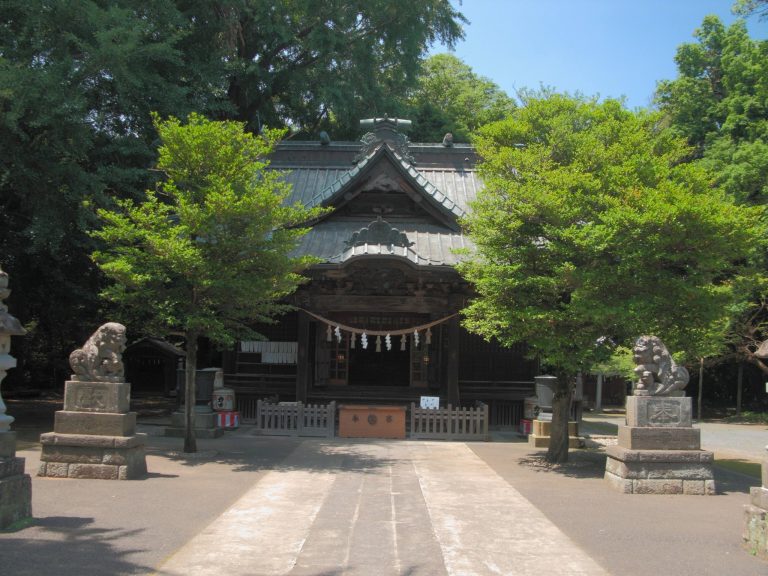
The surviving complex comprises the main sanctuary, offering hall, worship hall, rear sanctuary, and the building of the Hachiman and Inari subsidiary shrine. The principal buildings combine curved gabled and hipped-and-gabled roofs with copper-sheet roofing. Carvings throughout the shrine are attributed to Ishihara Tsunehachi, who is said to have been the tenth-generation successor of the sculptor Hidari Jingoro.
Main shrine buildings
Main sanctuary and offering hall
The main sanctuary and offering hall were built in 1835. The main sanctuary is a two-bay nagare-zukuri building, a shrine form with a curved gabled roof extending forward over the entrance. It has a chidorihafu, or triangular gable, and a batten-seam copper-sheet roof.
Worship hall
Built in 1819, the worship hall has an irimoya roof, a hipped-and-gabled form, with its entrance on the eaves side. A chidorihafu gable and a porch with a karahafu, a curved-front gable, distinguish its exterior. Its roof is covered with batten-seam copper sheets.
Rear sanctuary
The rear sanctuary dates from 1868. It is a three-bay, eaves-side-entry building with an irimoya roof and batten-seam copper-sheet covering. Inside is a shrine to Izanami Okami, the female creator deity traditionally paired with Izanagi in Japanese creation mythology. At Raiden Shrine, Izanami is associated with family harmony, conception, safe childbirth, and successful marriage.
Subsidiary shrine and associated features
Hachiman and Inari subsidiary shrine
The Hachiman and Inari subsidiary-shrine building was erected in 1547 during the late Muromachi period. It is an unusual two-bay structure that houses two deities in one building. An irimoya roof, a two-bay projecting porch, and copper-sheet roofing define its present form, and it is regarded as the oldest shrine building in Gunma Prefecture.
During dismantling and repair in 1960, the building’s original kirizuma roof, a gabled roof with interlocking tile roofing, was replaced by the present irimoya roof with copper sheets. The building’s successive roof forms therefore reflect both its sixteenth-century construction and its modern repair.
Dragon-Lantern Cedar
The Dragon-Lantern Cedar stands on the eastern side of the precinct as the dead trunk and lower portion of the former tree. Its surviving remains preserve the physical focus of the tradition about the light that rose from a pond during the festival associated with Sakanoue no Tamuramaro.
Catfish and Fukurokuju statues
A stone catfish statue called Namazu-san stands in a separate building behind the precinct. Tradition holds that rubbing it wards off earthquakes and brings renewed vitality, improved eyesight, and self-confidence. A stone statue of Fukurokuju, one of the Seven Lucky Gods associated with longevity, wealth, and wisdom, stands in the camellia garden and is traditionally linked with flourishing descendants, material wealth, and long life.
The main sanctuary, offering hall, worship hall, and rear sanctuary are collectively designated important cultural properties of Gunma Prefecture. The shrine is also known for its spring displays of wintersweet and camellias, while catfish dishes are a local specialty at the shrine gate.