Tatebayashi Castle: A Japanese Castle and Domain Seat
Site at a Glance
- Country
- Japan
- Primary era
- Early Modern
- Eras represented
- Early Modern
- Civilizations
- Tokugawa
- Site type
- Military
- Remains
- Castle
On this page15 sections
History
Tatebayashi Castle, also known as Obiki Castle, was a Japanese castle in Tatebayashi, Japan, whose history spans the Sengoku period, an era of conflict among regional powers, and the Edo period under Tokugawa rule. Its origins are uncertain, but it later served as the seat of Tatebayashi Domain, including for the Akimoto family late in the Edo period.
Origins and Sengoku-period conflict
The Edo-period Tatebayashi Chronicle attributes the castle’s foundation to local lord Akai Terumitsu, though neither the date nor the founder is certain. In its fox legend, Terumitsu rescues a cub, which traces the castle’s layout with its tail and inspires the name Obiki Castle. One version also says Inari, a Shinto deity associated with food and agricultural abundance, indicated the site. An Inari shrine was established in the castle’s Inari Enclosure.
In 1471, during the Kyotoku War, a series of fifteenth-century conflicts in the Kantō region, Uesugi forces led by Nagao Kagenobu, his son Kageharu, and Nagao Tadakage attacked the castle. It was then held by Akai Bunzō and Bunroku.
Nagao Kagenaga, allied with Uesugi Kenshin, captured the castle on February 17, 1562, and drove out Akai Bunroku. By April 5, Kagenaga was assigning land to his retainers. After Kenshin’s defeat at the Battle of Usui Castle in 1566, Kagenaga and other lords in eastern Ueno shifted their allegiance to the Hōjō clan. In 1570, after attacking Karasawa Castle, Kenshin awarded Tatebayashi to Hirota Naoshige. Nagao Akinaga appears to have regained it and sponsored the construction of Raiden Shrine in 1573.
Hōjō rule and Tokugawa reconstruction
Hōjō forces invaded the Tatebayashi territory in 1584, and the castle was surrendered early the following year. Nagao Akinaga met Hōjō Ujinao, submitted, received a pardon, and withdrew to Ashikaga. Tatebayashi then became Hōjō territory. Ujinori, lord of Nirayama Castle, served as the castle’s deputy, while Nanjo Masaharu commanded its garrison.
Tatebayashi fell during Toyotomi Hideyoshi’s 1590 campaign against the Hōjō, which helped bring the Kantō region under Tokugawa Ieyasu’s control. Although the capture is traditionally credited to Ishida Mitsunari, a letter from Satake Yoshihisa dated April 29 shows that the castle had already fallen. Mitsunari did not leave the siege of Odawara to attack Oshi Castle until May 5.
After taking control of the Kantō in 1590, Ieyasu appointed Sakakibara Yasumasa, one of his four leading generals, as lord of Tatebayashi with revenue assessed at 100,000 koku, a measure of rice yield used to value a domain. Yasumasa extensively rebuilt the castle and town and constructed waterworks to protect the new town from flooding. Control of the Tone River mattered for supplying Edo and reaching northeastern Japan.
Changing rule and the castle’s dismantling
The Sakakibara family held Tatebayashi until 1643, when it was transferred to Shirakawa and the territory briefly came under direct shogunal rule. The Ōgyū-Matsudaira family took over in 1644 with 60,000 koku. Its second lord held 53,000 before moving to Sakura in 1661. That year Tokugawa Tsunayoshi, younger brother of the fourth shogun, Tokugawa Ietsuna, entered Tatebayashi with 250,000 koku. Tsunayoshi became Ietsuna’s adopted heir and the fifth shogun, Japan’s military ruler, in 1680, while his son Tokumatsu succeeded him at Tatebayashi. When Tokumatsu died in 1683, the domain was abolished, the castle was dismantled, and the territory returned to direct shogunal rule.
In 1707, Matsudaira Kiyotake took over with 24,000 koku, and a smaller castle was rebuilt. Grants in 1710 and 1712 raised the domain’s revenue to 54,000 koku. In 1718, peasants rose in the Tatebayashi Disturbance after tax increases intended to cover reconstruction costs.
In 1734, an Ōta lord with 50,000 koku became the shogunate’s senior official in charge of Osaka Castle. Tatebayashi again became shogunal land, with a castle guard appointed; the lord’s son entered the domain in 1740. The Ōta family moved to Kakegawa in 1746, when a Matsudaira lord arrived from Tanakura with 54,000 koku. His family’s revenue rose to 61,000 in 1769, and it remained until its transfer to Hamada in 1836.
Late Edo period and modern changes
In 1836, Inoue Masaharu arrived from Tanakura with 60,000 koku; he moved to Hamamatsu in 1845. The Akimoto family then came from Yamagata with the same assessed revenue. During the Boshin War, the 1868–69 conflict between forces supporting the shogunate and the new imperial government, the Akimoto lord supported the new government and sent troops to fighting in the Kantō and Tōhoku regions. Tatebayashi Domain was abolished in 1870 and became Tatebayashi Prefecture. A fire in 1874 destroyed most of the remaining castle buildings, and much of the grounds was sold as the moats were filled.
Remains
Castle layout and defenses
Enclosure arrangement
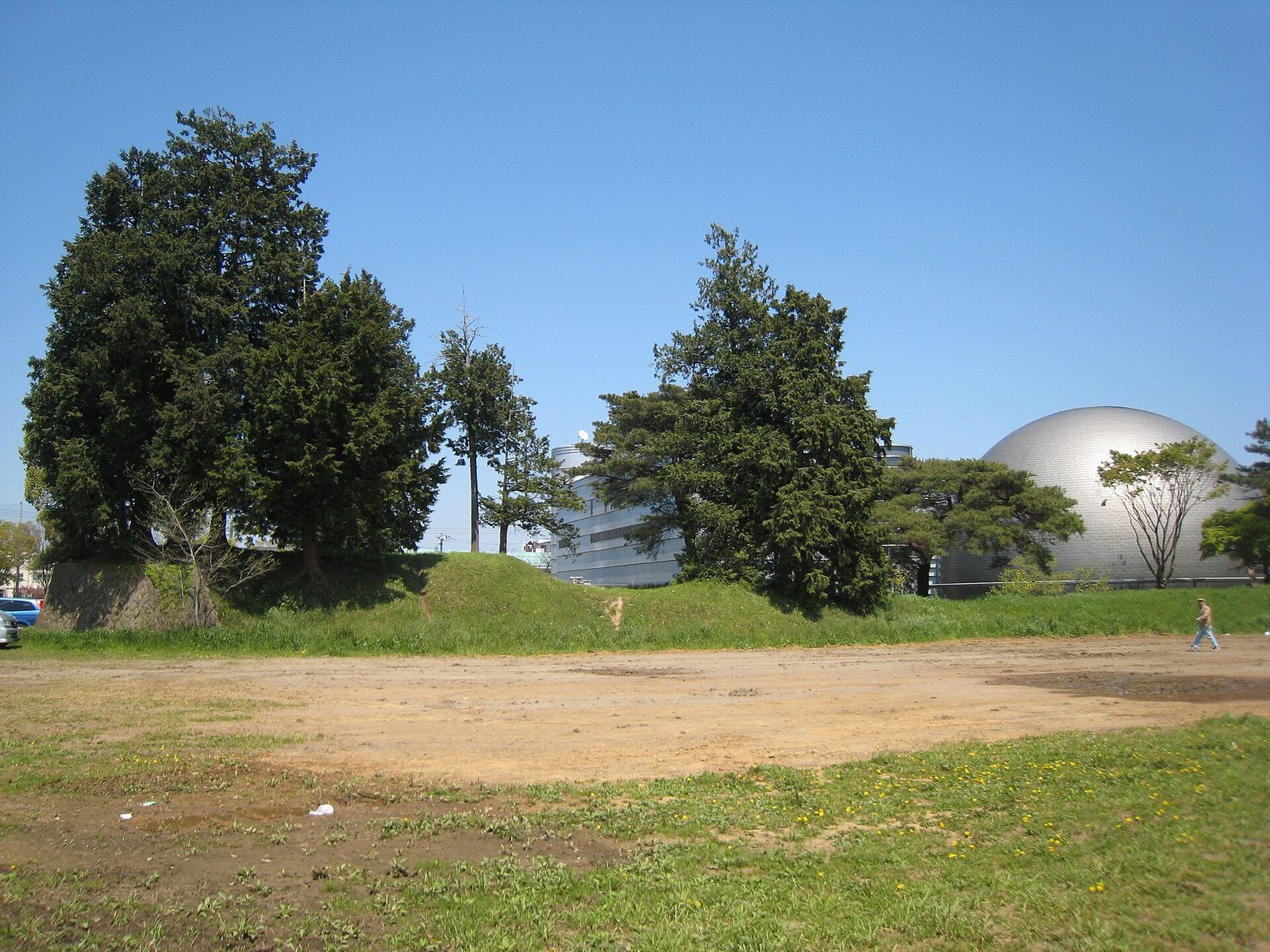
The lowland castle covered about 43 hectares and comprised seven bounded sections, or enclosures, in a plan combining tiered and linked groups. It occupied a low plateau projecting into a pond to the east, which served as an outer moat. The main, second, and third enclosures, along with the Hachiman and South enclosures, lay on the plateau; the Inari, outer, and larger outer enclosures surrounded them. Earthen ramparts and moats enclosed the castle and the town to its west. The main enclosure lay south of the present children’s science museum, the second occupies the city hall site, and the third the cultural hall site.
Tower arrangements
Before the castle was dismantled in 1683, a three-storey tower in the main enclosure served in place of a conventional keep, alongside a two-storey tower. The enclosure later called the South Enclosure had two additional two-storey towers. The smaller castle rebuilt in 1707 had a two-storey tower in the main enclosure serving as its keep substitute, with one two-storey tower apiece in the South and third enclosures.
Surviving fabric
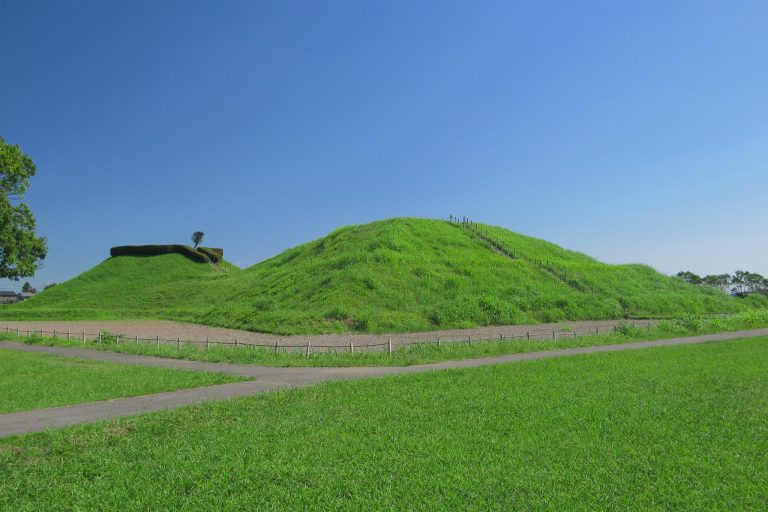
Sections of earthen rampart survive in the main, third, and Inari enclosures and in the former castle town. Some stone walls also remain. Modern buildings now occupy much of the former castle grounds.
Gates and associated buildings
Dobashi Gate
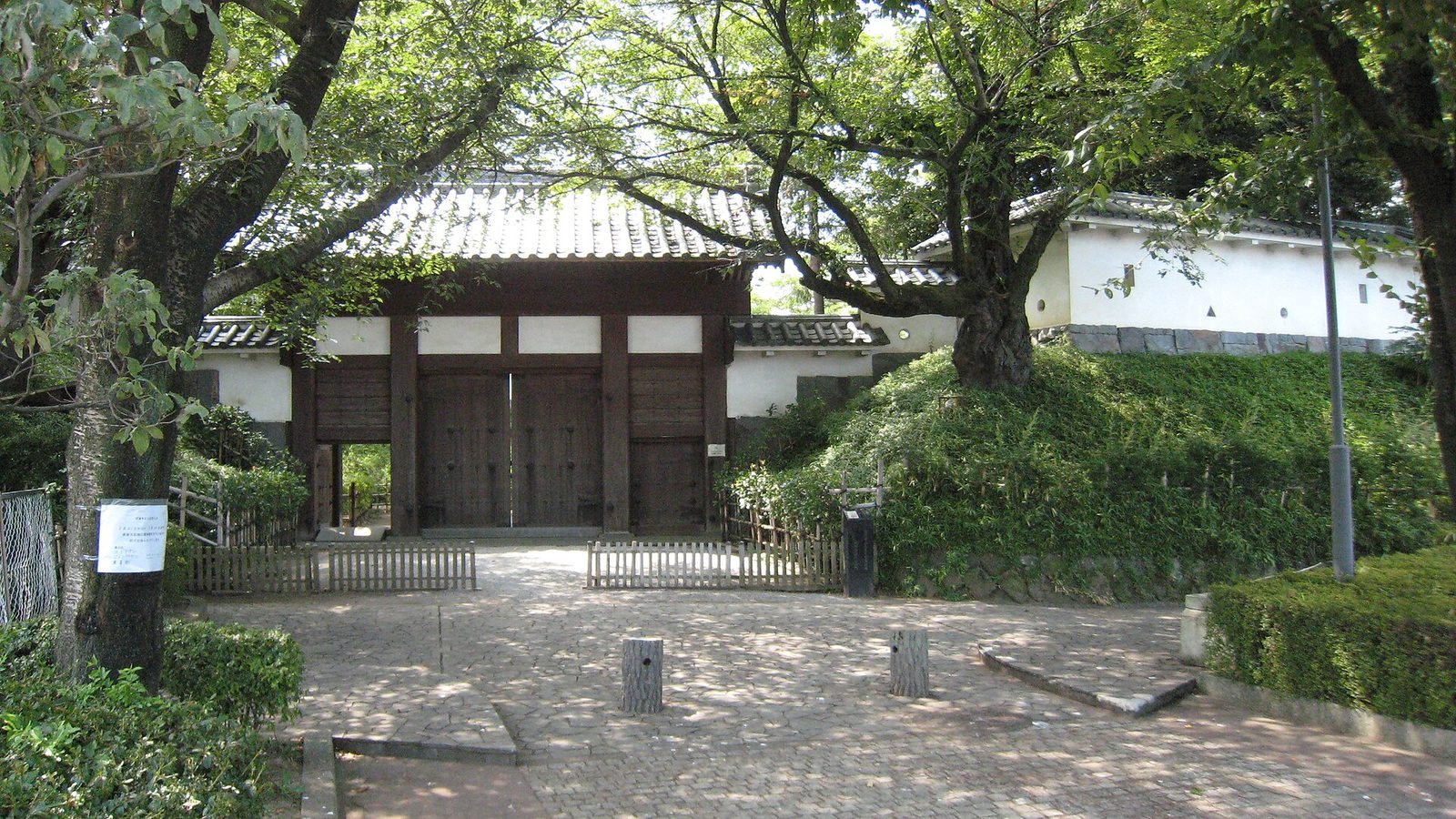
The reconstructed Dobashi Gate stands in the third enclosure, which connected with the castle’s central area. It served as a common entrance, while samurai used Sengamon as their formal entrance. The gate’s name is traditionally linked to an earthen bridge over the inner moat in front of it. Black iron plates were fitted for defense, giving the gate its local name, Black Gate. It was reconstructed in 1983.
Sengamon
Sengamon stood at the center of the third enclosure’s northern side. This major gate had a tower above its passage and served as the formal entrance for samurai. A Tatebayashi-born printmaker made a relief associated with the gate for his Mountain Picture Collection. The relief is said to have been based on a votive image of Tatebayashi Castle dedicated at Obiki Inari Shrine.
Main gate and Daimyo Lane
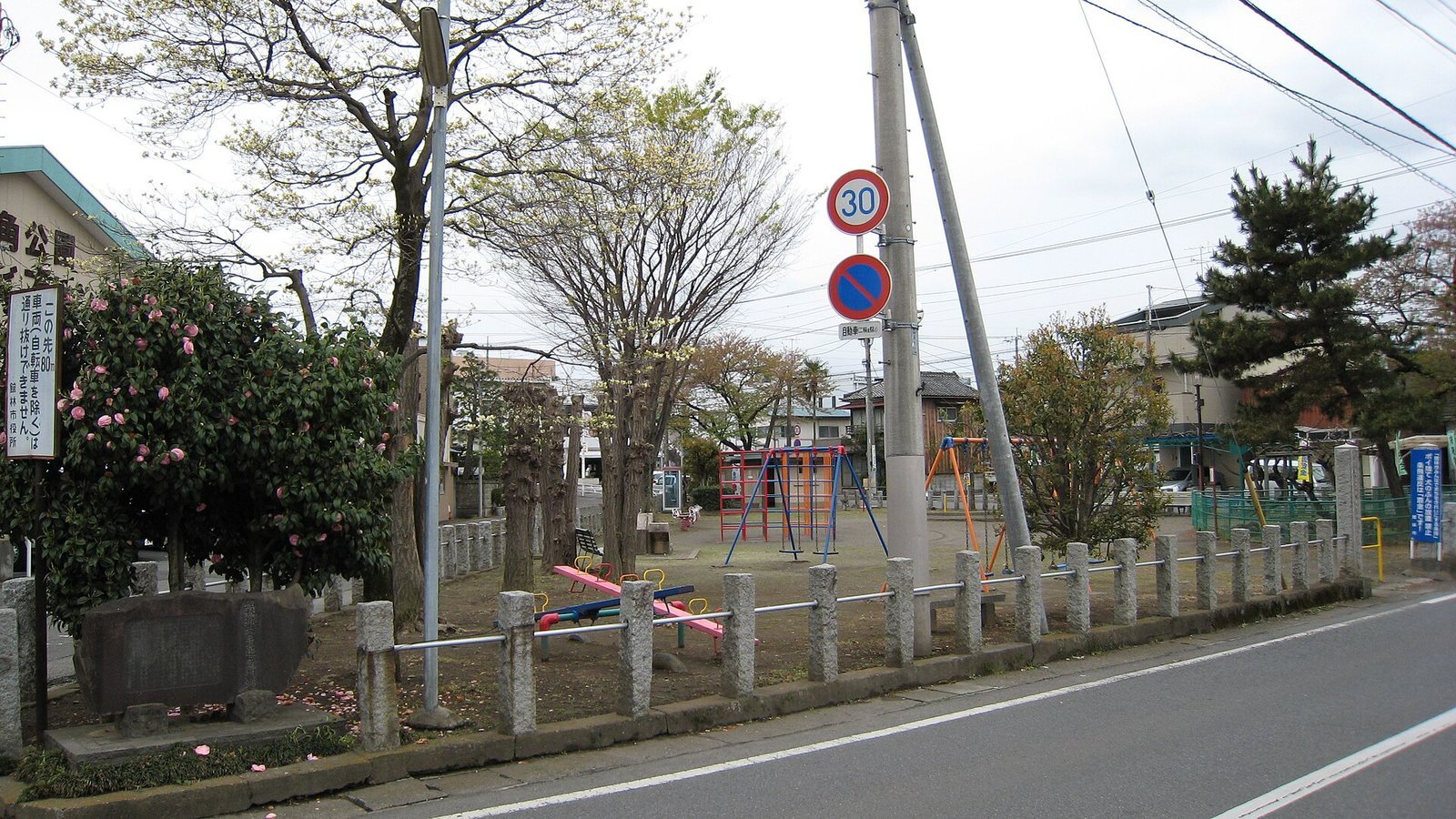
The main gate stood at the northeastern corner of present-day Triangle Park in Otemachi, separating samurai residences to the east from the castle town to the west. Daimyo Lane, a broad road, ran about 400 metres east from the gate toward Wide Street and Sengamon. A marker identifies the gate’s former location.
Relocated residences and displays
Two samurai residences and a large Nagayamon, a long gatehouse associated with a samurai residence, were moved to the castle grounds from a prosperous farmstead. A castle diorama and other artifacts are housed in a wing of the library near Dobashi Gate.