Koga Castle: A Koga Kubo Fortress and Edo-Period Domain Center in Japan
Site at a Glance
- Rating
- 3.5
- Popularity
- Very Low
- Country
- Japan
- Primary era
- Early Modern
- External website
- Open
- Eras represented
- Early Modern
- Civilizations
- Tokugawa
- Site type
- Military
- Remains
- Castle
On this page19 sections
History
Koga Castle in Koga, Japan, was a Japanese fortified site whose origins are traditionally placed around 1180, during the late Heian or early Kamakura period. Shimokobe Yukihira, a warrior who served Minamoto no Yoritomo, is said to have built a fortified residence at Tatsuzaki. The precise date and the relationship between this early fortification and the later castle remain uncertain. Built beside the Watarase River and surrounding wetlands, the site gained strategic importance from its natural defenses and its position on a river transport network.
Medieval Fortification and Conflict
The Shimokobe estate stretched along the Watarase and its downstream continuation, the Taihi River. After the Hojo family assumed effective control of the Kamakura shogunate, the fortification is thought to have come under Hojo authority. The site then became involved in several medieval struggles. It served as a base during the Battle of Nogi-no-miya in 1183. Around 1340, the Northern Court commander Taka Fuyu occupied it while opposing Kitabatake Chikafusa, a leader of the Southern Court.
In 1382, Oyama Yoshimasa captured the castle after a defense led by Shimokobe Tomoyuki, deputy of its lord Uesugi Noriei. Ashikaga Ujimitsu, the second Kamakura kubo, entered the castle in 1386 while suppressing the Wakainumaru Rebellion, after which members of the Noda family became its lords. During the Yuki War of 1440–1441, Noda Mochitada and Yabe Oinosuke defended the castle for the Yuki side. It fell after the capture of Yuki Castle.
The Koga Kubo
In 1455, during the Kyotoku War, the fifth Kamakura kubo, Ashikaga Shigeuji, moved his base from Kamakura to Koga after Imagawa Noritada occupied Kamakura. This relocation established the Koga kubo, the Ashikaga family’s military and administrative governor of the Kanto region, as an independent regional power. Koga consequently became a major political center during the later Muromachi and Sengoku periods, an era marked by prolonged warfare among regional military powers.
Shigeuji initially lived at the Koga Kubo Residence in Konosu and later developed the Tatsuzaki fortification as his principal castle. Koga offered several advantages. The Tone and Watarase rivers formed natural defenses against the Uesugi, allied military families including the Oyama and Yuki were nearby, and estates held by the Kamakura kubo provided an economic base. The Koga kubo and its successors maintained their position for roughly 130 years.
Nagao Kagenobu attacked in 1471, forcing Shigeuji to abandon the main castle temporarily. It was recovered the following year, and peace between Shigeuji and the Muromachi shogunate ended the Kyotoku War in 1482. Shigeuji is traditionally associated with the enshrinement of a Hase Kannon image at the castle in 1493 as protection against the northeast direction. He died in 1497. Later disputes over succession continued when Ashikaga Masauji and his heir Takamoto divided in 1506, Takamoto entered the castle in 1512, and the fourth Koga kubo, Ashikaga Haruuji, became involved in conflicts between the Uesugi and Hojo.
Uesugi and Hojo Rivalry
During the sixteenth century, Koga became part of the struggle between Uesugi Kenshin and the Later Hojo family over the appointment of the Koga kubo. In 1561, Ashikaga Fuji, the court noble Konoe Sakihisa, and Uesugi Norimasa entered the castle with Kenshin’s support. Later Hojo forces retook it in 1562. Following the reconciliation between Hojo Ujiyasu and Uesugi Kenshin in 1569, Ashikaga Ujiyoshi entered the castle and consolidated his position as Koga kubo under Hojo support.
Hojo Ujiteru directed repairs and expansion from 1567 through the Tensho period to counter the Satake and Yuki families. Ashikaga Ujiyoshi died in 1582, ending the Koga kubo line. His successor, Ujihime, retained a distinct Koga Ashikaga base for a time rather than allowing the castle to become simply a Later Hojo branch castle. After Toyotomi Hideyoshi destroyed the Later Hojo in 1590, the territory passed to Tokugawa Ieyasu. Ogasawara Hidemasa then entered Koga and repaired and enlarged the castle.
Edo-Period Domain Center
During the Edo period, the era of Tokugawa rule, Koga Castle became the administrative center of Koga Domain and the residence of successive fudai daimyo. These hereditary Tokugawa retainers were generally entrusted with strategically important domains and shogunate offices. Matsudaira Yasunaga added the Kannonji enceinte, the Hyakken Moat, and the main gate around 1602. Okudaira Tadamasa expanded the Tatsuzaki and Suwa enclosures and enlarged the districts occupied by samurai and townspeople from 1619. Nagai Naokatsu later built the ceremonial entrance gate.
Doi Toshikatsu became lord in 1633 and carried out the principal early-Edo reconstruction, including the castle’s main tower-like structure and palace buildings. Koga’s lords often held senior shogunate offices. They included the grand elders Doi Toshikatsu and Hotta Masatoshi, together with the councillors Nagai Naomasa, Matsudaira Nobuyuki, Honda Tadayoshi, Doi Toshitsura, and Doi Toshikazu. The Doi family governed from 1633 to 1681 and again from 1762 until the end of the domain system. The intervening lords came from the Hotta, Fujii-Matsudaira, Okochi-Matsudaira, Honda, and Matsui families.
The castle served as a northern defensive position for Edo, the seat of domain government, and a lodging castle for shogunal pilgrimages to Nikko. Tokugawa Hidetada stayed there in 1617 and 1622. Tokugawa Iemitsu visited or stayed at Koga repeatedly between 1629 and 1642, and Tokugawa Ieharu stayed there in 1776. Tokugawa Ieyoshi’s pilgrimage in 1843 was the last such shogunal visit. Repeated flooding of the Watarase also led to the preparation of an unusually detailed flood-control manual.
The castle town developed alongside the Nikko Highway post station and Watarase river transport, making Koga a center of traffic and logistics. The river and wetlands continued to support defense and transportation. The domain lord Doi Toshitsura also wrote Sekka Zusetsu in 1832, reflecting the scholarly activity associated with the domain.
Demolition and River Works
During the Boshin War, the domain leadership united behind the imperial side and avoided fighting at the castle. In 1868, Doi Toshiyori publicly declared loyalty to the emperor in Kyoto. The abolition of domains in 1871 converted Koga Domain into Koga Prefecture. The Abolition of Castles Order of 1873 then led to the castle’s demolition, and all remaining buildings were destroyed by the following year.
A sixteen-year Watarase River improvement project began in 1910 and continued until 1925. Embankments and floodplain works leveled the principal baileys and filled the moats, causing most of the castle site to disappear. The former Koga domain village of Yanaka, north of the castle, was also abandoned to create a flood-retention basin. Tanaka Shozo opposed this approach and argued that enlarging the lock at the Tone–Edogawa diversion at Sekiyado could direct Tone River water toward Tokyo Bay without a retention basin.
Koga Castle is now interpreted as a ruined historic site. A stone monument and explanatory panel marking the main bailey were installed on the Watarase embankment in 2018. A detailed model of the castle town is exhibited at the Koga History Museum.
Remains
Layout and Defensive Compounds
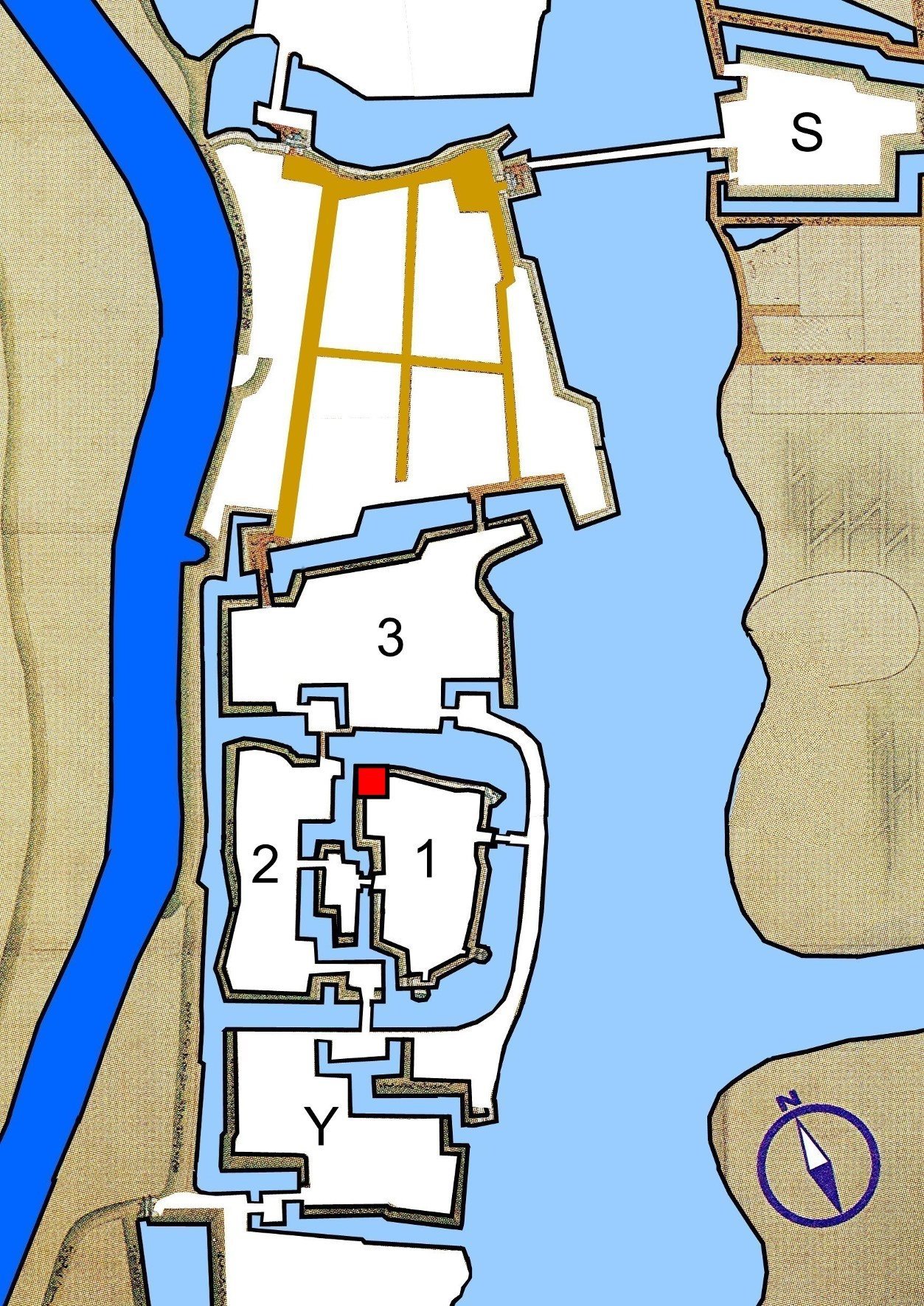
Koga Castle was a flatland castle on a narrow peninsula running from north to south. The Watarase River bordered it on the west, while wetlands lay to the east and south. In the Edo period, the castle and its water moats occupied approximately 0.45–0.55 kilometers from east to west and about 1.8 kilometers from north to south. Its linear plan consisted of multiple baileys, enclosed functional or defensive sections, protected by earthen ramparts.
From north to south, the principal areas were Kannonji Bailey, Sakuramachi Bailey, San-no-Maru, Ninomaru to the west, Honmaru to the east, Yorimasa Bailey, and Tatsuzaki Bailey. Suwa Bailey lay east of Sakuramachi beyond the Hyakken Moat. Kannonji, Sakuramachi, and Suwa contained residences for senior retainers. The lord’s palace occupied Ninomaru, a horse ground lay in San-no-Maru, and the Yorimasa Bailey contained a shrine to Minamoto no Yorimasa. The main gate stood north of Kannonji Bailey, while the ceremonial entrance gate stood east of Sakuramachi.
Gosan-kai Yagura
Doi Toshikatsu built the Gosan-kai Yagura at the northwestern corner of Honmaru in 1633. A yagura was a fortified tower used for observation, defense, storage, or status display. This three-tier, four-story structure served the practical role of Koga Castle’s principal tower, rose approximately 22 meters, and was comparable in height to the tower at Matsue Castle and to the Gosan-kai Yagura towers at Mito and Sakura castles.
Palaces and Main Gate
Doi Toshikatsu also constructed the Honmaru and Ninomaru palaces. Matsudaira Yasunaga created Kannonji Bailey and the Hyakken Moat, while Okudaira Tadamasa enlarged Tatsuzaki and Suwa baileys. The ceremonial entrance gate built by Nagai Naokatsu used an external square enclosure and a fortified entrance passage. Shoguns used it when entering the castle during pilgrimages to Nikko, and stonework was built around the gate.
Medieval and Castle-Town Features
The medieval arrangement is less certain than the Edo-period plan. The area controlled by Ashikaga Shigeuji is thought to have been near the later Honmaru. A fifteenth-century account describes a large four-legged gate at the Koga kubo residence and a settlement of retainers, known as the lodging quarter, around it. The Koga kubo residence at Konosu may have formed a large water castle connected with the main castle by boat, although this interpretation remains uncertain.
A pre-Nikko Highway route toward the northeast is traditionally said to have crossed the later castle along the river. Kannonji and Sakuramachi baileys contained post-station areas associated with the castle town. Kannonji held Koyama Kannonji temple until the temple was moved into the town during the expansion around 1602. Sakuramachi reportedly contained the residence of the renga poet Inawashiro Kensai, known for its many cherry trees.
River Landing and Religious Sites
The Shigehira river landing in Sakuramachi Bailey handled the movement of supplies and personnel between the castle and the river. Suzume Shrine and its associated Jinguji Temple stood near the landing. Hachiman Shrine occupied San-no-Maru, while the southern Tatsuzaki area contained the Yorimasa shrine, Tokuseiji, Myokoji, and Ryujui-in. Castle expansion moved these religious institutions into the castle town except for the Yorimasa shrine. Eijuji and Shoteiji, positioned around the moats, also functioned as defensive outposts.
Late-Sengoku Plan
A surviving study of a castle plan suggests that the late-Sengoku arrangement may have included the Osawa, Kannonji, and Kerai baileys within the later Kannonji area; the Ouchi Bailey within Sakuramachi; the Hojo or Hojo-related Bailey within San-no-Maru; and the Yamauchi Bailey and Yorimasa Hall south of Honmaru. The plan also indicates a water moat extending toward the Koga kubo residence. Its proposed dating to the period of Ashikaga Ujiyoshi and Ujihime remains uncertain because it includes clearly Edo-period references and disputed interpretations.
Surviving Earthworks and Relocated Buildings
Yorimasa Shrine and Shishigasaki Rampart
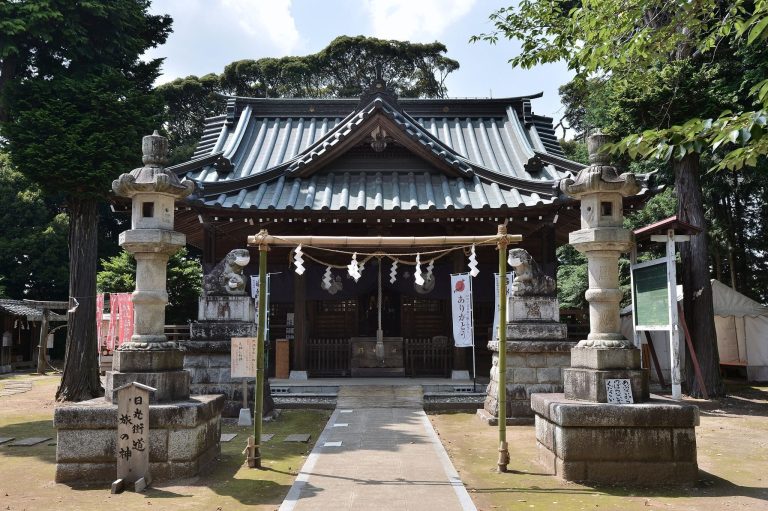
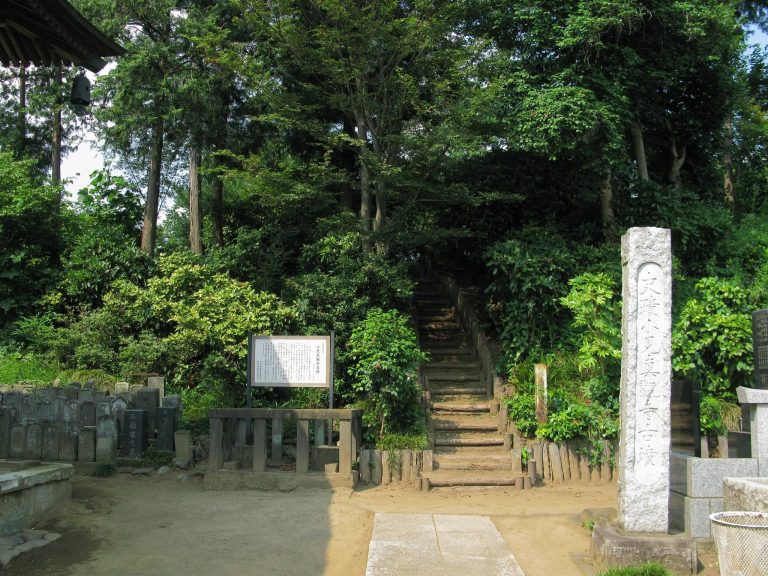
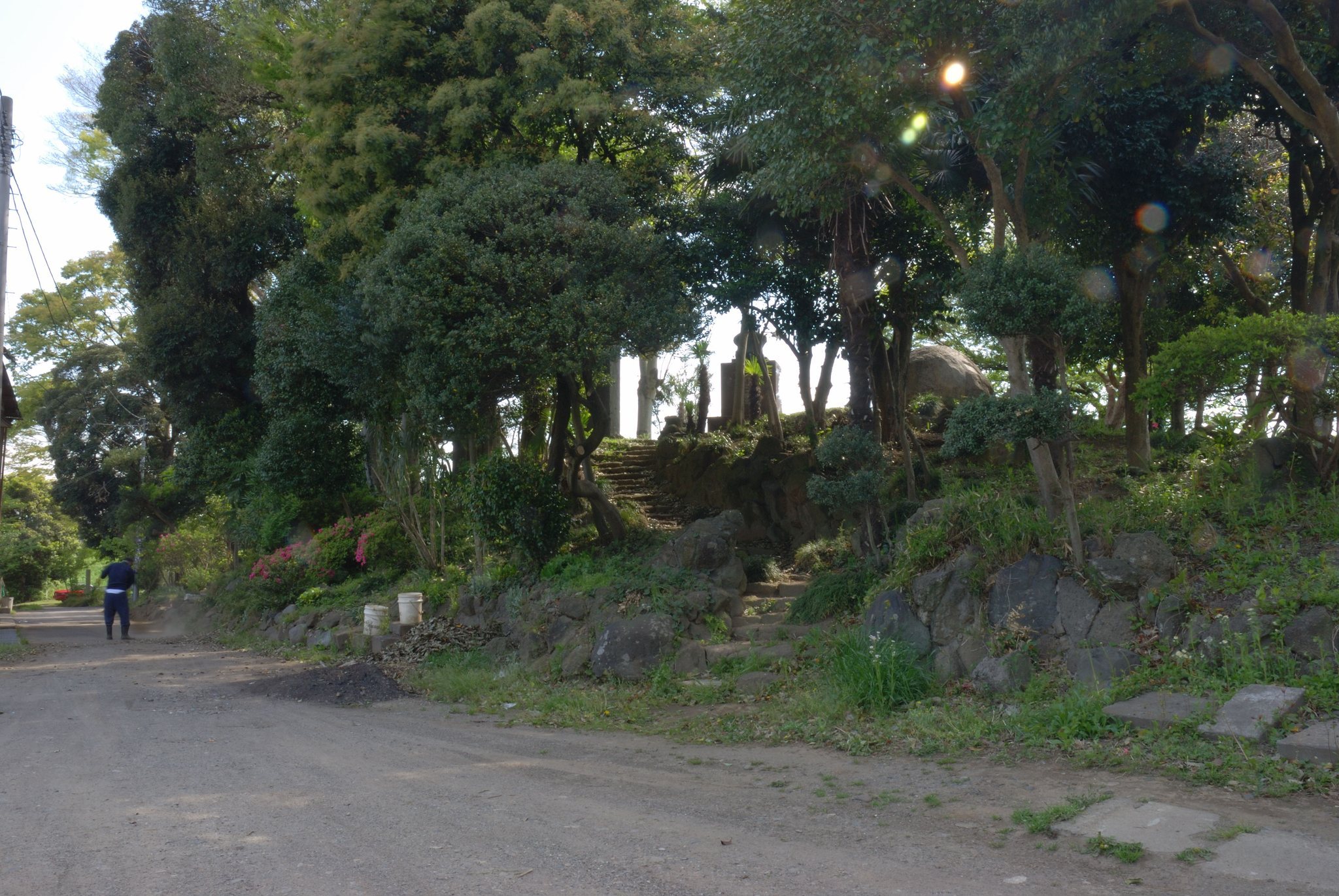
The Yorimasa Shrine was moved during the Watarase River works to the top of an earthen rampart in the northwestern part of the former Kannonji Bailey. Part of that rampart survives. Part of the northern Sakuramachi rampart, known as the Shishigasaki Rampart, also remains within the modern town.
Suwa Bailey and History Museum
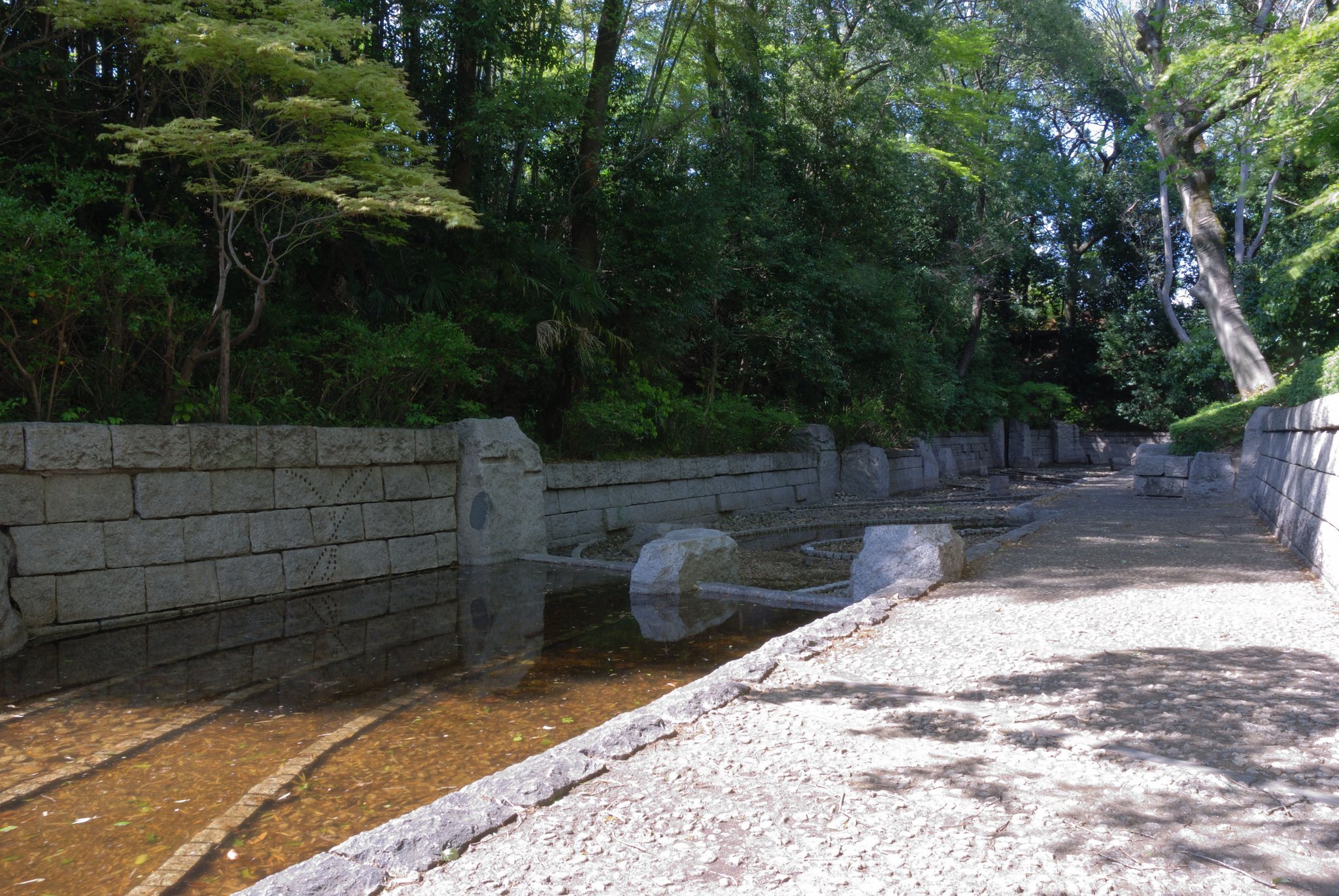
The Koga History Museum occupies the former Suwa Bailey site. Fragments of an earthen rampart and moat survive within the museum grounds, preserving part of the castle’s peripheral defensive works.
Inui Gate
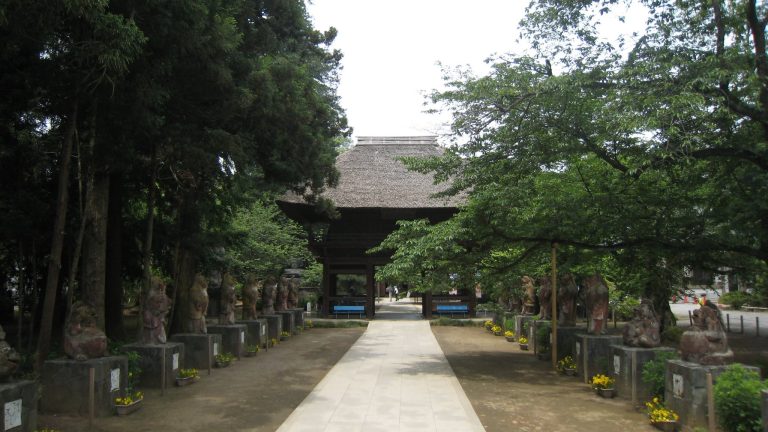
The gate of Fukuhouji Temple was transferred from the former Koga Castle Ninomaru Palace. Identified as the former Inui Gate, it is a designated municipal cultural property. Its name refers to a northwestern position in the traditional directional system.
Sakanaga Storehouses
Two buildings at Sakanaga are traditionally identified as relocated castle storehouses, the former library storehouse and the Inui Storehouse. They survive as historic structures and are registered national tangible cultural properties.
Markers and Floodplain Traces
Stone monuments mark the former Otemon, Funawatari Gate, and Sakuramon sites, while a marker on the embankment indicates the former Honmaru. The former Honmaru and Ninomaru areas now correspond largely to the embankment and floodplain between Mikuni Bridge and Shin-Mikuni Bridge. Former baileys and filled moats can still be traced faintly through changes in surface color and in aerial photographs. A small burial mound was discovered when the Yorimasa Bailey, also called the Tatsuzaki Bailey, was leveled during the river works.
The medieval Koga kubo complex included a large gate, retainers’ residences, religious buildings, and water defenses, but its precise arrangement remains uncertain. The documented Edo-period plan and surviving fragments of earthen ramparts provide the clearest evidence for the castle’s former layout.