Iwashimizu Hachimangū: A Historic Hachiman Shrine in Japan


Site at a Glance
- Rating
- 4.4
- Popularity
- Medium
- Country
- Japan
- Primary era
- Early Modern
- External website
- Open
- Eras represented
- Medieval, Early Modern, Modern
- Civilizations
- Japanese, Tokugawa, Toyotomi regime
- Site type
- Religious
- Remains
- Sanctuary
On this page22 sections
History
Iwashimizu Hachimangū is a historic Hachiman shrine in Japan, founded on Mount Otoko near Kyoto in the ninth century. Its foundation is dated to either 859 or 860, with 860 traditionally associated with construction ordered by Emperor Seiwa. The shrine became an imperial center of Hachiman worship and a guardian of the capital’s vulnerable southwestern direction.
Foundation and Shrine-Temple Development
In 859, the monk Gyōkyō of Daian-ji, a disciple of Kūkai, reportedly received a message from Usa Jingū saying that Hachiman wished to move to Mount Otoko to protect the country. Gyōkyō conveyed the message to the court, and Emperor Seiwa ordered construction at the mountain in 860. Hachiman was understood as a composite of the deified Emperor Ōjin, Hime-Ōkami, and the deified Empress Jingū.
A possible predecessor called Iwashimizu-dera may have stood on Mount Otoko before the shrine was founded. Roof tiles dating from before the foundation have been found within the grounds. Another theory links the original site with Jinganjī, the former clan temple of the Wake family, although the location of Jinganjī remains uncertain.
From its beginning, the institution combined kami worship and Buddhism in a shrine-temple complex known as Iwashimizu Hachimangūji. Iwashimizu-dera, whose principal Buddhist image was Yakushi Nyorai, became the complex’s Buddhist temple serving the shrine and was renamed Gokoku-ji in 862. During the Heian period, these religious connections deepened, and Iwashimizu maintained close ties with Tō-ji, Kiyomizu-dera, Enryaku-ji, Ninna-ji, Kinkaku-ji, Ginkaku-ji, Daian-ji, and other temples.
Imperial Patronage and the Heian Capital
The court regarded Iwashimizu as the guardian of the southwestern ura-kimon, a direction traditionally considered vulnerable to harmful influences in the geomantic protection of Heian-kyō. Its role corresponded to that of Enryaku-ji in protecting the capital’s northeast. Because of its proximity to the capital, Iwashimizu received imperial patronage comparable to that of Kamo, Matsuo, and Kasuga.
In 939, the shrine received court offerings in a position second only to Ise Grand Shrine. Together with Ise, it came to be regarded as one of the two imperial ancestral shrines. Imperial and court visits eventually numbered more than 250. In 965, Emperor Murakami ordered imperial messengers to report important events to the guardian kami of Japan, and Iwashimizu belonged to the first group of 16 shrines to receive these offerings. Emperor Enyū visited in 979, and emperors continued to come until the reign of Emperor Go-Daigo. Visits then ceased for about 200 years before resuming as a commemorative practice after the Ōnin War.
The shrine controlled numerous shōen, privately controlled estates often held by religious institutions or aristocratic families. In 1069, Emperor Go-Sanjō’s estate-reorganization edict caused Iwashimizu to lose 13 of its 34 estates. Imperial and shogunal authorities also intervened periodically in appointments at the shrine.
Hachiman Worship and Warrior Lineages
Iwashimizu became the clan shrine of the Minamoto and other branches of the Seiwa Genji, warrior lineages claiming descent from Emperor Seiwa. Minamoto no Yoshiie underwent his coming-of-age ceremony there at the age of seven and took the name Hachimantarō Yoshiie. Hachiman, a major kami associated with war, protection, the imperial lineage, and warrior houses, consequently became closely linked at Iwashimizu with martial protection, archery, and victory.
The shrine’s sacred emanations were installed at many other Hachiman shrines, including Tsuboi Hachimangū and Tsurugaoka Hachimangū. The Taira also revered Iwashimizu. Contributions by Taira no Masamori and performances by Taira no Kiyomori and other members of the Ise Taira are recorded, showing that the shrine’s religious importance extended beyond the Minamoto line.
Major Buddhist construction accompanied this religious and political development. In 1111, Shirakawa commissioned the Great Pagoda in a Shingon Buddhist style. The Hōtō-in Pagoda, also called the Koto Pagoda, followed in 1112 in a Tendai style. The site later became the setting of the Battle of Yawata in 1352, fought during the conflict between the Northern and Southern Courts. In 1428, a lot was drawn at the shrine to select the sixth Ashikaga shogun, resulting in the appointment of Ashikaga Yoshinori. Ashikaga Yoshimasa visited with officials of the Grand Council of State in 1456.
From the Mount Otoko Lodges to the Edo Period
Until the Edo period, the approaches to the shrine were lined with temple and lodging compounds known as the Forty-Eight Lodges of Mount Otoko. Shōkadō Shōjō served as a shrine-associated monk, while Hōzōbō functioned as a prayer institution for the shogunal family and housed an image of Tōshō Daigongen, the deified Tokugawa Ieyasu.
During the Keichō era, Toyotomi Hideyori repaired or rebuilt several buildings. He rebuilt the Great Pagoda in 1603, the Hōtō-in or Koto Pagoda in 1604, and the Amida Hall in 1605. These works formed part of the complex’s later Buddhist architectural history.
Meiji Separation and Modern Status
The Meiji government’s separation of Shinto and Buddhism dismantled the Buddhist dimension of Iwashimizu. On March 12, 1868, Hachiman’s designation changed from Hachiman Daibosatsu to Hachiman Ōkami. The shrine was renamed Otokoyama Hachimangū in August 1869, and Gokoku-ji was abolished that year. Buddhist buildings were dismantled, relocated, or lost.
During the separation, the Gokoku-ji abbot Dōki moved the Yakushi Nyorai and the Twelve Divine Generals to Tōzan-ji on Awaji Island. The Buddhist Hachiman image, a Senju Kannon, an Aizen Myōō, an Amida triad, and former shrine buildings were transferred to Zenpōritsu-ji. The image of Tōshō Daigongen from Hōzōbō was moved to Tōji-in. The Great Pagoda and Hōtō-in or Koto Pagoda were dismantled, while the Amida Hall was moved in 1870 to the rear mound of Nishikurumazuka Kofun, then an outlying precinct of Shōhō-ji.
Iwashimizu was ranked a first-rank imperial shrine in 1871 and became a Chokusaisha, a shrine designated to receive offerings sent by the emperor, in 1883. Its name was restored to Iwashimizu Hachimangū in January 1918. The former Buddhist hōjōe, a ritual of releasing living creatures to accumulate religious merit, was renamed the Iwashimizu Festival after the Meiji separation. Held on September 15, it remains one of Japan’s Three Great Imperial Festivals, together with the Aoi Festival and Kasuga Festival.
During the Second World War, a prayer service for the defeat of enemy countries was held at the shrine. Iwashimizu was also the onboard shrine of the Japanese battleships Yamashiro and Fusō, both sunk during the Battle of Leyte Gulf in 1944. A memorial service for their crews is held each October. In 1948, the shrine became a Beppyo shrine of the Association of Shinto Shrines. It is also counted among the Twenty-Two Shrines, the two imperial ancestral shrines together with Ise, and the Three Great Hachiman Shrines.
The grounds were designated a National Historic Site in January 2012. The historic precinct includes the upper shrine on Mount Otoko and the lower precinct at the mountain’s foot. The site is popularly known as Yawata no Hachiman-san. Its history also includes an association with Thomas Edison, whose improvement of the incandescent light bulb used bamboo from the shrine grounds. An Edison monument and a memorial festival held on February 11 commemorate that connection. The 2018 Northern Osaka Earthquake destroyed nine stone lanterns along the approach and caused the ornamental finials of 32 others to fall.
Remains
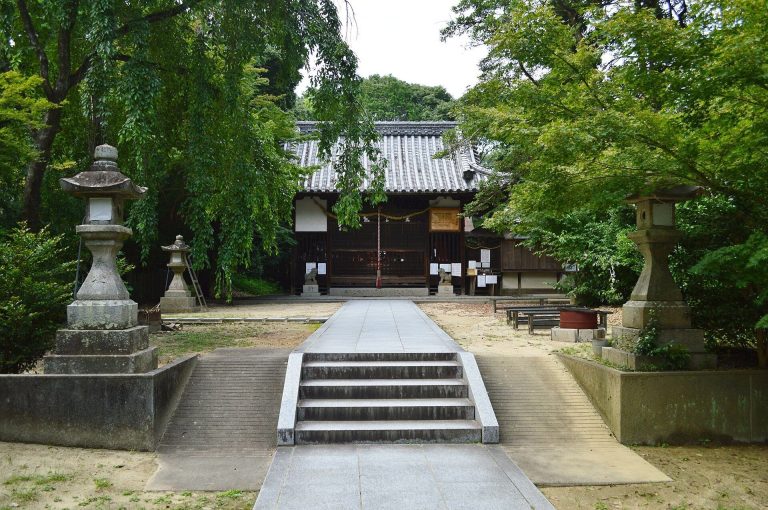
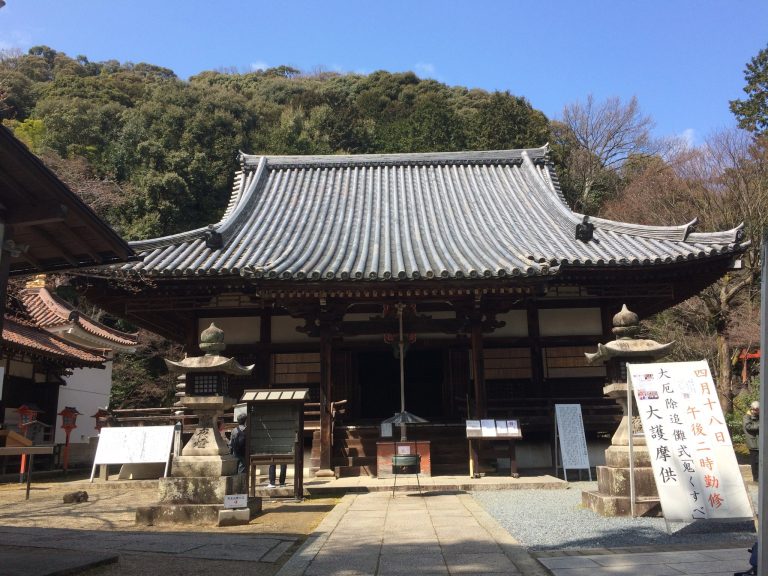
Iwashimizu Hachimangū occupies Mount Otoko, also called Hatogamine, a 143-meter mountain southwest of Kyoto. The grounds are divided into an upper precinct on the summit and a lower precinct at the foot of the mountain. The upper shrine is organized around a sequence leading inward from the Tower Gate through the Dance Hall and Offering Hall to the Main Hall. The lower precinct contains festival buildings, subsidiary shrines, gates, a pond, and surviving elements transferred from earlier structures.
Upper Shrine and Main Sanctuary
Main Hall
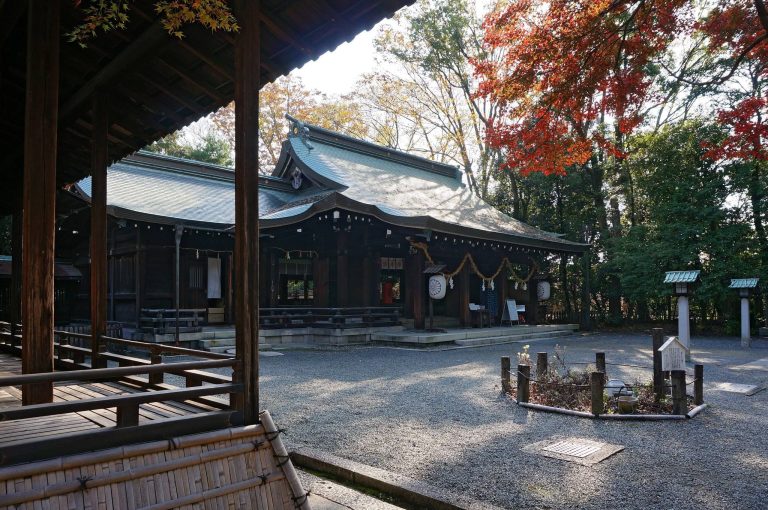
The Main Hall follows the Hachiman-zukuri form, in which a sanctuary is divided into front and rear halls beneath connected roofs. Its inner hall and outer hall are also called the rear and front halls. Their eaves meet at a golden rain gutter donated by Oda Nobunaga in August 1580. This arrangement reflects the belief that the kami move to the outer hall by day and to the inner hall by night.
The sanctuary has burned repeatedly since its first construction under Emperor Seiwa. It has undergone 14 rebuildings and 17 major repairs. The present inner and outer halls were rebuilt in 1634 under Tokugawa Iemitsu. Hondawake no Mikoto occupies the central sanctuary, Hime-Ōkami the western sanctuary, and Okinaga Tarashi-hime no Mikoto the eastern sanctuary. Hime-Ōkami represents the three Munakata kami.
Gates and Enclosure
The inner hall, outer hall, Offering Hall, Dance Hall, East Gate, West Gate, surrounding corridors, Tower Gate, and Takeuchi-sha sanctuary are National Treasure structures. The upper precinct also contains the South Outer Gate, rebuilt in 1938, together with the Kagura Hall, duty office, distribution office, and additional corridors.
The West Gate carries a carved monkey known as the Monkey with Eye-Grain, traditionally attributed to Hidari Jingorō. A local tradition says that the monkey escaped at night to damage fields at the mountain’s foot, leading to a nail being driven into its right eye to immobilize it. The northeast section of the surrounding corridor has foundation stonework cut away as a device for sealing the geomantically vulnerable northeastern direction.
Walls and Storehouse
The clay wall donated by Oda Nobunaga is known as the Nobunaga Wall. The west, north, and east outer gates were rebuilt during the early Edo period. The storehouse, or azekura, was rebuilt in the middle Edo period.
Lower Precinct and Transferred Buildings
Tongū
The lower precinct contains the Tongū, a temporary sanctuary where the mikoshi, portable shrines used to carry kami during festivals, wait during ceremonies. It corresponds to the otabisho found at other shrines. After the Toba-Fushimi conflict destroyed the original building, a sanctuary from Iwamotobō, one of the Forty-Eight Lodges of Mount Otoko, was moved there as a temporary palace. The Tongū was rebuilt in 1915.
Saikan and Lower Gates
The Saikan stands on the former site of Gokuraku-ji, founded in 878. Its principal building was moved after serving as the attendants’ office associated with the temporary Daijōsai palace during the Taishō enthronement ceremonies from 1916 onward. A north-side bathhouse and lavatory annex were later replaced by buildings used as attendants’ quarters during the Shōwa enthronement ceremonies from 1931 onward.
The lower precinct’s North Gate was moved there in 1928 from the former entrance to Kōshunden, a building used during the Shōwa enthronement ceremonies. The South Gate, originally the upper precinct’s South Outer Gate, was moved to its present position in 1939. The lower precinct also includes a black gate, a surrounding corridor rebuilt in 1969, and the Hōjō Pond.
Springs, Torii, and Monumental Features
Iwashimizu Shrine and Springs
Tsutsui, built in 1749, and Fujii beside Kōra Shrine are two celebrated springs of Mount Otoko. Iwashimizu Shrine stands beside the spring called Iwashimizu and contains a main sanctuary, a water pavilion, and a torii. Its enshrined kami is Amenominakanushi.
First Torii
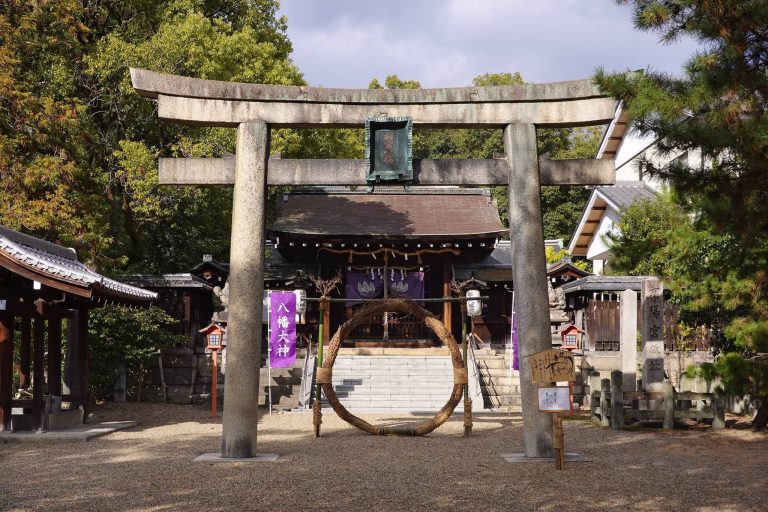
The First Torii follows the Hachiman torii form. Its copper tablet bears the inscription Hachimangū. Tradition holds that the lettering reproduces calligraphy written by Fujiwara no Yukinari at Emperor Ichijō’s command and copied by Shōkadō Shōjō in 1619. The character for “eight” is shaped as two opposed pigeons facing outward.
Five-Ring Pagoda and Yoritomo’s Pine
The six-meter-high Five-Ring Pagoda, known as the Navigation Memorial Pagoda, is one of Japan’s largest examples of its type. It was reportedly erected by a merchant from Amagasaki who had prayed at Iwashimizu and survived a maritime disaster, offering the monument in gratitude.
The grounds include a pine known as Yoritomo’s Pine. Minamoto no Yoritomo reportedly donated six pine trees during a visit in May 1195. The surviving original was destroyed by lightning in 1947, and the present tree was donated in 1955 as its successor.
Subsidiary Shrines and Other Features
Upper and Lower Precinct Shrines
Takeuchi Shrine is located inside the Main Hall enclosure, a distinctive position among the subsidiary shrines. The upper precinct also includes the Hirota, Ikuta, Nagata, Ichidō, Kifune, Tatsuta, Kehi, and Mitsuonna shrines. The Important Cultural Property sanctuaries include Wakamiya, Wakamiya-dono, Mizuwakamiya, and Sumiyoshi, which was rebuilt in the early Edo period.
Kōra Shrine, founded in 860 and rebuilt in 1879, has a worship hall in the lower precinct. Ōtobira Inari Shrine was built in 1829. Toga-no-o Shrine, an outlying precinct west of the Main Shrine, has an Important Cultural Property sanctuary dedicated to Amaterasu, Ōkuninushi, and Amenokoyane. Aizuchi Shrine stands at the foot of the mountain but is not administered as a subsidiary shrine of Iwashimizu.
Hakkakudō and Natural Features
The grounds also contain the site of the Shōkadō hermitage, now associated with a separate location south of Mount Otoko, and Hakkakudō, an octagonal hall formerly called the Amida Hall. Hakkakudō originally stood northwest of Mitsuonna Shrine and was moved to its present location in 1870.
The camphor tree at the Kagura Hall and the camphor tree beside the shrine archive are designated prefectural natural monuments. These trees form part of the historic landscape alongside the surviving halls, corridors, gates, and subsidiary sanctuaries.
Archaeological and Movable Remains
Objects recovered from the former Gokoku-ji site include six copper dharma wheels and six brass single-pronged vajras. The group is designated as a set of Kyoto Prefecture archaeological cultural properties. The objects preserve material evidence of the Buddhist practices once conducted within the shrine-temple complex.
A jeweled Indonesian kris dagger was identified during a 2005 inventory of the shrine’s treasures. It was later exhibited at the Kyoto National Museum in an exhibition of famous swords from Kyoto temples and shrines.