Aotsuka Kofun: An Early Kofun-Period Burial Mound in Japan


Site at a Glance
- Rating
- 4.1
- Popularity
- Low
- Country
- Japan
- Primary era
- Classical
- External website
- Open
- Eras represented
- Classical
- Civilizations
- Yamato
- Site type
- Burial
- Remains
- Burial Mound
On this page10 sections
History
Aotsuka Kofun is an early Kofun-period burial mound in Inuyama, Japan, probably constructed around the middle of the fourth century. Its keyhole-shaped form reflects the funerary architecture of ancient Japan, and the mound is the second-largest kofun in Aichi Prefecture after Danpusan Kofun in Nagoya.
The Aotsuka Kofun Cluster
Aotsuka Kofun once formed part of the Aotsuka Kofun Cluster, a group of more than ten burial mounds. Most of the other tumuli have since disappeared, leaving Aotsuka as the principal surviving monument associated with the group.
Shrine tradition and military reuse
The mound remained associated with Ōagata Shrine, historically ranked as the second-ranking shrine of Owari Province. The shrine identifies it traditionally as the grave of Oarata-no-mikoto, a Shinto deity regarded as the ancestor of the hereditary rulers of Niwa district, an ancient local administrative area. The identity of the person buried in the mound is otherwise unknown, and Ōagata Shrine continues to hold an annual ritual connected with this tradition.
In 1584, during the Battle of Komaki and Nagakute, a conflict of the Sengoku period, an era of intense political and military rivalry in Japan, forces under Toyotomi Hideyoshi fortified the mound as Aotsuka Fort. The fortification enlarged the mound’s terrace areas and produced broader level surfaces. These military traces were later removed from view when the mound was restored as a kofun.
Investigation and preservation
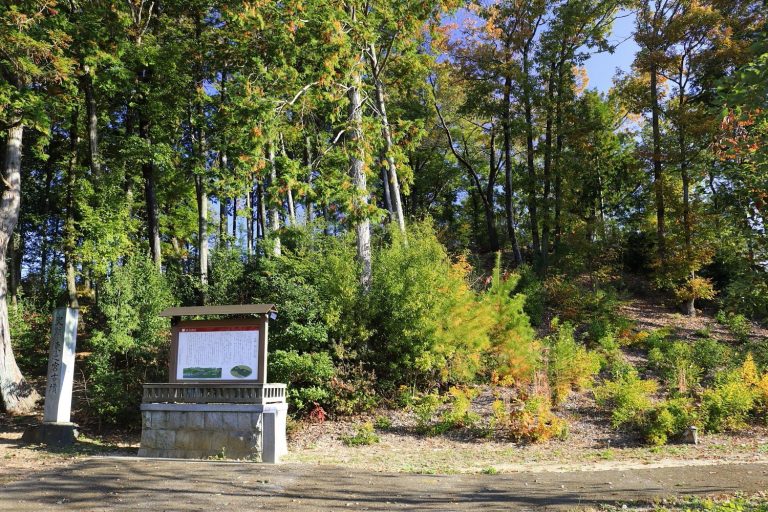
Inuyama designated Aotsuka Kofun a municipal historic site in 1966. Archaeological investigation took place in 1979 during agricultural-land improvement and again between 1995 and 1998 as part of historic-site development. Japan designated the mound a National Historic Site on 8 February 1983. Ōagata Shrine owns the site, which was developed as a historic park between 1996 and 2000.
Remains
Layout and construction
Aotsuka Kofun is a keyhole-shaped mound, combining a circular rear section with a roughly trapezoidal front section oriented toward the southwest. It stands on a matching keyhole-shaped basal platform and measures approximately 123 metres in length. The rear section is about 78 metres in diameter and 12 metres high, while the front section is about 45 metres long, 62 metres wide, and 7 metres high. The connecting neck is about 43 metres wide.
The rear section was built in three tiers and the front section in two. River stones covered the entire outer surface as fukiishi, a revetment laid over a burial mound’s slopes to stabilize and surface them. The exterior has been restored to its presumed appearance at the time of construction. A third-order triangulation point, standing at an elevation of 43.39 metres, is installed on the summit of the rear section.
Front platform and haniwa
Ceremonial platform
A low, rectangular platform-like mound occupies the top of the front section. It measures approximately 9 metres from east to west and 7 metres from north to south, and is estimated to stand just under 0.5 metre high. It may have served as a ceremonial platform. Arrangements of river stones and split stones, together with a stone-paved surface, surround it. Three arrowhead-shaped objects made of green tuff were excavated within the eastern stone arrangement. About 6 centimetres long, they were ritual objects rather than functional weapons.
Clay funerary objects
Haniwa, clay funerary objects placed on and around burial mounds, stood along each tier at intervals of approximately 2 metres. The pot-shaped examples include elongated-bodied and swollen-bodied forms. They are about 60 to 70 centimetres high, with rim diameters of approximately 35 centimetres, circular openings at their bases, and surfaces coated with red pigment.
A surrounding row of cylindrical haniwa marks the area around the rectangular platform. These include finned morning-glory-shaped forms and cylindrical examples, also bearing red pigment. Special barrel-shaped haniwa are thought to have been placed at the neck of the mound and on top of the rear section. Fragments of haniwa are among the other excavated materials.
Moat and outer boundary
A somewhat irregular, shield-shaped moat and outer embankment enclosed the mound. Part of the moat survives on the west side, while a raised crossing or bridge remains within the moat area on the east. Together, these features define the mound’s outer boundary and preserve elements of its original surrounding earthwork.