Atago Shrine: Kyoto’s Mountain Shrine of Fire Protection


Site at a Glance
- Rating
- 4.5
- Popularity
- Low
- Country
- Japan
- Primary era
- Modern
- External website
- Open
- Eras represented
- Medieval, Modern
- Civilizations
- Tokugawa
- Site type
- Religious
- Remains
- Sanctuary
On this page16 sections
History
Atago Shrine is a Shinto shrine in Japan, located on Mount Atago in northwestern Kyoto and traditionally founded in 701–704 within the Buddhist and Shinto religious traditions of Japan. It is the head shrine of approximately 900 Atago shrines throughout the country and remains especially associated with fire prevention and the protection of Kyoto.
Foundation and Buddhist-Shinto Worship
The shrine’s foundation is traditionally attributed to En no Ozunu, a semi-legendary religious ascetic, and the monk Taichō. They are said to have established a sacred enclosure at Asahi Peak between 701 and 704. In 781, the monk Keishun Sōzu and the court official Wake no Kiyomaro revived the site. A Buddhist temple called Hakuun-ji was then established on Mount Atago, where Atago Gongen, a Buddhist-Shinto manifestation associated particularly with fire protection, was worshipped.
Mount Atago consequently became a center where Buddhism and Shinto were practiced together. By the ninth century, it was counted among the Seven Sacred Mountains and attracted worship alongside Mount Hiei. The complex was organized in the tradition of China’s Wutai Mountain, a Buddhist mountain associated with five sacred peaks and temples. Hakuun-ji at Asahi Peak served as the principal temple, while four others were linked with nearby peaks: Tsukinowa-ji at Owashi Peak, Jingo-ji at Takao Peak, Nichirin-ji at Ryuho Peak, and Denpo-ji at Kamakura Peak.
Mountain Asceticism and the Medieval Complex
During the medieval period, Mount Atago was an important center of Shugendo, a Japanese tradition of mountain asceticism that combines Buddhist, Shinto, and older religious practices through pilgrimage and physical austerity. The principal hall enshrined Victorious Army Jizo, a martial form of the Buddhist bodhisattva Jizo, as the Buddhist manifestation of Atago Gongen. The inner sanctuary, now associated with Wakamiya Shrine, enshrined Taro-bo, the tengu of Mount Atago. Tengu are supernatural mountain beings associated in Japanese tradition with ascetic practice, martial ability, and sacred mountains.
The complex flourished during the Edo period, when residences served shrine-monks connected with the mountain institution. These included Shochi-in, Kyogaku-in, Daizen-in, Itoku-in, and Fukuju-in. The mountain therefore remained both a destination for worship and a setting for religious communities devoted to its temples and shrines.
Separation of Buddhism and Shinto
The Meiji government’s 1868 policy separating Buddhism and Shinto ended the combined religious institution on Mount Atago. Hakuun-ji was abolished, the site became Atago Shrine, and Victorious Army Jizo was transferred to Konzo-ji in Oharano, Kyoto. The shrine entered Japan’s modern shrine-ranking system as a prefectural shrine in 1881 and was later affiliated with the Association of Shinto Shrines as a special-ranking shrine.
Pilgrimage and Historical Traditions
In 1929, a railway linking Arashiyama with Kiyotaki opened, followed by a cable railway from Kiyotaki to Atago Station. Hotels, a mountaintop amusement park, and a ski area turned Mount Atago into a mountain resort. During the Pacific War, the railway was classified as nonessential, and its rails were removed in 1944 under a metal-recovery order. The resort then closed, and the mountain returned to functioning chiefly as a place of religious pilgrimage.
Atago Shrine’s long-standing religious identity centers on protection from fire. Its fire-prevention talisman bears the words “Be cautious with fire” and is displayed in kitchens, restaurants, company tea rooms, and other places. The tradition called Atago’s Three-Year Visit holds that a child who visits the shrine before reaching the age of three will receive lifelong protection from house fires.
The annual Sen-nichi Tsuyasai, or Thousand-Day Pilgrimage, takes place from the night of July 31 until the early morning of August 1. A visit during the observance is believed to provide a thousand days of fire protection, and tens of thousands of pilgrims attend. During the pilgrimage, people ascending and descending the mountain traditionally exchange the greetings “Okudariyasu” and “Onoboriyasu.” The mountain road from Kiyotaki is illuminated at night for the event. Other annual observances include the fire-prevention festival on April 24, the annual festival on September 28, and the Fire-Mortar Festival on the boar day in November.
Several historical traditions connect the shrine with major political events. A Heian-period rumor held that Emperor Sutoku ordered Fujiwara no Yorinaga to perform a curse at Atago against Emperor Konoe. According to the tradition, retired Emperor Toba, angered by the alleged act, installed Go-Shirakawa instead of Prince Shigehito. The resulting succession dispute contributed to the Hogen Rebellion, a mid-twelfth-century conflict over imperial succession and political authority.
In May 1582, shortly before the Incident at Honno-ji, the military commander Akechi Mitsuhide stayed at Atago Shrine while ostensibly praying for victory. He reportedly drew lots three times to determine whether he should attack his lord, the warlord Oda Nobunaga, who was expected to remain at Honno-ji in Kyoto. Mitsuhide then held a linked-verse gathering known as the Atago Hyakunin. Its opening poem, beginning “Now is the time; the fifth month when the heavens are ruled,” has traditionally been understood as expressing his resolve.
Remains
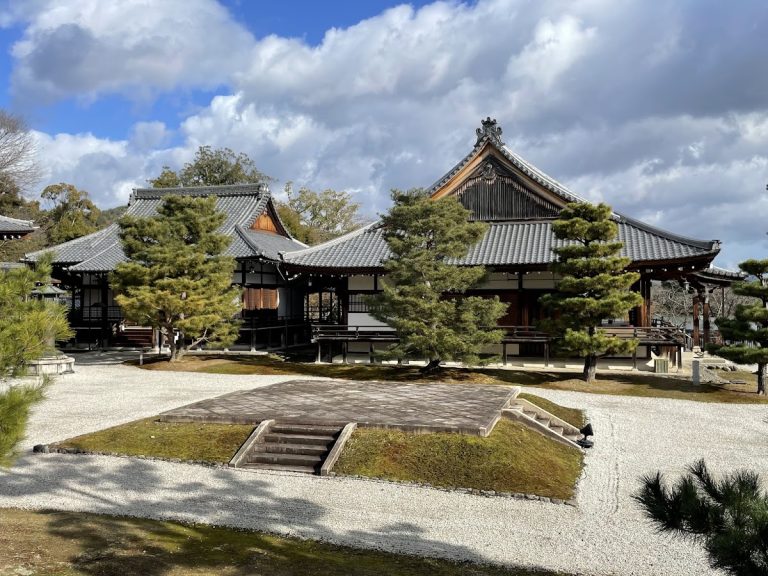
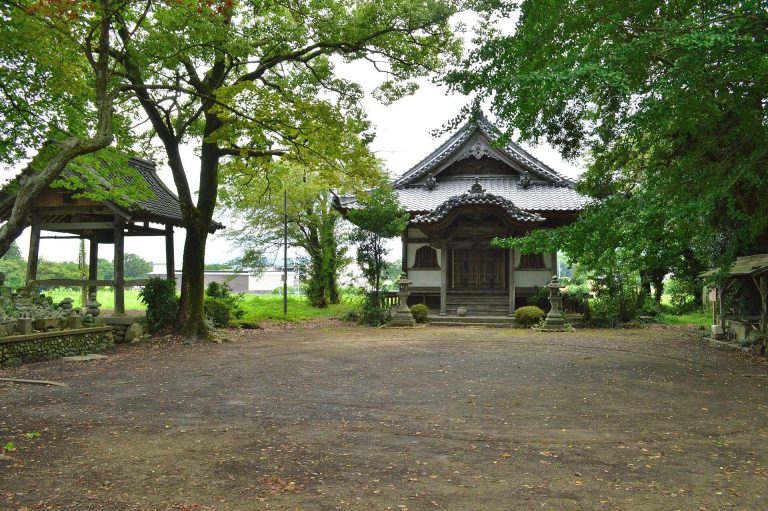
Atago Shrine occupies the summit area of Mount Atago at an elevation of 924 meters, on the historical boundary between Yamashiro and Tamba provinces. The precinct contains the principal hall, an offering hall, a worship hall, a shrine gate, a shrine office, and several subsidiary shrines. Its surviving features reflect the present Shinto institution as well as elements of the former Hakuun-ji complex and the pilgrimage landscape leading up the mountain.
Summit Precinct
Principal Hall and Subsidiary Shrines
The principal hall was rebuilt in 1836. The main sanctuary enshrines Izanami, Haniyamahime, Amekumahito, Wakumusubi, and Toyoukehime. Wakamiya Shrine enshrines the thunder deity, Kagutsuchi, and another deity, while Okumiya enshrines Okuninushi and seventeen additional kami, the Japanese term for deities or sacred spiritual presences. Shinmei Shrine is dedicated to Amaterasu, and Kumano Shrine to Izanagi. Two additional structures combine several smaller shrines within the precinct.
Iron Torii
The Iron Torii is made of iron and carries carvings of wild boar. The animals are regarded as messengers of the shrine’s deity, giving the gate a distinctive religious association within the mountaintop precinct.
Black Gate
The Black Gate, formerly called the Kyoguchi General Gate, stood on the Kyoto side of the former Hakuun-ji complex. It marked the historical entrance to that precinct and is one of the few surviving features associated with Hakuun-ji. From the junction of the Kiyotaki and Mizuo pilgrimage routes, the gate is reached after approximately fifteen minutes. Beyond it, the route continues for about 400 meters before stairs rise toward the principal hall.
Mountain Pilgrimage Routes
Fifty Stations
The principal pilgrimage road begins at the First Torii at Torii-moto in Saga-Torii-moto and was traditionally divided into fifty units, each identified by a sign. Former teahouses survive along the route, while rest areas are located at the third, fifth, and seventh stations. The First Torii’s shape is also said to have provided the design for the torii-shaped motif used in one of Kyoto’s Five Mountain Bonfires.
Fifth and Seventh Stations
At the fifth station, worship centered on the Great Cedar Deity and a large sacred cedar. A typhoon in autumn 2019 uprooted the cedar and damaged its shrine. Near the seventh station, a former flower-selling place was associated with the sale of shikimi, a plant used as a fire-protection talisman. The Kiyotaki and Mizuo routes meet near this point.
Tsukinowa Route and Natural Features
Kuya Waterfall and Tsukinowa Temple
The approach associated with the Tsukinowa Temple route passes Kuya Waterfall, where the Buddhist practitioner Kuya is traditionally said to have practiced. Tsukinowa Temple has longstanding connections with Hakuun-ji and is associated with Kuya, Honen, the founder of Japan’s Jodo school of Buddhism, and the court noble and regent Kujo Kanezane.
Rhododendron and Azaleas
A hon-shakunage rhododendron at Tsukinowa Temple is designated a natural monument of Kyoto City. The mountain approaches also contain areas where Mitsubatsutsuji azaleas bloom in spring, adding a natural feature to the pilgrimage landscape connected with Atago Shrine.