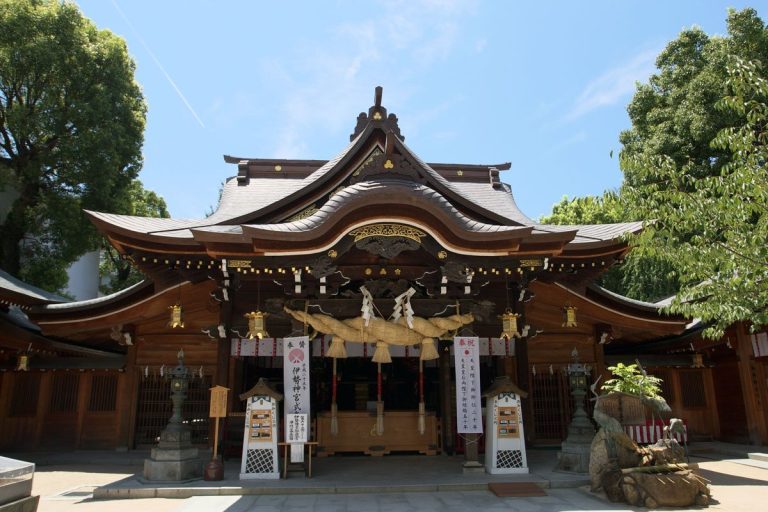
Hakozaki Shrine: A Historic Hachiman Shrine in Fukuoka, Japan


Site at a Glance
- Rating
- 4.4
- Popularity
- Medium
- Country
- Japan
- Primary era
- Early Modern
- External website
- Open
- Eras represented
- Medieval, Early Modern
- Civilizations
- Ashikaga shogunate, Tokugawa, Toyotomi regime
- Site type
- Religious
- Remains
- Sanctuary
On this page15 sections
History
Hakozaki Shrine is a Shinto Hachiman shrine in Fukuoka, Japan, whose foundation is traditionally dated to 923 and whose history is closely connected with maritime protection and the Hachiman tradition. Hachiman is a major Japanese kami tradition associated especially with the deified Emperor Ojin, protection, warfare, and security at sea. The shrine venerates Hachiman, particularly Emperor Ojin, Empress Jingu, and Tamayori-hime, a deity of Japanese myth and religious tradition.
Foundation and early status
The shrine’s origin is linked to an oracle of Hachiman on June 21, 921. The deities were transferred from Daibu Shrine in Honami District, Chikuzen Province, to a location facing the Genkai Sea. In 923, the shrine was moved to its present site, and this relocation provides the basis for the commonly cited foundation date.
Hakozaki Shrine was listed in the Engishiki Jinmyocho, a tenth-century court compilation of officially recognized kami and shrine institutions, completed in 927. It was recorded as a Myojin Taisha, a shrine granted high ritual status within that system. Probably during the eleventh or twelfth century, it was ranked as the first shrine of Chikuzen Province.
Also known as Hakozaki Hachimangu, the shrine is traditionally grouped with Usa Shrine and Iwashimizu Hachimangu as one of the three great Hachiman shrines. Its religious tradition is associated with Usa Shrine, where the Hachiman cult originated.
Warfare, rebuilding, and maritime associations
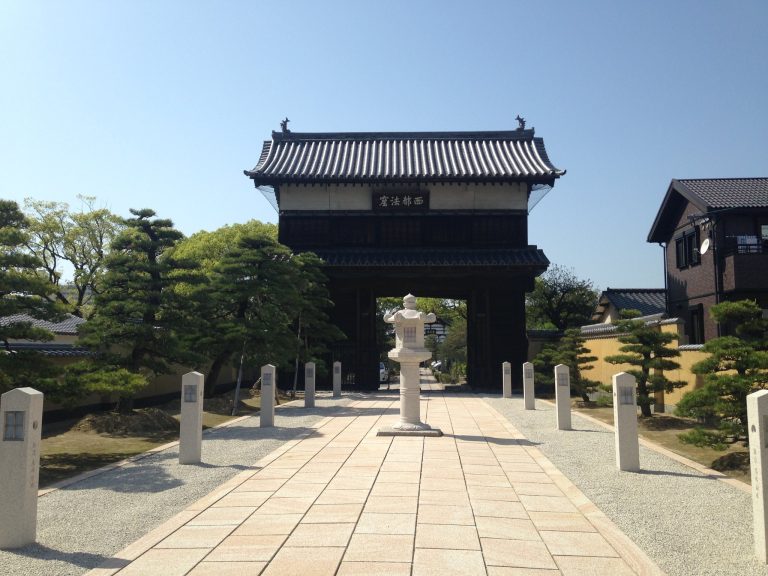
During the first Mongol invasion of Japan in 1274, fighting reached the shrine after Japanese defenders had been pushed back from several landing sites, and the buildings were burned. Following reconstruction, a calligraphic plaque bearing the words “Surrender of the Enemy Nation” was installed on the tower gate. Tradition attributes the inscription to Emperor Daigo and connects its dedication with the retired Emperor Kameyama’s prayer for victory over invaders. These events strengthened the shrine’s association with maritime travel and protection from threats arriving overseas.
Fire repeatedly destroyed the shrine buildings, while warfare during the Sengoku period, an era of prolonged political and military conflict from the fifteenth to the late sixteenth century, left the precinct in disrepair. Reconstruction followed in 1546 under the patronage of Ouchi Yoshitaka, the Dazaifu deputy governor. Dazaifu served as the imperial government’s administrative and military headquarters for Kyushu. Kobayakawa Takakage later commissioned the tower gate in 1594.
The shrine’s maritime connections also appear in the remains of the fourteenth-century Shinan ship, which sank near the Korean coast while carrying cargo from Ningbo to Hakata. Some wooden cargo labels recovered from the wreck bear legible characters identifying Hakozaki Shrine, linking the institution with the sea route between Song China and Japan. Song China, ruled by the Song dynasty from 960 to 1279, maintained extensive maritime connections across East Asia.
Modern status and continuing observances
Under Japan’s modern shrine-ranking system, Hakozaki Shrine became a prefectural shrine in 1871, a government-supported middle-ranking shrine in 1885, and a government-supported grand shrine in 1914. A government-supported grand shrine was the highest rank in the pre-1946 state shrine system. The shrine is now separately listed as a Beppyo shrine by the Association of Shinto Shrines because of its historical or institutional importance.
The main hall, worship hall, tower gate, first torii, and a stone lantern are Important Cultural Properties of Japan. The principal designations date from 1902 for the tower gate, 1907 for the main and worship halls, 1955 for the first torii, and 1962 for the stone lantern.
Several observances continue to express the shrine’s connections with land, sea, and protection. Tamaseseri takes place on January 3, while the spring and autumn Shajitsu festivals are held near the equinoxes. Hojoya, held from September 12 to 18, expresses respect for life and gratitude for the products of the sea and land. It is regarded as one of Hakata’s three major festivals, and within the shrine and Fukuoka tradition its name is pronounced “Hojoya” rather than the more general “Hojoe.”
During Tamaseseri, men divide into “Land” and “Sea” teams and carry an approximately 8-kilogram wooden sacred ball from nearby Tamatori Ebisu Shrine to Hakozaki Shrine, a distance of about 250 meters. Around 200 participants traditionally take part. The ball is believed to bring good fortune, and the event is also a prayer for successful harvests and fishing. Victory by the Land team foretells an auspicious harvest, while victory by the Sea team indicates abundant fishing.
A January 11 thanksgiving ceremony recalls the protection attributed to Hakozaki Hachiman when the monk Enni Ben’en encountered danger at sea while returning from Song China. Monks from Jotenji recite Buddhist sutras before the shrine. At the spring and autumn Shajitsu observances, participants gather purifying sand, known as oshioi, from Hakozaki Beach and scatter it over homes and fields while praying for household safety and good harvests. Participants in the Hakata Gion Yamakasa festival also collect the sand for ritual purification.
In 1945, during the final phase of the Second World War, Japan’s Communications Institute issued a postage stamp depicting the “Surrender of the Enemy Nation” plaque to encourage wartime morale and prayers for victory. Regulations prohibiting stamps associated with militarism and Shinto ended its use in 1947.
Remains
Precinct and approach
Hakozaki Shrine lies beside Hakata Bay. Its long approach runs for approximately 850 meters from the first torii near the bay to the main sanctuary. A second torii stands near the point where the approach crosses the Nishitetsu bus-only road. A large torii erected in 1930 at the former intersection of the coastal National Route 3 and the approach was dismantled and removed between March and April 2018 after deteriorating mortar threatened to shed fragments.
The coastal setting has changed substantially. Hakozaki Beach was formerly celebrated for white sand and pine trees, but seawalls installed by 1936 and the development of Hakozaki Pier, Higashihama Pier, warehouses, and other Hakata Port facilities transformed much of the waterfront. The beach adjoins the Hakozaki boat basin, and a sandy area near the approach remains associated with the collection of oshioi, the purifying sand used in local rituals.
Main sanctuary buildings
Main hall
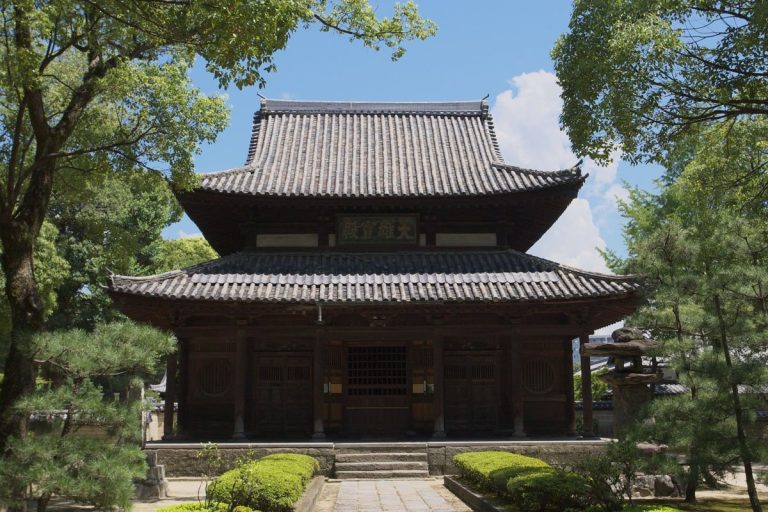
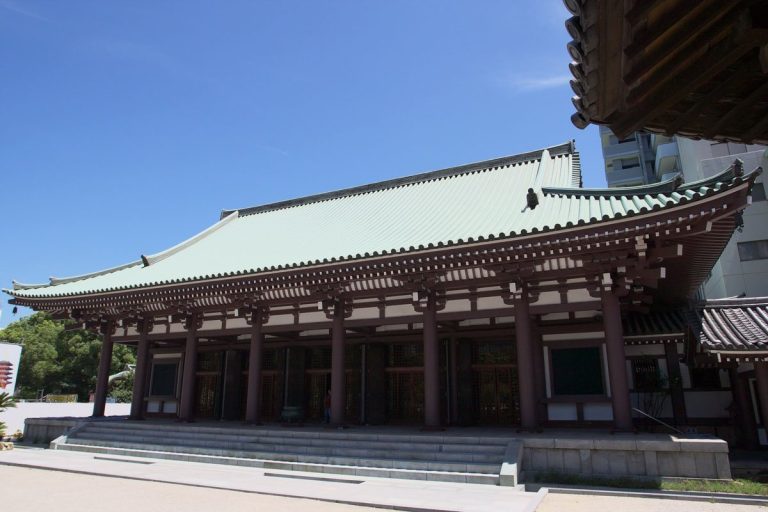
The main hall was rebuilt in the mid-sixteenth century, with the reconstruction associated specifically with 1546. It is a nine-bay structure in the nagare-zukuri style, an architectural form with a curved projecting gable over the front of the sanctuary. The building covers approximately 46 tsubo, has a cypress-bark roof, and includes attached carriage porches on both sides.
Worship hall
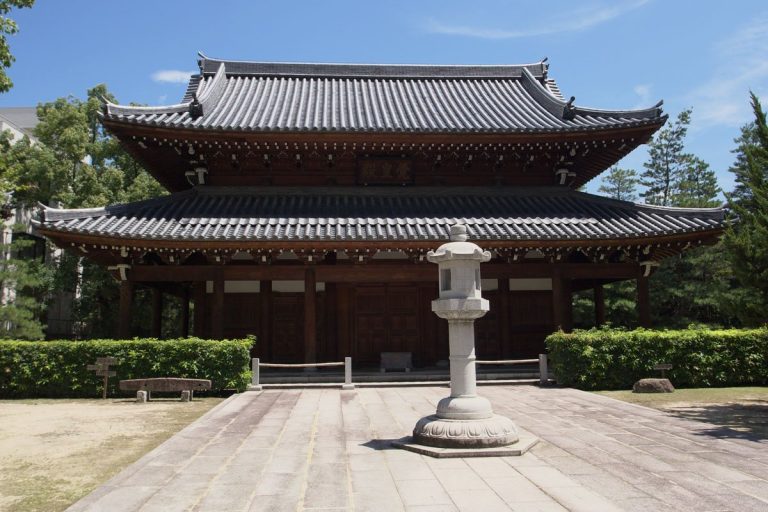
The worship hall dates from approximately the same period as the main hall. It has a four-bay frontage and is one bay deep, with a single-story gabled form and cypress-bark roofing. Double rainbow beams and kaerumata, curved frog-leg-shaped decorative supports beneath a beam, contribute to its architectural character.
Gate and torii
Tower gate
The tower gate was commissioned by Kobayakawa Takakage in 1594. It is a three-bay, single-entrance building with an irimoya-zukuri roof, which combines hipped roofing with gabled ends, covered in cypress bark. Its doors carry carved paulownia crests traditionally attributed to the sculptor Hidari Jingoro. The “Surrender of the Enemy Nation” plaque hangs on the gate, beneath which general worship is conducted. The gate is regarded as one of Japan’s three great tower gates.
First torii
The first torii is a Hizen-style stone torii made from Aō stone, a distinctive material associated with Takashima in Nagasaki Prefecture. Its columns are divided into three sections, taper downward into broad bases, and continue into foundation stones. The kasagi and shima-ki are cut from a single stone, with upward-curving ends, while the nuki and kasagi are equal in length. An inscription on the columns gives its construction date as 1609.
The torii was long attributed to Kuroda Nagamasa, who was traditionally believed to have erected it. Research by Sadao Hisamura established that Nabeshima Katsushige, lord of the Saga domain, was its builder. Its form is therefore specifically Hizen-style rather than a distinct “Hakozaki torii” type.
Stone features and sacred places
Stone lantern
Among the shrine’s stone lanterns is one whose fire-box base bears an inscription dated 1350. Tradition states that Sen no Rikyu, the sixteenth-century tea master who helped shape the Japanese tea ceremony, donated it in 1587.
Hako-matsu
The sacred pine called Hako-matsu stands within a vermilion fence to the right of the tower gate. Shrine tradition holds that Empress Jingu placed the afterbirth of the future Emperor Ojin in a box, buried it in the ground, and planted the pine as a marker. This tradition is associated with the name Hakozaki. In the shrine’s formal spelling, “hako” uses the character for a cylindrical container, while the surrounding place-name and station name use the character meaning “box.”
Other features of the precinct include the Chinese-ship tower, the Emergence Stone, the shrine flower garden, the High Lantern, and Hakozaki Shrine’s seaside sanctuary.