Kōzen-ji Temple: A Sōtō Zen Temple in Himi, Japan


Site at a Glance
- Rating
- 4.2
- Popularity
- Low
- Country
- Japan
- Primary era
- Early Modern
- External website
- Open
- Eras represented
- Early Modern
- Civilizations
- Tokugawa
- Site type
- Religious
On this page10 sections
History
Kōzen-ji Temple is a Sōtō Zen temple in Himi, Japan, traditionally founded in 1327 by Meihō Sotetsu, a leading disciple of Keizan Jōkin. Sōtō Zen is a major Japanese school of Buddhism that places particular emphasis on seated meditation, known as zazen. The temple’s traditional mountain name is Kaikeizan, an honorific name used alongside its institutional name.
Foundation and Kaga protection
Meihō Sotetsu was associated with Keizan Jōkin, a medieval monk regarded as one of the principal founders of the Sōtō Zen tradition in Japan. Keizan was said to have founded Sōji-ji, one of the school’s major head temples. This connection placed Kōzen-ji within the institutional history of Sōtō Zen from its earliest period.
In 1632, Maeda Toshitsune, the third lord of the Kaga domain, visited Kōzen-ji. He donated a portrait of Maeda Toshiie, the first lord of the domain, and issued a vermilion-seal document naming the temple as a place of prayer for the Kaga domain. The document brought official protection to Kōzen-ji’s landholdings and strengthened its position within the domain’s religious network.
Rebuilding in the early eighteenth century
By the time Gekkan Gikō became the temple’s nineteenth head priest, Kōzen-ji had fallen into disrepair. Gekkan, who lived from 1653 to 1702, traveled throughout Japan to collect funds for reconstruction. Instead of using the money for Kōzen-ji, however, he gave it to Sakai Genpachi, a merchant in Ushitaki in Mutsu Province. Sakai was rebuilding his family temple, Honseiji, after it had been destroyed by fire.
Once Honseiji had been rebuilt, Sakai promised to send Hiba cypress from Ushitaki to Kōzen-ji in Etchū. Hiba cypress is a durable northern Japanese conifer valued as building timber. The wood was marked for delivery to Kōzen-ji and sent by sea, but a storm in the Sea of Japan forced the crew to throw it overboard. The timber later drifted ashore on Sado Island. Fishermen from Himi, many of whom followed Gekkan, recovered every piece and arranged for it to be transported to Etchū.
Kōzen-ji was rebuilt in 1701 with the timber from Ushitaki. Gekkan died in 1702, shortly after the reconstruction was completed. Sakai Genpachi remained in Himi for the rest of his life rather than returning to Ushitaki. His surviving grave bears his name and identifies his origin as Ushitaki in Nanbu territory.
Fire, reconstruction, and later associations
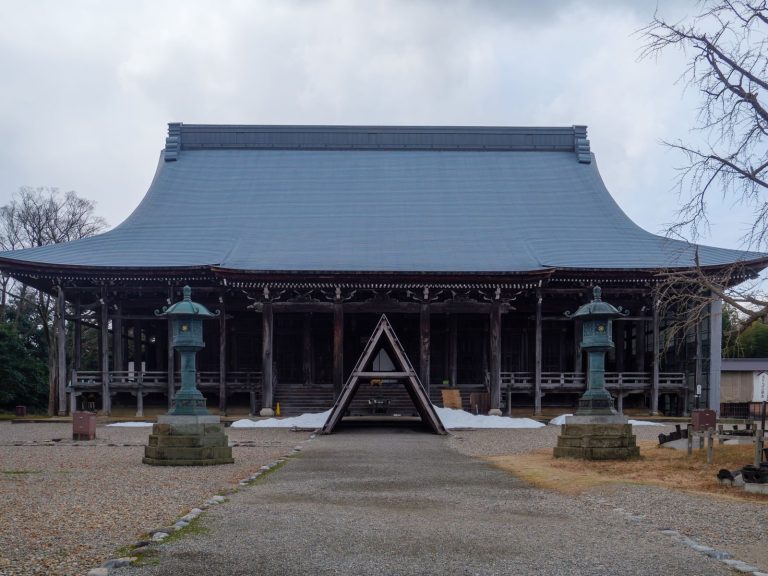
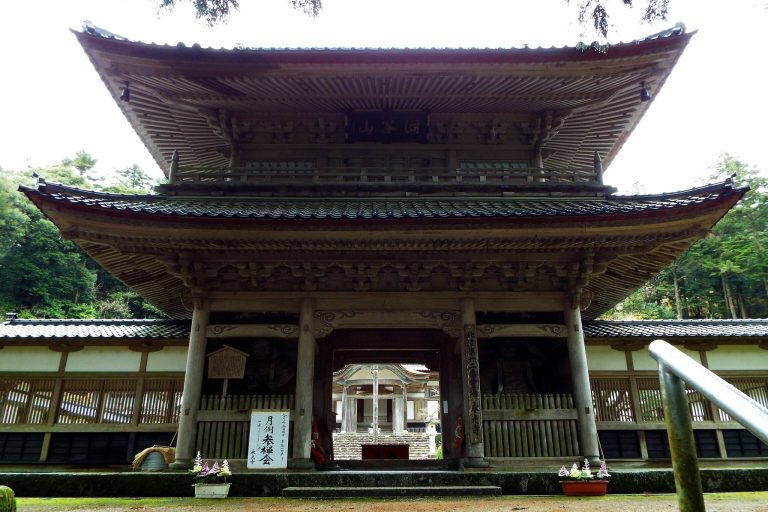
The reconstructed temple burned completely in the Himi Town Great Fire on September 6, 1938. Work to reconstruct the precinct continued over an extended period, and the temple gate was rebuilt in 2008.
Kōzen-ji is also the birthplace of manga artist Fujiko Fujio A, whose real name was Motoo Abiko (1934–2022). He was born as the eldest son of Kōgyoku Abiko, the temple’s forty-ninth head priest. After his father died when he was eleven, Abiko moved to Takaoka, where he met Hiroshi Fujimoto, who later became known as Fujiko F. Fujio. In 2022, Fujiko Fujio A’s nephew was serving as Kōzen-ji’s fifty-second head priest.
Remains
Kōzen-ji’s surviving precinct combines the main temple compound with a detached island precinct in Toyama Bay. A detached precinct is a physically separate parcel of temple land that remains institutionally part of the same temple. The complex includes the rebuilt gate, stone statues connected with Fujiko Fujio A’s manga, residential quarters preserving works and objects associated with the artist, and Karajima, an island containing a hall dedicated to Benten.
Main temple precinct
Gate and manga statues
The temple gate was rebuilt in 2008 as part of the reconstruction that followed the 1938 fire. Within the precinct, stone statues represent four protagonists from Fujiko Fujio A’s works: Ninja Hattori-kun, Kaibutsu-kun, Pro Golfer Saru, and The Laughing Salesman. The Himi Town Shopping Street Promotion Association erected the statues in 2009.
Residential quarters and preserved objects
The residential quarters preserve Buddhist paintings donated during Fujiko Fujio A’s lifetime. They also contain a screen depicting Daruma Daishi, the Japanese name for Bodhidharma, the Indian monk traditionally regarded as the founder of Chan Buddhism in China, the tradition from which Zen developed in Japan. The figure is shown in a pose modeled on Moguro Fukuzō’s “Doon!” gesture from The Laughing Salesman.
Another preserved object is the work desk used by Fujiko Fujio A and Hiroshi Fujimoto. Osamu Tezuka gave them the desk when they moved into Tokiwasō. The residential quarters are not generally open to the public, although special openings may be held in connection with the annual Manga World Festival on May 5.
Karajima island precinct
Benten Hall and festival grounds
The entire island of Karajima, approximately 500 meters east of Himi Fishing Port in Toyama Bay, belongs to Kōzen-ji as a detached precinct. Its Benten Hall is dedicated to Benten, a Buddhist-Shinto deity associated especially with music, eloquence, and prosperity.
Karajima hosts the Karajima Grand Festival in early May, the temple’s annual festival. Prayers are offered there for maritime safety and good catches. The island is designated a natural monument by Toyama Prefecture, and landing is restricted to people involved in the festival.