Iwatateono Shrine: A Historically Disputed Engishiki Shrine in Japan


Site at a Glance
- Rating
- 4
- Popularity
- Very Low
- Country
- Japan
- Primary era
- Early Modern
- Eras represented
- Early Modern
- Civilizations
- Tokugawa
- Site type
- Religious
- Remains
- Sanctuary
On this page10 sections
History
Iwatateono Shrine is a Japanese Shinto shrine associated with Sagamihara in Kanagawa, Japan, and with an officially recognized shrine listed in the tenth-century Engishiki. This compilation of court procedures and regulations included the Jinmyōchō, a register of shrine names. The entry identifies Iwatateono as a small shrine in Kōza District of Sagami Province in 927, although the shrine’s exact location remains disputed among seven claimant shrines in Kanagawa Prefecture.
The Engishiki identification
The dispute arose after medieval fires destroyed ancient records relating to the shrine. One claimant is Nagura Daigongen, also called Nagura Gongen, while another is the shrine at Sano River, known as Oishi no Mori. Each preserves traditions linking it to Iwatateono. The Nagura tradition places the original shrine farther west, near the former boundary between Kai and Sagami provinces. One theory proposes that Kōza District once extended northwest along the Sagami River, which would bring the location within the area named in the Engishiki.
Nagura Daigongen was traditionally associated with a visit by Emperor Ojin, a figure of Japan’s early imperial tradition, followed by a shrine-building project. In 857, it received the rank of Junior Fifth Rank and entered the system of officially recognized shrines. Its listing as an Engishiki small shrine followed in 927. The word “small” described a category in the historical shrine system rather than the physical size of the buildings.
Nagura Daigongen
A rock called Eboshi Rock formerly served as the object of worship at Nagura. It stood east of the shrine until its removal during construction of the Chuo Main Line. A local explanation connects the name Iwatateono with the shrine’s position at the “tail,” or extremity, of the land as viewed from the rock.
The shrine buildings and old records were destroyed in 1569 during the Battle of Mimase, when Takeda Shingen attacked Odawara. The present buildings were constructed in 1724. A detailed shrine register was said to have been lost in 1570, and its correction was authorized in 1942. The state then formally recognized Nagura Daigongen as an Engishiki shrine, while postwar documentary evidence was also used to support the identification.
Nagura Daigongen stands south of the Katsura River. A study of the Engishiki shrines judged this position geographically likely for the recorded shrine. Ritual offerings presented by the Department of Divinities in 1808 and 1809 survive and are regarded as the oldest surviving physical evidence among the claimant shrines.
Sano River Oishi Shrine
The Sano River shrine preserves a different foundation tradition. It states that in 110, Yamato Takeru, a legendary imperial prince associated with the early expansion of the Yamato court into eastern Japan, returned from his eastern expedition and enshrined a heavenly rock shield at Mikuniyama. The purpose was said to be the stabilization of the eastern provinces. The tradition also connects the place with worship of Emperor Jimmu, who is traditionally regarded as Japan’s first emperor.
According to the same tradition, the shrine once stood east of Mount Shoto at Tsutsugura Peak, where an inner sanctuary was located. A front shrine was established at Mount Koyama, leading to the name Kōza Iwatateono Shrine. Sakanoue no Iwatate, described as a local chieftain of Kōza District, is traditionally regarded as the shrine’s protector. He was said to have received five districts in 764 after suppressing the Fujiwara no Nakamaro Rebellion, an eighth-century revolt against the imperial court. Fujiki-hime is identified in the tradition as the wife of Ishimura no Iwatate.
The former inner sanctuary at Tsutsugura Peak was affected by a wildfire during the Bunroku period, from 1593 to 1596. The shrine’s original worship focused on a huge stone. During the Edo period, pilgrims came from Musashi, Kai, and Sagami, including people who sought prayers against kanmushi, a traditional childhood ailment associated with irritability.
Modern shrine history
In 1871, the shrine at Sano River was formally designated Iwatateono Shrine, while the shrine formerly located on Mount Koyama was abolished. The hall of offerings and worship hall were rebuilt in 1937, and the main sanctuary continued to preserve the architectural style of the Muromachi period. The shrine is administered jointly with Yose Shrine in Yose, Sagamihara.
Nagura Daigongen became a village shrine under the modern shrine-ranking system in 1873. In 1923, it was designated a shrine eligible to receive state-provided ritual offerings. In 1948, it was designated a shrine to which an envoy of the Association of Shinto Shrines in Kanagawa Prefecture would be dispatched. These later institutional histories form part of the continuing effort to establish which claimant preserves the Iwatateono named in the Engishiki.
Remains
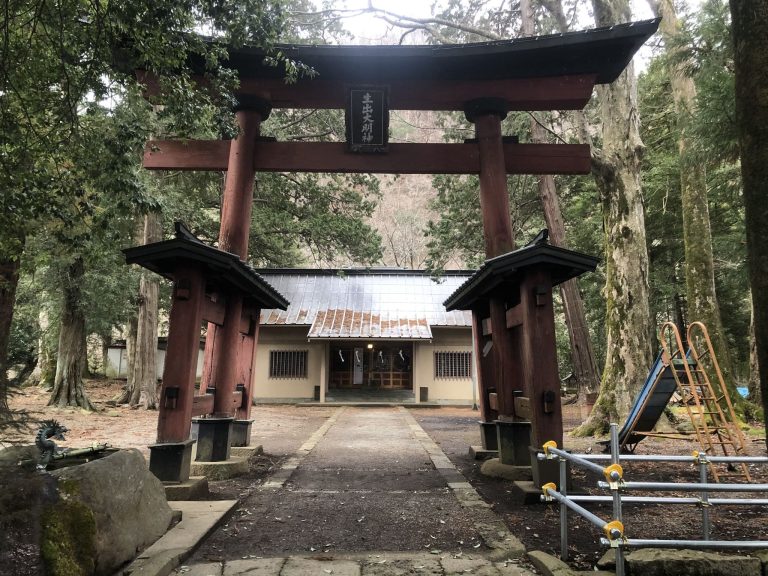
The physical remains associated with Iwatateono traditions are preserved at Nagura Daigongen and Sano River Oishi Shrine. They include shrine sanctuaries in distinct architectural forms, mature sacred trees, rebuilt worship structures, and a ritual-performance hall. Together, these features provide the material setting for two competing identifications of the ancient shrine.
Nagura Daigongen
Nagura Daigongen’s principal sanctuary follows the Shinmei-zukuri style, a Shinto form characterized by an elevated sanctuary, a gabled roof, and a clear emphasis on structural simplicity. At the center of the grounds stand two sacred Japanese cedars known as the husband-and-wife cedars. They are estimated to be about 400 years old, reach approximately 40 meters in height, and have trunk circumferences of 3.7 meters measured at breast height. The trees stand within a sacred grove and form a prominent surviving element of the shrine grounds.
Sano River Oishi Shrine
Main sanctuary
The main sanctuary at Sano River Oishi Shrine is identified as Hachiman-zukuri, an arrangement in which two gabled roofed sections are joined along their length. It is a large, one-bay structure with a gabled roof and measures approximately 3 meters along the eaves. The projecting worship porch and the rear beam of the main body align at the same height, allowing one roof to cover the entire building.
Frog-leg struts and other ornamental forms indicate that the sanctuary was probably built in the late sixteenth century. An inscription on the ridge plaque records work carried out by parishioners in November 1836 and names the people who copied and recorded it. The main sanctuary was designated a prefectural important cultural property on February 13, 1996.
Worship and performance buildings
The hall of offerings and worship hall were rebuilt in 1937. The worship hall is the structure from which worshippers address the sanctuary, while the main sanctuary houses the shrine’s principal sacred presence. A kagura hall, used for sacred music and dance performed as ritual worship, was built in 1854. Rows of subsidiary shrine buildings also stand within the grounds, linking the principal structures with the wider compound.