Nōfuku-ji Temple: A Tendai Buddhist Temple in Kobe, Japan


Site at a Glance
- Rating
- 4.1
- Popularity
- Low
- Country
- Japan
- Primary era
- Modern
- External website
- Open
- Eras represented
- Medieval, Modern
- Civilizations
- Japanese, Kamakura shogunate
- Site type
- Religious
- Remains
- Monastery
On this page10 sections
History
Nōfuku-ji Temple is a Tendai Buddhist temple in Kobe, Japan, traditionally founded in 805 by the monk Saichō. Its mountain name, Hōshakuzan, is an honorific designation used for a Buddhist temple. The foundation tradition connects Nōfuku-ji with Saichō’s return from Tang China and identifies it as his first site of Buddhist instruction in Japan.
Saichō and the foundation tradition
According to the temple tradition, Saichō landed at Owada Port, now part of Hyōgo Port, after returning from China. Local people welcomed him and donated a hall where he taught Buddhist doctrine. He installed a Yakushi Nyorai image that he had made himself, prayed for national peace and the welfare of the people, and gave the temple the name Nōfuku Gokoku Mitsu-ji. Tendai Buddhism, the school associated with Saichō, is a Japanese Mahayana tradition centered on the Lotus Sutra and combining meditation, esoteric practices, and devotion to Buddhas and bodhisattvas.
The Heike and Fukuhara-dera
Nōfuku-ji became closely connected with Taira no Kiyomori, the late Heian-period warrior and political leader who helped establish the power of the Taira family. In 1168, Kiyomori is said to have renounced secular life and taken Buddhist vows at the temple under the name Jōkai. When plans were made in 1180 to establish the capital at Fukuhara, Nōfuku-ji became the Heike family’s prayer temple. The Heike was the Taira warrior clan, whose leading members held major political and military influence during the late Heian period.
The temple was revived by Chūkai, a senior Buddhist cleric who was the son of Taira no Norimori and Kiyomori’s nephew. A large complex had been built by 1186, after which Nōfuku-ji flourished. It was regarded as the foremost of the five major temples of Fukuhara and as the most powerful temple in Hyōgo. The temple was commonly called Fukuhara-dera, while another tradition called it Hattō-ji, meaning “the temple of eight buildings,” in reference to the reputed size of its complex.
Kiyomori died in 1181, and his remains were buried at Nōfuku-ji in accordance with his will. The memorial mausoleum associated with him is connected with the Heishōkokubyō, although traditions place the original mausoleum at the affiliated Taiheizan Hattō-ji before its later association with Nōfuku-ji.
Destruction and revival
The seven-hall complex was completely destroyed by fire during warfare in 1341. Nōfuku-ji was revived in 1599 by Chōsei, who was reportedly a former retainer of Akechi Mitsuhide. Chōsei’s natal family, the Nanjō family, donated the former site of Kiyomori’s residence known as “Flower-Viewing Hill,” or Hōshaku-ga-oka. That property became the location of the present temple.
During the Edo period, Nōfuku-ji held the status of an inge, a formally ranked affiliated temple of Shōren-in in Kyoto. It served as a substitute when the monzeki institution lacked its resident head. A monzeki was a Buddhist temple or institution traditionally headed by an imperial or aristocratic cleric, while an inge was a temple formally associated with such an institution.
War damage and modern rebuilding
Nōfuku-ji was almost entirely destroyed in the Kobe air raid of 17 March 1945. The bell tower was the principal surviving structure, while numerous cultural materials were lost, including a Senju Kannon image, older Buddhist statues, haiga paintings, historical documents, and printed Buddhist scriptures.
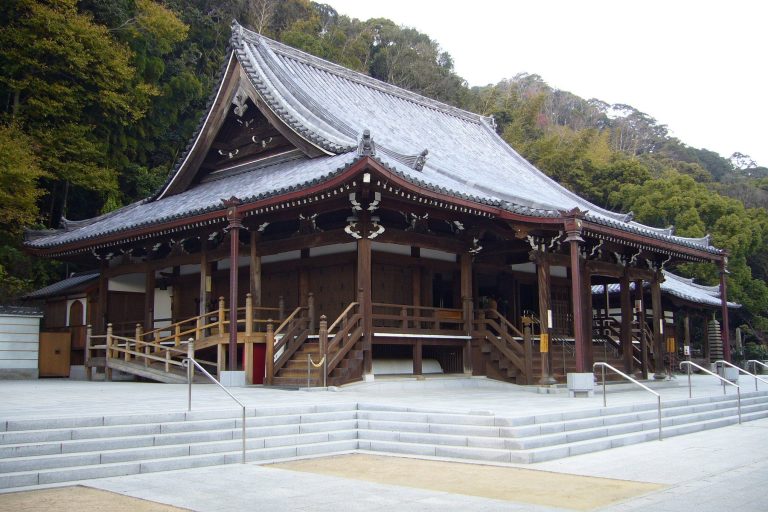
The present main hall was rebuilt in 1954 after a worship hall from the Tsukinowa Imperial Mausoleum precinct at Sennyū-ji in Kyoto was transferred to Nōfuku-ji by the Imperial Household Ministry and the Kujo family. A lecture hall was added in 1975 to commemorate 1,200 years since Saichō’s ordination. The Great Hanshin Earthquake of 17 January 1995 destroyed the main hall and caused the bell tower to collapse. The hall was restored in December 1997, and the bell tower was rebuilt in autumn 2018.
Nōfuku-ji remains connected with several pilgrimage traditions. It is stop 23 on the Shin-Saigoku Thirty-Three Kannon Pilgrimage, stop 32 on the Fukuhara Saigoku Thirty-Three Kannon Pilgrimage, and stop 8 on the Kobe Thirteen Buddhas Pilgrimage. It is also the Bishamonten site of the Hyōgo Seven Lucky Gods pilgrimage. Bishamonten is a Buddhist guardian deity associated with protection and military power.
The temple holds nationally and municipally recognized cultural properties. These include an important wooden Eleven-Faced Kannon and a wooden Amida Buddha accompanied by two attendants, the latter group receiving designation as Kobe municipal tangible cultural property in 2024.
Remains
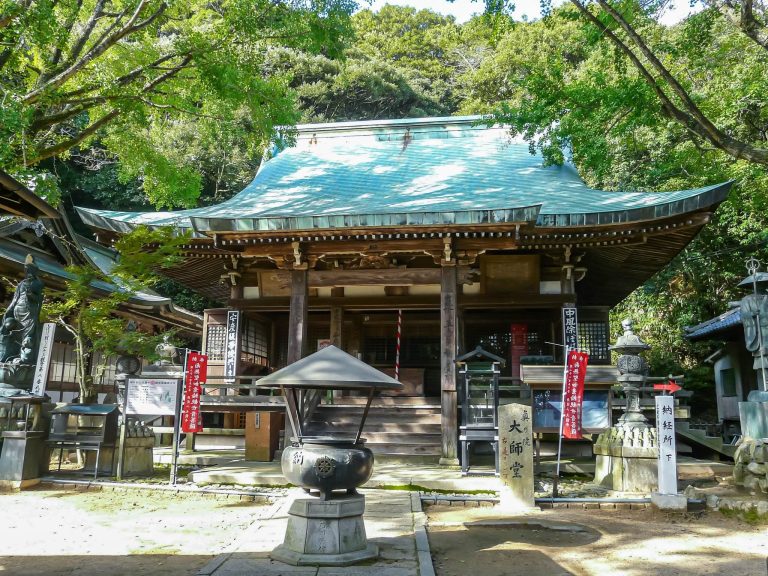
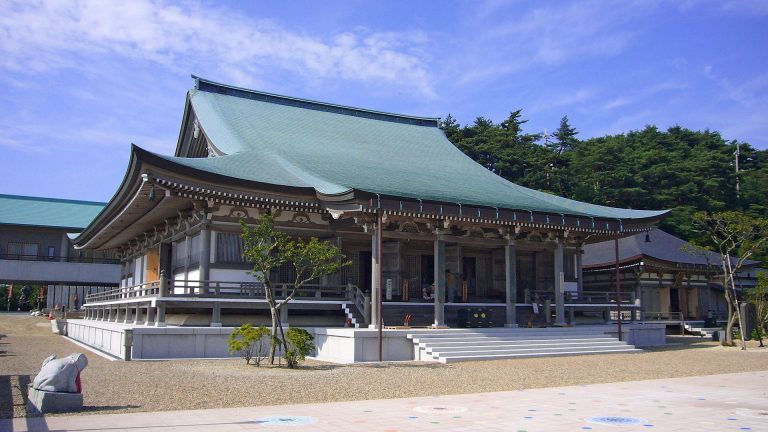
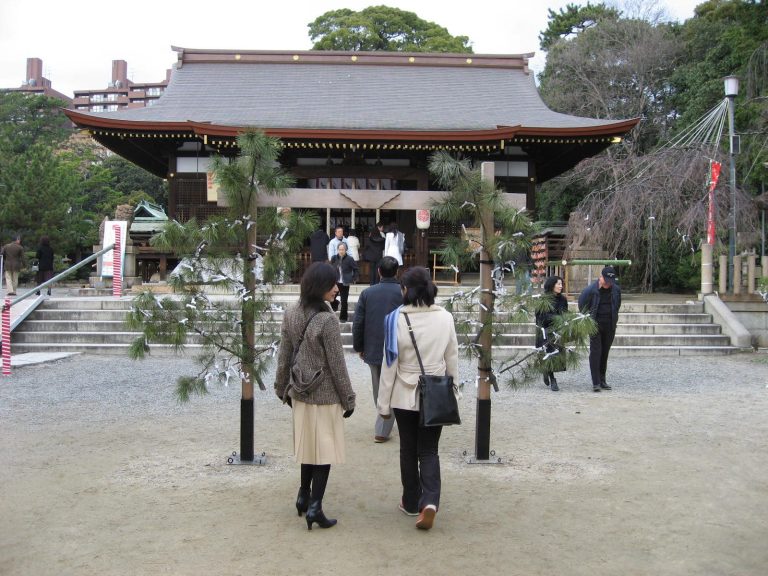
Nōfuku-ji is entered from the east. The approach runs directly toward the main hall, while the abbot’s residence and the monks’ quarters stand to the north behind two memorial stones. The southern part of the grounds contains the Great Buddha of Hyōgo. Other buildings include the Goma Hall, the abbot’s residence and kitchen quarters, the lecture hall, and the Tōshō Inari Hall. A Goma Hall is used for goma, a Buddhist fire ritual in which offerings are placed into a consecrated fire.
Main hall and temple buildings
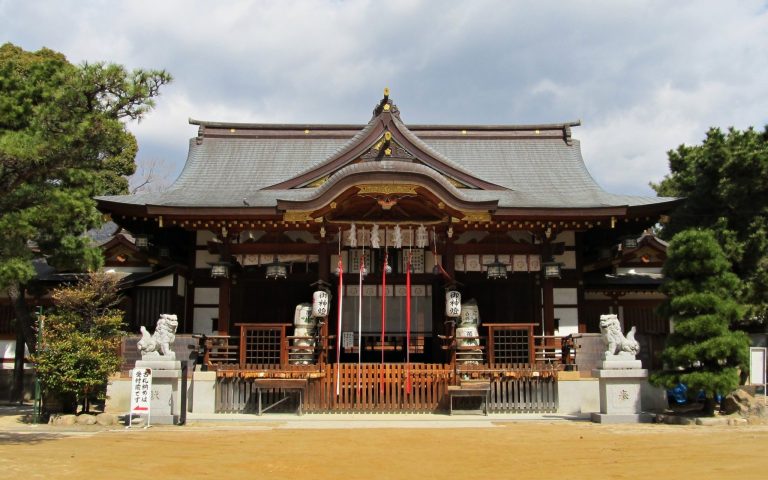
Tsukinowa-eiden, the main hall, began as a worship hall in the Tsukinowa Imperial Mausoleum precinct of Sennyū-ji in Kyoto. It was transferred to Nōfuku-ji in 1954, destroyed in the 1995 earthquake, and restored in 1997. Its principal image is a seated Amida Buddha. Standing images of Kannon and Seishi flank Amida; they were brought from Taizan-ji in Kobe when the hall was transferred and are regarded as works of the late Heian period. Kannon is the bodhisattva associated with compassion, while Seishi, also known as Mahasthamaprapta, is commonly represented as an attendant of Amida alongside Kannon. The Tōshō Inari Hall was rebuilt in December 2016, and the lecture hall dates from 1975.
Great Buddha of Hyōgo
The Great Buddha of Hyōgo is a large seated image of Vairocana, also called Birushana, a cosmic Buddha associated with universal illumination. The original bronze image was erected in May 1891 through a donation from the wealthy merchant Nanjō Sōbei. Its body measured three jō and eight shaku, it weighed 3,000 kan, and it was counted among Japan’s Three Great Buddhas.
The original image was dismantled in May 1944 under the Metals Recovery Ordinance and surrendered to the state. After the war, the temple’s abbot recovered and stored metal fragments from the statue. These fragments were incorporated into the material of the replacement image, which was rebuilt on 9 May 1991. The present image is about 11 metres high and weighs approximately 60 tonnes. With its lotus platform and pedestal, it reaches 18 metres. It stands on an octagonal platform reached by a stairway, while the Birushana Hall beneath the pedestal enshrines an Eleven-Faced Kannon.
Kiyomori mausoleum and stone monuments
The Heishōkokubyō, a memorial mausoleum for Taira no Kiyomori, is represented by a thirteen-storey stone pagoda. A lantern-shaped Hōkyōintō stands in front of it, and a separate nine-storey stone pagoda is also on the grounds. Both stone works are attributed to the Kamakura period. A Hōkyōintō is a Japanese Buddhist stone pagoda traditionally associated with preserving sacred texts and accumulating religious merit. A statue of Saichō is also displayed within the temple grounds.
Memorials and Buddhist images
A memorial monument commemorates Kitakaze Shōzō, a wealthy merchant associated with the loyalist movement. Its inscription records his role in securing a truce before Himeji Castle was exposed to the fires of the Boshin War, in exchange for 150,000 ryō in military funds. The inscription was written by Itō Hirobumi.
Another stele commemorates Hamada Hikozō, better known as Joseph Heco, and describes the temple’s history. It is described as Japan’s first monument bearing an inscription in English. A separate monument honors Taki Zensaburō, the samurai who committed seppuku in connection with the Kobe Incident. Originally located at Eifuku-ji, it was transferred to Nōfuku-ji in 1969 for the centenary memorial observance of his death.
The grounds also contain the tomb of Enjitsu, an abbot of Nōfuku-ji who buried the remains of the teacher associated with Kiyomori’s tonsure and entry into religious life. The wooden Eleven-Faced Kannon is a Heian-period sculpture carved from a single block of Japanese cypress. It was transferred during the Hōreki era, from 1751 to 1764, from Zensui-ji in Shiga Prefecture to Wada Shrine in Hyōgo, and later came to Nōfuku-ji during the Meiji period. The wooden Amida Buddha and its two attendants form a separate sculptural group associated with the temple and are recognized as Kobe municipal tangible cultural properties.