Taiyū-ji Temple: A Historic Shingon Buddhist Temple in Osaka


Site at a Glance
- Rating
- 4
- Popularity
- Medium
- Country
- Japan
- Primary era
- Early Modern
- External website
- Open
- Eras represented
- Classical, Early Modern
- Civilizations
- Tokugawa
- Site type
- Religious
- Remains
- Monastery
On this page7 sections
History
Taiyū-ji Temple is a temple of the Kōyasan branch of Shingon Buddhism in Osaka, Japan, traditionally founded by the Buddhist priest Kūkai in 821. Shingon is an esoteric Buddhist tradition centered on ritual practice, mantra, mandala, and the Buddha Dainichi. The temple is formally known as Kabokuzan Hōju-in Taiyū-ji and is classified as a quasi-special head temple. It is also connected with several pilgrimage networks in the Kansai region, including the New Saigoku, Kinki Thirty-Six Fudō, Eighty-Eight Temples of Settsu, Osaka Thirteen Buddhas, Osaka Thirty-Three Kannon, Naniwa Seven Fortunes, Shinto-Buddhist, and Kinki Ten-Joy Kannon pilgrimages.
Foundation and early development
Temple tradition places the beginning of Taiyū-ji in 821, when Kūkai, also known as Kōbō Daishi, made statues of Jizō and Bishamonten from a sacred tree at the site. He then established a thatched hermitage for their worship. A related foundation tradition says that Emperor Saga ordered Kūkai to build the temple. Saga ruled Japan in the early ninth century, and tradition holds that he visited Taiyū-ji in 822 and presented it with his personal image of the thousand-armed Kannon, the bodhisattva of compassion. That image became the temple’s principal object of worship.
In 843, Saga’s son Minamoto no Tōru expanded the precinct and created a seven-hall temple compound measuring eight chō on each side. A chō was a traditional Japanese unit used to describe land area. The temple adopted the mountain name Kabokuzan and took the name Taiyū-ji from Tōru’s personal name. A guardian shrine was established at the same time. It is now known as Tsunashiki Tenjin Shrine and became independent during the Meiji period, when the government ordered the separation of Buddhism and Shinto.
Taiyū-ji became known as a major temple of Naniwa, the historical name associated with the Osaka area. Its name was sometimes written with a different first character, a form particularly common in medieval and early-modern documents. The temple’s historical identity is also closely connected with Minamoto no Tōru, who was the twelfth son of Emperor Saga, a minister of the left, and the traditional ancestor of the Saga Genji. His association survives in local place-names around the temple.
War, reconstruction, and civic history
Taiyū-ji was completely burned during the fires of the Siege of Osaka in May 1615. The siege was the final conflict between the Tokugawa shogunate and the Toyotomi family, ending with the destruction of Toyotomi power at Osaka. Although the temple’s land had been reduced, its main hall, South Great Gate, and 23 other buildings were reconstructed during the Genroku period, from 1688 to 1704. The Genroku era belonged to the Tokugawa shogunate and was associated with cultural and economic growth in Japan’s cities. After reconstruction, Taiyū-ji again drew many worshippers.
The temple also played a part in nineteenth-century political history. On March 17, 1880, the League for the Formation of a National Assembly was established at Taiyū-ji. The league contributed to the Freedom and People’s Rights Movement, which sought representative government and a national assembly in Japan.
During the Pacific War, the temple bell was exempted from metal requisition because it was judged to possess outstanding artistic value. Taiyū-ji was nevertheless completely burned in the second Osaka air raid on June 1, 1945. The principal thousand-armed Kannon image survived because it had been entrusted to Mount Kōya beforehand.
After the war, more than 20 buildings, including the main hall and Founder’s Hall, were rebuilt. The main hall was restored in 1960, followed by the rest of the temple compound. Taiyū-ji later served as a temporary morgue for victims of the Tenroku gas explosion in 1970 and the Sennichi Department Store fire in 1972, linking the temple’s long history with the civic life of modern Osaka.
Remains
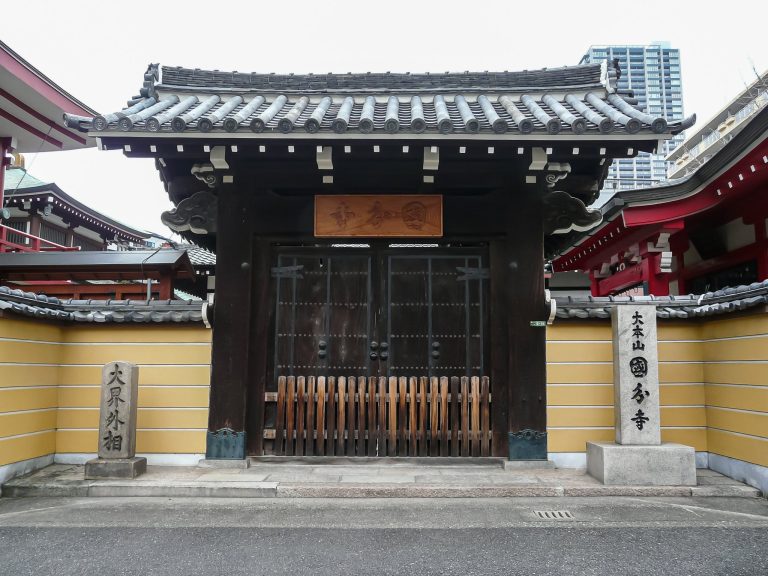
The rebuilt precinct is entered through a West Gate or a simple South Gate and contains a group of religious, commemorative, and residential buildings. Its principal structures include the Main Hall, Bell Tower, Founder’s Hall, Fudō Hall, Goma Hall, a treasure pagoda, a pilgrim guest area, and the abbot’s and monks’ quarters, including a refectory. The southern part of the grounds contains the Nine Mountains and Nine Seas Garden. The surviving compound occupies only part of the much larger grounds once associated with Taiyū-ji, which historically extended across areas now corresponding to several surrounding Osaka neighborhoods and a park.
Principal buildings and religious spaces
The Main Hall is the central building of the reconstructed compound, while the Founder’s Hall commemorates the temple’s religious foundation. The Bell Tower houses the bell that was retained during wartime metal collection because of its recognized artistic quality. Fudō Hall contains an object of worship identified as Fudō, a Buddhist guardian deity associated with immovable resolve. The Goma Hall is another principal religious building, and the treasure pagoda houses an image of Dainichi, the central cosmic Buddha of Shingon Buddhism. The compound also includes a small Hakuryū Ōkami shrine, together with the residential and institutional buildings that support temple life.
Images, inscriptions, and commemorative features
The principal object of worship is a wooden standing statue of the thousand-armed Kannon. The form represents the ability to respond to suffering in many ways, and the image traditionally presented by Emperor Saga is identified with Taiyū-ji’s principal image. The statue is designated as an Osaka City tangible cultural property. Beside the West Gate stands a memorial stone to Minamoto no Tōru, preserving the connection between the temple and its ninth-century patron.
A stele commemorating the seventeenth-century poet Matsuo Bashō bears a haiku translated as “White chrysanthemum, conspicuous to the eye, but no deer.” Bashō was renowned for his haiku, and the stele forms part of the temple’s commemorative landscape. The Nine Mountains and Nine Seas Garden occupies the southern part of the precinct and is among the named landscape features within the rebuilt grounds.
Cemetery and historical memorials
The cemetery contains the grave of Yododono, the prominent consort of Toyotomi Hideyoshi and a major figure associated with the Toyotomi family during the final conflict at Osaka. Her grave is marked by a six-ring stone stupa, a Buddhist commemorative monument. The monument originally had nine rings. Together with the memorial to Minamoto no Tōru and the Bashō stele, the grave connects the precinct’s physical remains with successive chapters of Osaka’s political, literary, and religious history.