Kokubunji Temple: A Shingon Head Temple in Osaka


Site at a Glance
- Rating
- 3.9
- Popularity
- Low
- Country
- Japan
- Primary era
- Modern
- External website
- Open
- Eras represented
- Modern
- Civilizations
- Japanese
- Site type
- Religious
- Remains
- Sanctuary
On this page4 sections
History
Kokubunji Temple is a Buddhist temple in Osaka, Japan, traditionally founded in 655 during the reign of Empress Saimei. Also known as Settsu Kokubunji and Nagara Kokubunji, it belongs to the Shingon Kokubunji school, a branch of Shingon Buddhism, and serves as its head temple.
Origins and the Settsu Kokubunji
Temple tradition connects Kokubunji with Nagara-dera, which Doshō is said to have established within part of the Naniwa Nagara Toyosaki Palace complex in memory of Emperor Kotoku. Doshō was a Buddhist monk traditionally associated with the early transmission of Yogacara Buddhism to Japan. In 741, Emperor Shomu promoted the creation of provincial Kokubunji temples, institutions intended to support Buddhism across the provinces. Nagara-dera is traditionally said to have been designated as the Kokubunji of Settsu Province at that time.
The temple later became an imperial prayer temple linked with fourteen successive emperors. Another tradition, preserved in the Illustrated Guide to Famous Places in Settsu, gives a different account of its beginnings. It attributes the foundation to Gyoki, the principal Amida image to Prince Shotoku, and the Red Fudo image to Kukai, the founder of Shingon Buddhism in Japan. These traditions differ from the account centered on Doshō.
Destruction and Restoration
Kokubunji was almost completely destroyed by fire during the Siege of Osaka in 1615. The temple then declined for nearly a century during the early Edo period. Restoration began in 1718 under Kaien Risshi, who is remembered as the temple’s restorer. The Edo shogunate later granted Kokubunji the privilege of issuing permits that exempted travelers from checkpoint procedures.
During the Meiji period, an anti-Buddhist movement led to a major reduction in the temple grounds. In 1897, a senior Buddhist priest repaired and reorganized the halls, established a hall dedicated to Emperor Shomu, and erected a commemorative monument. The Muroto Typhoon severely damaged the temple in 1934. Before repairs were finished, the Fourth Osaka Air Raid on June 15, 1945, destroyed the temple and its treasures. The former study-hall gate survived and later became the main gate.
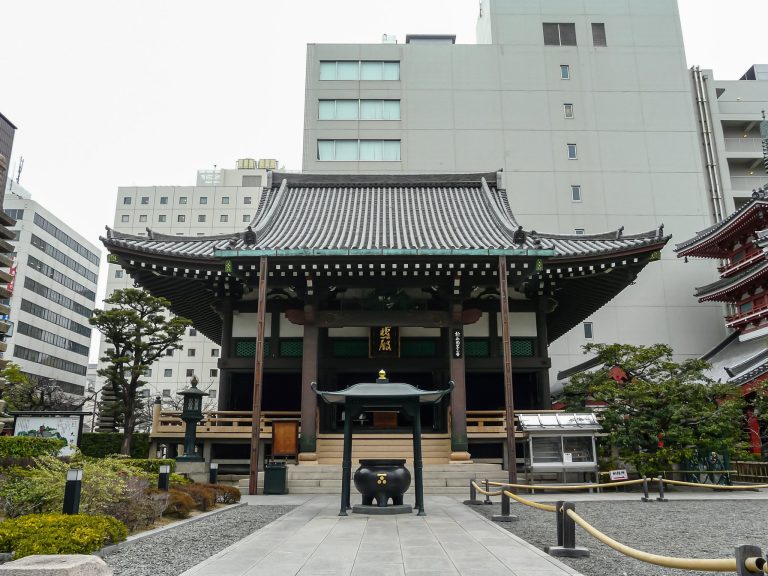
After the Second World War, the grounds were reduced again. In 1947, Kokubunji became independent as the head temple of the Shingon Kokubunji school. Its Showa-era Golden Hall was completed in 1965. The temple is also associated with several pilgrimage networks, including the Eighty-Eight Settsu Kokubunji Pilgrimage, the Kinki Thirty-Six Fudo Sacred Sites, the Forty-Nine Saigoku Yakushi Sacred Sites, and the Osaka Thirteen Buddhas Pilgrimage.
Remains
The surviving temple complex occupies grounds that were substantially reduced during the Meiji period and again after the Second World War. Its principal image is a seated statue of Yakushi Nyorai, the Buddha associated with healing and medicine. The present buildings reflect both the temple’s postwar reconstruction and the earlier efforts to preserve its institutional identity after repeated destruction.
The former study-hall gate is the principal surviving structure from the wartime destruction of 1945 and now serves as the temple’s main gate. The 1897 hall dedicated to Emperor Shomu and its commemorative monument belong to the Meiji-period reorganization of the grounds. The present Golden Hall, completed in 1965, is a Showa-era reconstruction within the reduced postwar temple precinct.
Kokubunji is also associated with several traditionally attributed Buddhist images. The Illustrated Guide to Famous Places in Settsu connects an Amida image with Prince Shotoku and a Red Fudo image with Kukai. Amida is the Buddha of the Pure Land tradition, while Fudo is a wrathful Buddhist deity associated with immovable resolve and protection.