Shidami Kofun Group: Ancient Burial Mounds in Nagoya


Site at a Glance
- Rating
- 4
- Popularity
- Low
- Country
- Japan
- Primary era
- Classical
- External website
- Open
- Eras represented
- Classical, Medieval
- Civilizations
- Yamato
- Site type
- Burial
- Remains
- Necropolis
On this page15 sections
History
The Shidami Kofun group in Japan is a cluster of seven ancient burial mounds in present-day Nagoya, dating from the fourth to seventh centuries during the Kofun period, an era known for large burial mounds for elite members of Japanese society. The group lies in the Shidami area of Moriyama Ward and extends into adjacent parts of Seto, around the foothills of Mount Togokusan and along river terraces on both banks of the Shonai River.
Formation of the burial landscape
The wider Shidami area once contained more than 66 kofun, and its former total is also said to have exceeded 100. The surviving mounds represent a burial landscape that developed over several centuries, from the early fourth century through the latter half of the sixth century and into the seventh century. Its forms include keyhole-shaped, circular, scallop-shaped, and oblong mounds.
Several mounds traditionally carry associations with Yamato Takeru, a semi-legendary warrior prince in Japanese tradition. Shiratorizuka Kofun is one of several mounds in Japan that have been claimed as his grave, although the Shidami group’s historical value rests on its archaeological remains and long development as a regional cemetery.
Loss and preservation
Many kofun in the wider area disappeared after the land was used as an Imperial Japanese Army training ground before World War II. Further losses followed postwar land disposal, housing development, and planned urban redevelopment that reorganized land parcels and infrastructure. Thirty-three mounds survive in the broader area.
Shiratorizuka Kofun became a National Historic Site of Japan in 1972, a designation for cultural properties recognized for historical or archaeological importance. The protected area around it was expanded in 2008. On October 6, 2014, Owaribe Jinja Kofun, Naka-Yashiro Kofun, Minami-Yashiro Kofun, Shidami Ōtsuka Kofun, Kattezuka Kofun, and Tōgokusan Shirotori Kofun were added, and the designated property was formally named the Shidami Kofun group.
Archaeological investigation and interpretation
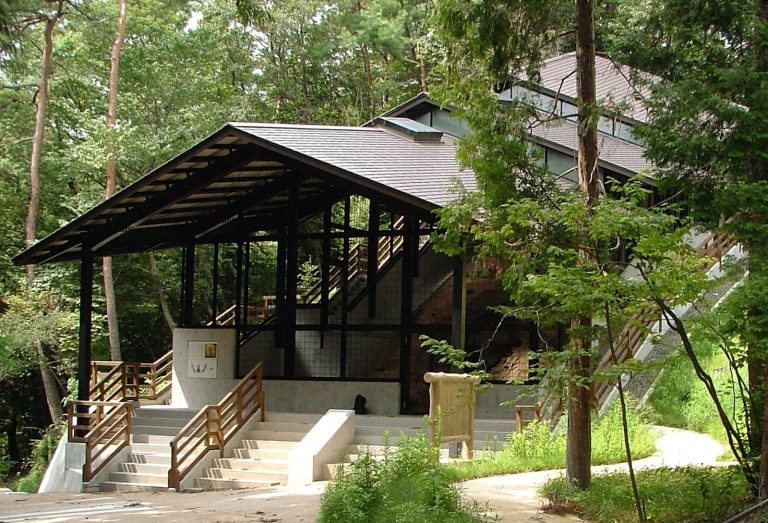
Nagoya began archaeological investigations in 2005 while developing the mounds and their surrounding natural environment as an archaeological park. The Experience! Shidami Kofun Group Museum opened as the park’s guidance facility on April 1, 2019. Investigations have continued to clarify the construction, dates, burial arrangements, and later treatment of individual mounds.
Shiratorizuka Kofun was surveyed by Nagoya University in 1969 and 2005, while an exploratory excavation in 1992 identified a moat beside the southeastern side of its square anterior section. During the Taishō period, from 1912 to 1926, part of the circular posterior section collapsed over an area of 1.8 square meters. A local antiquarian attempted to excavate the suspected burial-chamber location, but no discoveries were recorded.
Owaribe Jinja Kofun was the subject of an attempted robbery in 1935. The attempt encountered a large stone blocking the burial chamber, probably the ceiling stone of a below-ground pit-type stone chamber. The first exploratory archaeological survey followed in June 2008. Kyoto Imperial University excavated Shidami Ōtsuka Kofun in 1923 and recovered numerous grave goods. Resurveys in 1982 and 1983, followed by work from 2005 onward, revealed a second burial chamber and led to restoration of the mound’s presumed original appearance.
Tōgokusan Shirotori Kofun was investigated during the Taishō period and again in 1961, when additional grave goods were recovered. A C-shaped moat was identified in 2006. The Shidami Kofun group is sometimes treated separately from other mounds on Mount Togokusan. Related mounds shown in the site’s gallery include Tōgokusan No. 3, Tōgokusan No. 27, Tōgokusan No. 28-A, Tōgokusan No. 31, Shiratori No. 1, Ōtsuka Nos. 2 and 3, Higashi Okute, Nishi Okute, and Okute Nos. 3, 4, and 5. Tōgokusan No. 3 has been relocated.
Remains
The surviving mounds occupy foothill and river-terrace settings and display several forms used during the Kofun period. Their surfaces preserve or once carried fukiishi, stones applied to burial mounds, while haniwa, fired clay objects placed on or around mounds, provide evidence for construction dates and ritual display. The group also contains burial chambers, moats, grave goods, and later structures that have altered some of the original mounds.
Early keyhole-shaped mounds
Shiratorizuka Kofun
Dating from the late fourth century, Shiratorizuka is the third-largest kofun in Aichi Prefecture. It is a keyhole-shaped mound with a square anterior end and a circular posterior end. The mound was originally faced with river stones, and white siliceous stones covered the summit of the posterior section, creating the appearance associated with a white bird. Most of those stones disappeared after the end of the Edo period, the era of Tokugawa rule from 1603 to 1868, but traces remain. The anterior section is distorted, although whether this resulted from construction or erosion remains uncertain.
Surveys established that Shiratorizuka was built in two tiers in its anterior portion and three tiers in its posterior portion. Its interior has not been excavated, so the suspected burial chamber remains unverified. No haniwa traces have been found.
Owaribe Jinja Kofun
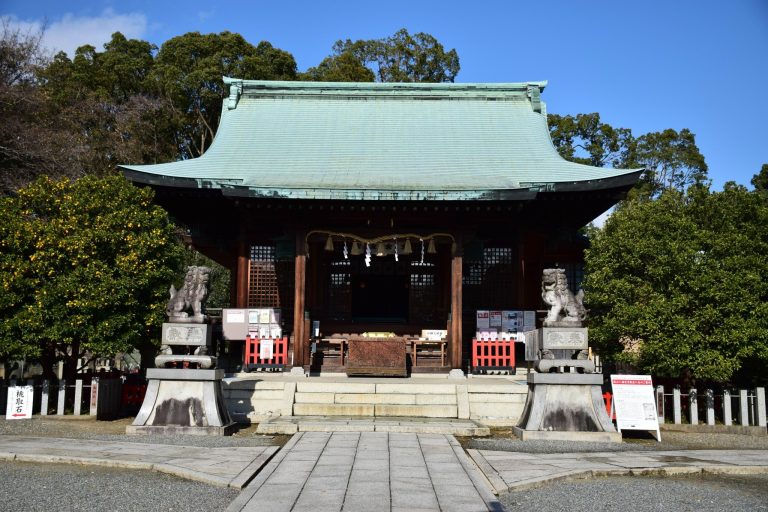
Owaribe Jinja Kofun is a circular mound beneath the main building of Owaribe Shrine. It measures 27.5 meters in diameter and is tentatively dated to the early fourth century. Its lack of haniwa and its fukiishi resemble those of Shiratorizuka. The mound may originally have been keyhole-shaped, with its rectangular anterior section later lost.
The 2008 survey identified two construction steps. Most of the second step had been flattened when the shrine was built. The first rises about 2 meters above the mound’s base, with slopes of 30 to 35 degrees covered mainly by gravel fukiishi. Base stones measure about 30 centimeters across, with 10 to 20 centimeters of gravel above them. A first terrace, 1.2 to 1.4 meters wide, was covered with quartz gravel. From the second step, approximately 30-centimeter base stones and part of the material above them survive.
Naka-Yashiro Kofun
Within the grounds of Owaribe Shrine, Naka-Yashiro Kofun forms a 63.5-meter-long keyhole-shaped mound. It has fukiishi and cylindrical haniwa, the oldest cylindrical examples found in the Tōkai region. Their strong southeastern Nara influence supports a construction date in the middle of the fourth century, later than Owaribe Jinja Kofun.
Minami-Yashiro Kofun
Minami-Yashiro Kofun is a circular mound, 30 meters in diameter, also within the Owaribe Shrine grounds. Fukiishi and haniwa survive, and the mound may originally have been keyhole-shaped. Analysis indicates that its haniwa were made at the same location and around the same time as those from Naka-Yashiro Kofun, supporting a date in the middle of the fourth century.
Scallop-shaped mounds
Shidami Ōtsuka Kofun
Shidami Ōtsuka Kofun is a 55-meter-long scallop-shaped mound oriented toward the northeast. Fukiishi cover its surface, and numerous haniwa fragments have been recovered. A horseshoe-shaped mound surrounds most of the tumulus. Its grave goods include a bronze mirror fitted with five small bronze bells, bird- and house-shaped haniwa, iron weapons and tools, and armor.
A second burial chamber measures 5.8 by 3 meters. Vermilion pigment and lacquer in its soil indicate that the chamber once held a red-painted wooden casket. The mound was restored to the appearance archaeologists believe it originally possessed after the second chamber was found during later surveys.
Kattezuka Kofun
Kattezuka Kofun is a 53-meter-long scallop-shaped mound whose summit is occupied by a small Shinto shrine, a place of worship dedicated to revered beings or forces known as kami. The mound shows two-tier construction. Cylindrical haniwa and fragments of Sue ware, a high-fired gray pottery tradition associated with ancient Japanese and Korean-influenced kiln technology, indicate a date from the fifth to the early sixth century. Its interior has not been excavated.
A double moat once surrounded Kattezuka. Parts of the inner moat survive on the western and northern sides, preserving evidence of the mound’s original perimeter.
Late sixth-century stone burial chamber
Tōgokusan Shirotori Kofun
Tōgokusan Shirotori Kofun is an oblong mound measuring 17.5 meters from east to west and 16.5 meters from north to south, with a height of 3.5 meters. It lies among eight mounds along Japan National Route 155 and is the largest of them. A corridor 3.2 meters long leads westward to its stone burial chamber.
The mound is believed to date from the latter half of the sixth century and preserves an almost complete stone chamber. Grave goods include earthenware, magatama, curved stone or glass ornaments, iron weapons and implements, Sue ware, and Haji ware, a generally reddish and unglazed earthenware tradition. Many of these objects are held at the Nagoya City Museum.
A lattice door has been installed and locked in front of the stone chamber, leaving its interior normally inaccessible. The mound formerly had a C-shaped moat approximately 4.5 meters wide, part of the physical arrangement that surrounded the burial monument.