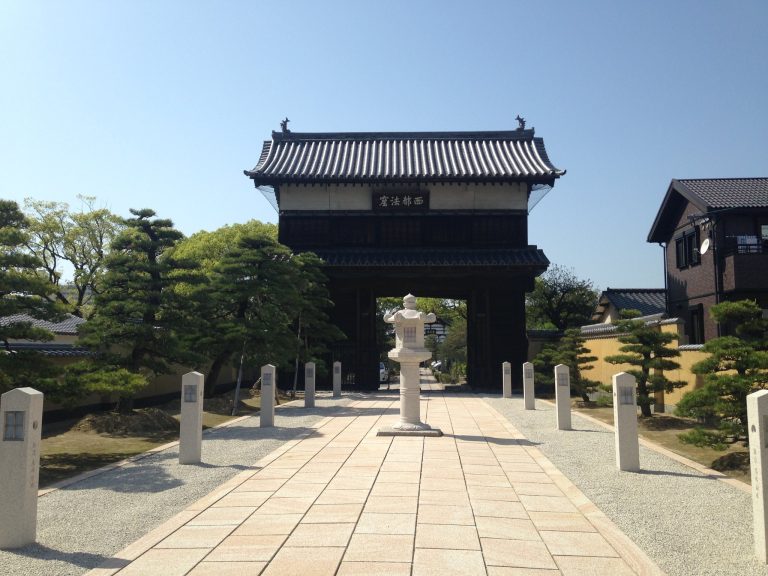
Sumiyoshi Shrine: A Maritime Shinto Shrine in Fukuoka


Site at a Glance
- Rating
- 4.5
- Popularity
- Very Low
- Country
- Japan
- Primary era
- Early Modern
- External website
- Open
- Eras represented
- Medieval, Early Modern, Modern
- Civilizations
- Japanese, Tokugawa
- Site type
- Religious
- Remains
- Sanctuary
On this page16 sections
History
Sumiyoshi Shrine is a Shinto shrine in Hakata, Fukuoka, Japan, traditionally regarded as the birthplace of the Sumiyoshi cult and the origin of more than 2,000 Sumiyoshi shrines across Japan. Its foundation date is unknown, but shrine tradition places its establishment in antiquity and identifies the site with Awagihara, the mythical place where the three Sumiyoshi deities were born.
Origins and Maritime Worship
The shrine’s principal kami, or Shinto deities, are Sokotsutsu-no-o, Nakatsutsu-no-o, and Uwatsutsu-no-o. These three sea and navigation deities were invoked for protection during voyages and were associated with the maritime and military activities of the Yamato court. The tradition linking them with Empress Jingu, a legendary imperial figure associated in early chronicles with an expedition to the Korean Peninsula, became central to the shrine’s religious identity.
One foundation tradition interprets a passage about Empress Jingu appointing an official to serve as priest of the Sumiyoshi deity as referring to this shrine. On that traditional understanding, Sumiyoshi Shrine was the earliest of the major Sumiyoshi shrines, although this identification is a religious tradition rather than a securely established historical fact.
The shrine stood on a cape projecting into the former mouth of the Naka and Hie rivers, a setting considered appropriate for worship of a navigation deity. An ancient reference to a maritime settlement called Amabe Township and the discovery of Yayoi-period bronze weapons have supported the theory that the area was an ancient sacred place of maritime communities associated with Nakoku. Another tradition places a predecessor at Arahitogami Shrine farther upstream on the Naka River and explains the move downstream as a response to the retreat of the coastline. A separate interpretation connects the two shrines through the ancient settlements and ritual landscape between them, including the Sugu-Okamoto archaeological complex.
Ancient Sumiyoshi shrines were situated in Chikuzen, Settsu, Harima, Nagato, Iki, and Tsushima, locations associated with routes toward the Korean Peninsula. Their distribution has been interpreted as evidence that these shrines served as strategic sites within a state cult of maritime protection.
Recognition by the Court
Sumiyoshi Shrine first appears in historical documentation in 737, when offerings were made to “Chikushi Sumiyoshi” after the court was informed of Silla’s disrespect. Silla was a Korean kingdom that maintained changing diplomatic and military relations with the Japanese court. In 806, thirty-six tax households in Chikuzen, the ancient province corresponding broadly to northern Fukuoka Prefecture, were assigned to support the Sumiyoshi deity.
The shrine also retained connections with Buddhist religious practice. The monks Ennin and Enchin recited Buddhist sutras there in 847 and 852 respectively while undertaking missions to Tang China. In 859, the Chikuzen Sumiyoshi deity received the rank of Junior Fifth Rank, Lower Grade. In 878, court offerings followed an oracle at Kashii Shrine warning of hostile forces from Silla.
The Engishiki, an early tenth-century compilation of court regulations and shrine registers, lists three Sumiyoshi seats in Naka District of Chikuzen as major shrines classified as Myojin Taisha. This was a major shrine category within the court register. The shrine continued to possess a state-related religious status in the late Heian period, receiving an offering associated with Emperor Go-Ichijo in 1019. In 1119, the date of a shrine transfer was submitted for official consideration.
Medieval Status and Early Modern Rebuilding
A chief priest served the shrine by 979. The Saeki family supplied priests connected with Minamoto no Yoritomo, and the office later passed through descendants of the Saeki family in the Yokota family. The shrine estate, known as Sumiyoshi Estate, successively belonged to the retired Emperor Go-Shirakawa, the Sen’yomon-in estate, the Fushimi-in estate, and the imperial household.
From the medieval period, and explicitly in a document of 1334, Sumiyoshi Shrine was recognized as the ichinomiya, or highest-ranking shrine, of Chikuzen Province. Its vermilion torii appears in Takezaki Suenaga’s Mongol Invasion Scrolls. In 1480, the renga poet Sogi visited the shrine and described its wartime devastation in his Tsukushi Travel Diary.
During the Sengoku period, shrine documents sent to the western Japanese warlord Ouchi Yoshitaka in Yamaguchi were lost in the Tainei-ji Incident of 1551. In the Edo period, Kuroda Nagamasa, the first lord of the Fukuoka domain, gave 2,000 units of silver in 1623 for the shrine’s reconstruction. The main hall built during that rebuilding remains the principal historic building of the precinct.
Kuroda Mitsuyuki granted the shrine an estate of 30 koku in 1683, and Kuroda Nariyoshi added 20 koku in 1816, bringing the total to 50 koku. The affiliated Buddhist temple at this time was Shoka-san Enpukuji. In 1833, chief priest Yokota Orie sought the restoration of Shinto-style rites that the Fukuoka domain had prohibited. After appealing to the Ichijo family in Kyoto with other senior shrine priests, he was ordered to return, arrested, forced to retire, and confined under house arrest.
Modern Religious and Archaeological History
After the Meiji Restoration, the shrine became a Prefectural Shrine in 1872. In 1925, it was promoted to an Imperial shrine of the third rank, or Kanpei-shosha, a category of shrine receiving offerings through the imperial government’s modern ranked-shrine system. After the Second World War, it became a Beppyo Shrine under the Association of Shinto Shrines.
Archaeological excavations around the precinct began in 2004. Three investigations completed by 2014 revealed residential remains dating from the medieval period into the early modern period, together with ritual artifacts. The orientation of the residential plots corresponds to that of the present main hall and can be traced back to the first half of the medieval period.
The shrine has two sessha and six massha, making eight subordinate shrines in total. These are connected to the principal shrine or form part of its religious sphere. Its annual observances include the October 12 to 14 Sumo Festival, the most important festival of the shrine. Tradition connects it with sumo and mounted archery performed by Empress Jingu after her return from Korea in gratitude for the aid of the Sumiyoshi deity. Modern rites include mounted archery and boys’ sumo.
Other festivals reflect the shrine’s maritime and agricultural associations. The Ota Festival on March 7 uses sowing rites to petition for abundant harvests. The Shiohi Festival on April 3 traditionally seeks safe navigation and good fishing; its procession was formerly conducted by boat because the shrine faced the sea, but it is now held on land. The Nagoshi Grand Festival, held from July 30 to August 1, commemorates the purification during which the Sumiyoshi deities were born and includes a ring of miscanthus and human-shaped offerings used to remove pollution. The Tsuina Festival on January 7 includes rites for expelling evil, while the Hosha Festival on November 7, traditionally linked to the imperial offering of 878, petitions for national protection through archery performed before the shrine.
Remains
The precinct covers 8,107 tsubo, approximately 2.68 hectares, on alluvial land formed by the Naka River. This ground differs from much of Hakata, which stands on sand dunes. The surviving complex brings together the seventeenth-century main hall, associated worship and ritual buildings, subordinate shrines, gates, and a modern Noh theater.
Main Shrine Buildings
Main Hall
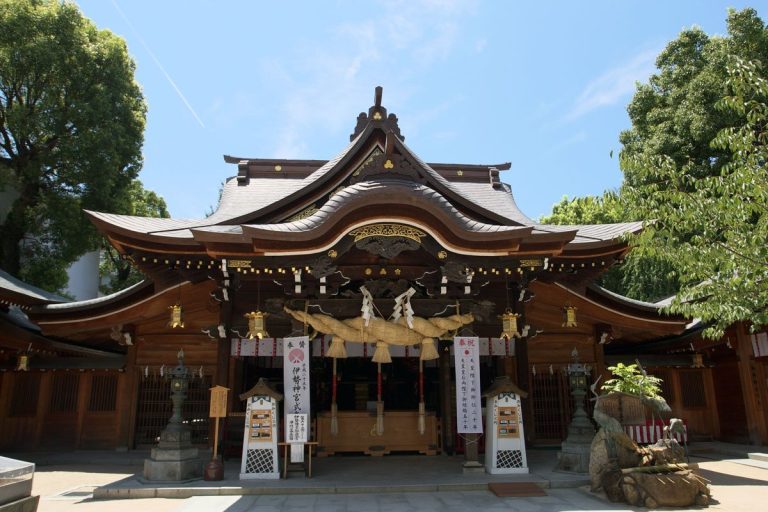
Built in 1623 under Kuroda Nagamasa, the main hall follows the Sumiyoshi-zukuri style, an archaic shrine form with a simple gabled shape and strongly linear roof silhouette. It measures four bays along its depth and two bays across its frontage and has a roof covered with layers of cypress bark. Its roof, triangular gables, forked finials, and three decorative roof logs use notably straight lines, giving the building an archaic architectural appearance.
Vermilion-painted pillars contrast with white-painted board walls. The building belongs to one of the old shrine-building types, alongside Shinmei-zukuri and Taisha-zukuri. It has been designated a National Important Cultural Property since 1922.
Worship Hall
The worship hall stands in front of the main hall. It is an irimoya-zukuri building, a form combining a gabled central roof with additional sloping sections, and its roof is covered with copper sheets.
Other Historic Buildings
The precinct also contains an Edo-period karamon gate, a gate with a curved gable roof, as well as a kagura hall, a shrine gate, and other shrine buildings.
Noh Theater and Subordinate Shrines
Noh Theater
On the southern side of the precinct, the Noh Theater was planned from 1935 after the Noh hall at Kego Shrine in central Fukuoka had become dilapidated. Completed at Sumiyoshi Shrine in 1938, it has an irimoya roof, an entrance in the gable end, and a corrugated iron roof. Its combination of Japanese traditional and Western-influenced forms makes it a modern Japanese-style building. The theater is designated a Fukuoka City tangible cultural property.
Affiliated Shrines
Funatama Shrine, one of the principal affiliated shrines, enshrines Sarutahiko and holds its festival on September 9. Shiga Shrine enshrines the three Watatsumi sea deities and holds its festival on June 1. Other subordinate shrines are dedicated to Sukunahikona, Inari, Ebisu, Sugawara no Michizane at a shrine also called Tenmangu, Kakinomoto no Hitomaro at Hitomaru Shrine, and Izanagi at Amatsu Shrine outside the western gate.
Archaeological and Documentary Remains
Yayoi Bronze Weapons
Six Yayoi-period bronze dagger-axes and five bronze spears are traditionally said to have been excavated behind the shrine buildings. Their precise findspots and archaeological contexts are unknown. The medium-narrow dagger-axes measure approximately 34 centimeters in length, and the objects were designated Fukuoka Prefecture tangible cultural properties in 1958.
Buddhist Images and Documents
The shrine formerly preserved a wooden seated image of the Buddha of Healing and standing images of the Twelve Divine Generals. These Buddhist images are now held by the Fukuoka City Museum. Surviving documentary material includes twenty-seven documents dating from the Kamakura period onward. The late-Kamakura Shoka Poetry Collection, Volume Five, is also associated with the site, and both the shrine documents and poetry collection are designated Fukuoka City cultural properties.