Takidani Fudō Myōō-ji Temple: A Shingon Buddhist Temple in Japan


Site at a Glance
- Rating
- 4.4
- Popularity
- Medium
- Country
- Japan
- Primary era
- Early Modern
- External website
- Open
- Eras represented
- Early Modern
- Civilizations
- Tokugawa
- Site type
- Religious
- Remains
- Temple
On this page7 sections
History
Takidani Fudō Myōō-ji Temple is a Japanese temple of the Chisan branch of Shingon Buddhism in Tondabayashi, Japan, traditionally founded in 821. Its mountain name is Takidani-san, its formal name is Myōō-ji, and it is commonly known as Takidani Fudō. The temple is associated with Fudō Myōō, a Buddhist deity representing immovable resolve, protection, and the defeat of spiritual obstacles.
Traditional Foundation
Temple tradition connects the foundation with Kūkai, the monk who established the Shingon school of esoteric Buddhism in Japan. While practising at Ryūsen-ji, he is said to have carved images of Fudō Myōō and his attendants, Kongara-dōji and Seitaka-dōji, while praying for peace in the country and the welfare of all people. Halls were then built to house the three figures. This traditional foundation story is separate from the later dates of the surviving sculptures.
The original temple stood on the middle slope of Mount Dake, about one kilometre south of the present site. It was traditionally described as a complete temple compound with extensive and elegant halls. During the Nanboku-chō period, the era of rival Northern and Southern imperial courts in fourteenth-century Japan, the military commander Kusunoki Masashige built Mount Dake Castle on the mountain and revered the temple’s Fudō Myōō as a guardian image.
Warfare and Relocation
In 1360, Ashikaga Yoshiakira, the second shōgun of the Ashikaga shogunate, attacked Mount Dake Castle and Kontai-ji Castle. The fighting destroyed the temple buildings by fire. Tradition holds that the three Buddhist images were carried beneath a waterfall, where they survived the destruction.
After the fire, a blind elderly monk is said to have preached the miraculous power of the Fudō image and established a small worship hall. The story says that he later regained his sight and disappeared. The tradition identifies him either as an incarnation of Kūkai or as a figure who revealed the image’s healing power. This account helped establish the temple’s enduring association with the treatment of eye diseases.
The temple was drawn into the Siege of Mount Dake Castle during the conflict between the rival Hatakeyama leaders Masanaga and Yoshinari. The siege began in December 1460, and the temple burned in 1463. It was later moved to its present location and rebuilt during the Keichō period, which lasted from 1596 to 1615.
Religious Role and Recognition
Daily prayers continue at the temple, including goma fire rituals in which offerings are burned before a sacred fire while prayers are recited. These rites address concerns such as averting misfortune and encouraging commercial prosperity. The Hōraku-den, a prayer hall within the grounds, is used for traffic-safety rites for vehicles and worshippers. An eye-disease-healing amulet called the Clear-Sight Amulet is offered in connection with the traditional healing benefit of Fudō Myōō.
Takidani Fudō is regarded as one of Japan’s Three Great Fudō sites, a traditional grouping whose membership varies among different traditions. The temple is also the thirty-second site on the Kinki Thirty-six Fudō Pilgrimage and the twelfth site on the Kawachi Asuka Ancient Temples Pilgrimage. Its principal Fudō Myōō and the accompanying Kongara-dōji and Seitaka-dōji are designated Important Cultural Properties of Japan, a national category for cultural properties judged to possess substantial historical, artistic, or cultural value.
Remains
Temple Grounds and Surviving Buildings
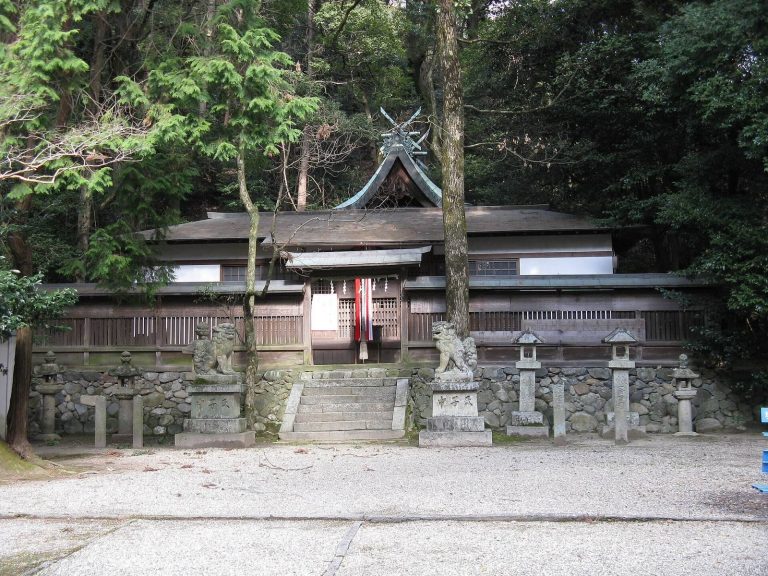
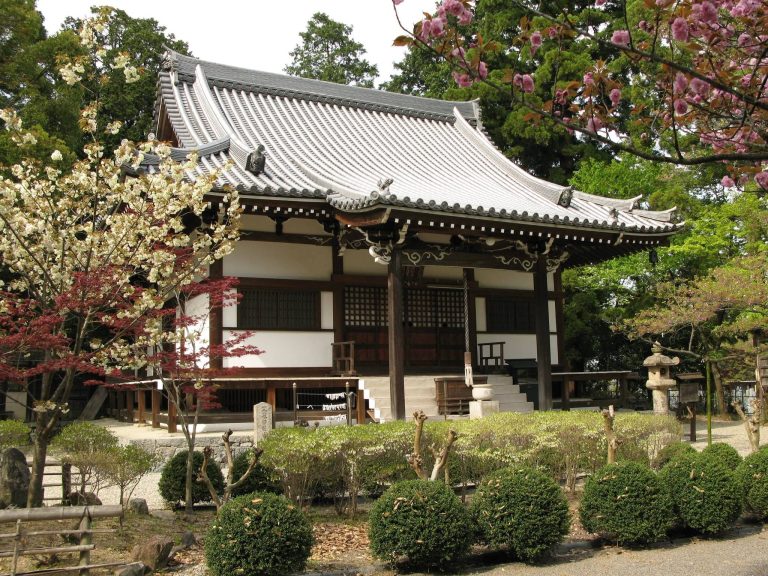
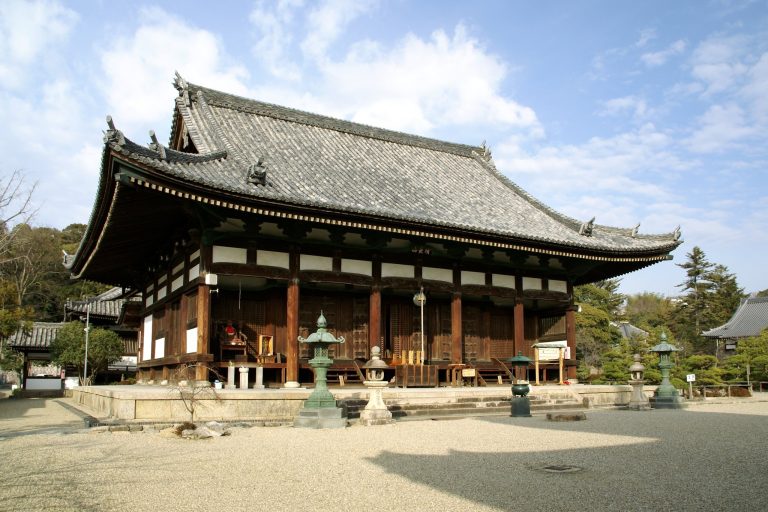
The present temple occupies the site to which the institution was relocated during the Keichō period and rebuilt after the destruction of its earlier compound. The original complex on Mount Dake was traditionally described as a group of large, graceful halls, while a two-bay square worship hall was reportedly erected beneath the waterfall after the 1360 fire to shelter the preserved images. At the present temple, the Hōraku-den remains a prayer hall used for traffic-safety ceremonies.
Late Heian Sculptures
The central image is Fudō Myōō, flanked by standing figures of Kongara-dōji and Seitaka-dōji, attendants commonly represented with the deity. Although tradition attributes all three sculptures to Kūkai, the surviving works belong to the late Heian period, around the end of the eleventh century. The late Heian era ended in 1185, so these statues predate the temple’s traditional 821 foundation date.
Repairs and dismantling in 1958 revealed dates preserved inside the sculptures. An ink inscription inside Fudō Myōō bears the year 1094, while a piece of paper inside Kongara-dōji carries the year 1097. Together, these findings place completion of the group around 1094 to 1097. The figures were made with the ichiboku-warihagi method, in which most of each statue was carved from one block of wood, split from front to back, hollowed inside, and then rejoined. The three Important Cultural Properties preserve this late Heian sculptural ensemble at the heart of the temple’s religious identity.