Kuroi Castle: A Sengoku-Period Mountain Fortress in Japan


Site at a Glance
- Rating
- 4.7
- Popularity
- Very Low
- Country
- Japan
- Primary era
- Medieval
- External website
- Open
- Eras represented
- Medieval
- Civilizations
- Ashikaga shogunate
- Site type
- Military
- Remains
- Castle
On this page10 sections
History
Kuroi Castle, also known as Hogetsu Castle or Hōzuki Castle, was a Japanese mountain fortress on Mount Inokuchiyama in present-day Tamba City, Hyogo Prefecture. Traditionally associated with construction during the Kenmu era, around 1334–1338, it occupied a strategically important position in the Hikami Basin and remained in use for approximately 250 years.
Origins and the Akamatsu rule
Construction is traditionally linked to Akamatsu Sadamori. A record states that he received the Kasukabe estate in Tanba on December 12, 1335, and began building the castle at that time. The possibility that the mountain had not yet been fortified before this work has also been raised. The Kenmu era belonged to the early Muromachi period, the age of the Ashikaga shogunate, which is conventionally dated from 1336 to 1573.
The Akamatsu clan governed the surrounding area for about 120 years and across five generations. Their rule was probably exercised through successive local deputies rather than by direct administration from Kuroi Castle itself. Control later passed to the Ogino clan, described as a branch family of the Akai clan.
The Ogino and Akai lords
Kuroi was involved in regional warfare by the sixteenth century. During the battles of Yakami and Kanno-yama in 1526, a lord of Kuroi Castle named Akai Goro led 3,000 men in an attack on the rear of the army besieging Kanno-yama Castle. His relationship to the later Akai line remains uncertain.
During the Tenbun era, Ogino Akikiyo held the castle. Akai Naomasa, the son of Akai Tokie, had earlier been sent as a hostage to Ogino Masamoto, Akikiyo’s father. In 1554, Naomasa killed Akikiyo and seized Kuroi Castle, although the motive and exact circumstances are uncertain.
Naomasa used the name Ogino Naomasa for a period and was also known as Akuemon. He made Kuroi his stronghold and expanded the Akai sphere of power into western Tanba, Tajima, and Tango. He also substantially strengthened the castle. Naomasa supported the faction of Hosokawa Harumoto, a leading figure in the Muromachi-period political order, and continued fighting the Miyoshi clan after Harumoto’s death.
In 1565, Naomasa killed Matsunaga Nagayori, also known as Naitō Shōkatsu and the brother of Matsunaga Hisahide, near Waku Castle. The action helped eliminate anti-Hosokawa forces from Tanba. In 1570, Naomasa and Akai Tadaie submitted to Oda Nobunaga, the powerful warlord who sought to unify Japan, and received recognition of their control over three districts of northern Tanba.
Relations with Nobunaga’s sphere later deteriorated. After defeating forces led by Yamana Suketoyo at Yamagaki Castle, Naomasa captured Takeda Castle and advanced toward Konosumiyama Castle. These actions brought his expanding power into conflict with Nobunaga’s wider military ambitions.
The campaigns of Akechi Mitsuhide
In 1575, Nobunaga ordered his general Akechi Mitsuhide to conquer Tanba. Mitsuhide besieged Kuroi Castle for more than two months, but on January 15, 1576, forces led by Hatano Hideharu attacked his rear and forced a general retreat. The episode is associated with the tactic known as the Akai invitation strategy, in which the besieged side encouraged an attack that exposed the besieging army to a counterattack.
Mitsuhide began a second campaign in Tanba in October 1577. Naomasa died of illness on March 9, 1578, possibly from a disease known as a neck-cutting boil. Since Naomasa’s son Naoyoshi was still a child, Naomasa’s brother Akai Yukie became head of the Akai family and prepared Kuroi for further attacks.
During the renewed campaign, Mitsuhide built Kinzan Castle to sever communications between Kuroi and Yakami castles. Hashiba Hidenaga and Akechi Hidemitsu attacked the western and eastern parts of Hikami District and secured Kuroi’s subsidiary castles. After Yakami Castle fell on June 1, 1579, Kuroi Castle fell approximately two months later, on August 9.
Later occupation and abandonment
Mitsuhide placed his senior retainer Saitō Toshimitsu in charge of the district and made him lord of Kuroi Castle. Toshimitsu’s daughter Fuku was born in the castle’s associated lower residence. She later became wet nurse to Tokugawa Iemitsu, the third shogun of the Tokugawa shogunate, and was known as Lady Kasuga.
After Mitsuhide’s defeat at the Battle of Yamazaki in 1582, his authority was removed from Tanba. Horio Yoshiharu, a retainer of Hashiba Hideyoshi, then entered Kuroi Castle. During the Battle of Komaki and Nagakute in 1584, Akai Tokinao occupied Kuroi and Yoden castles in cooperation with Tokugawa Ieyasu. Kuroi was ultimately abandoned, probably by the early seventeenth century.
Kuroi Castle was designated a National Historic Site on August 11, 1989. In 2017, it was selected as site number 163 in the Continued Top 100 Japanese Castles.
Remains
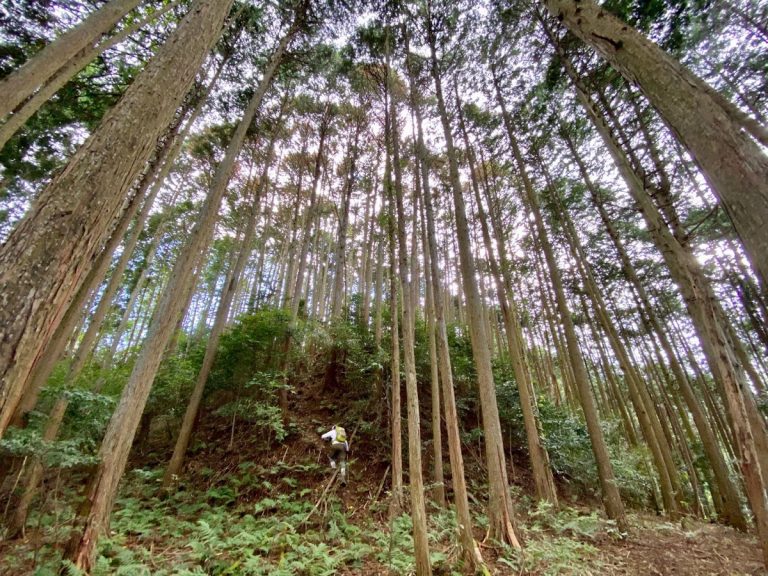
Kuroi Castle occupied the summit and three ridges of Mount Inokuchiyama, a mountain approximately 350 to 356 meters high in the middle of the Hikami Basin. Rivers protected the mountain on three sides, and the entire mountain was incorporated into the fortress. The surviving remains consist chiefly of stone walls, dry moats, cut ditches, earthen ramparts, enclosure traces, and related earthworks.
Summit enclosures
The summit complex is arranged along a northwest–southeast axis. Its principal enclosures are the Honmaru, or main enclosure, measuring approximately 48 by 22 meters; the Ninomaru, or second enclosure, measuring about 40 by 19 meters; and the Sannomaru, or third enclosure, measuring about 28 by 23 meters. Together with surrounding features, the principal summit enclosure extends approximately 170 meters from east to west and 45 meters from north to south. Its combination of enclosures, masonry, and substantial building traces has been interpreted as showing characteristics of an early-modern castle.
The East Enclosure measures approximately 25 by 15 meters, while the West Enclosure is about 10 by 30 meters. Belt enclosures, which follow the contours around another enclosure, lie between them and range from approximately 3 to 10 meters in width. Stone walls occur at the main entrance, the Ninomaru, the Honmaru, and other parts of the summit. Roughly piled fieldstone forms most of the masonry, while the corners use carefully arranged corner stones. These walls are generally attributed to the Tenshō era of the late sixteenth century.
Lower defenses and water facilities
Numerous lower enclosures reinforced the summit defenses. They include the Kitanomaru, Nishinomaru, Mizu-no-te Enclosure, Taiko-no-dan, Ishifumi-no-dan, and Sandan Enclosures. Their arrangement developed from a linear mountain-castle plan toward a more concentric plan. This organization allowed movement and coordination between enclosures while also strengthening the defenses against attackers climbing from below.
Nishinomaru, also called Small Castle, extends approximately 200 meters northwest of the summit and is enclosed by four earthen ramparts. In its second enclosure from the bottom, the rampart has a horseshoe-shaped form, approximately 2.5 meters wide at the top and 1.5 meters high, or about 3 meters above the bottom of the cut. A central break creates a steep slope and a cut ditch. The feature served a western defensive role and has also been interpreted as a castle of last resort.
The Mizu-no-te Enclosure lies between Ishifumi-no-dan and Taiko-no-dan and collected spring water. Water facilities using horizontal tunnels have been identified on the north side of the summit and on the lower southern side. These features formed part of the mountain stronghold’s arrangements for retaining water within its defended area.
Lower residence and castle settlement
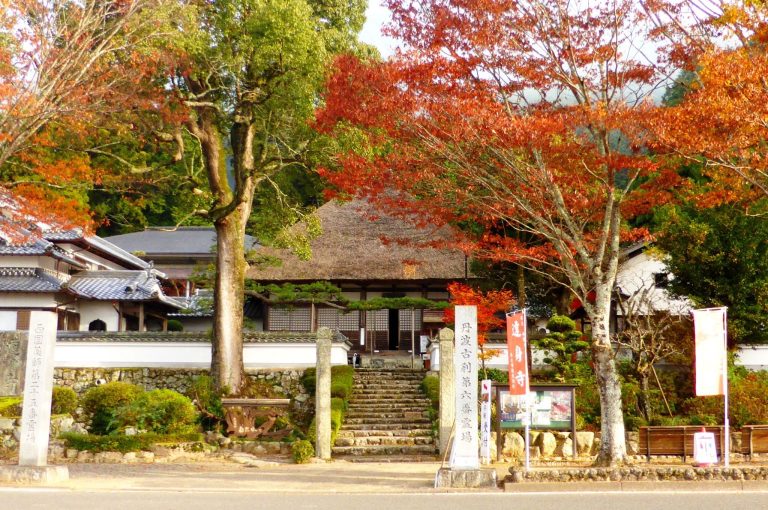
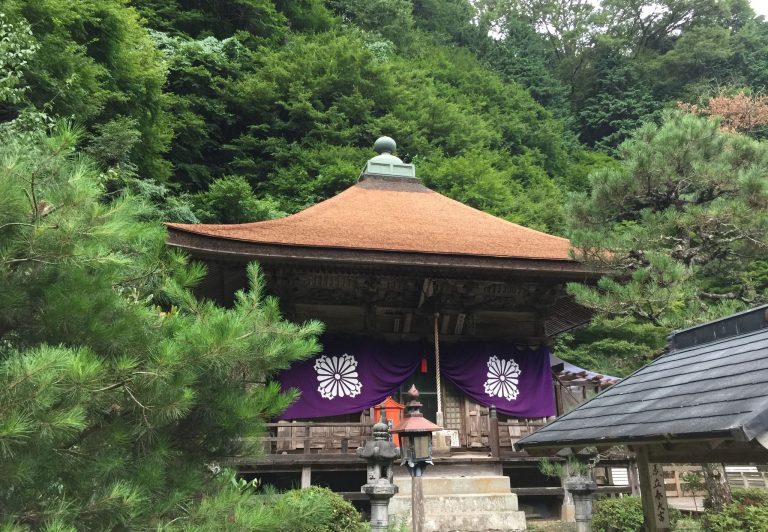
At the southern foot of the mountain, Kozenji occupies the presumed site of the Shimoyakata, or lower residence. The compound had a water moat and stone walls, making it more heavily fortified than an ordinary residence. It is associated with the residence where Fuku, later known as Lady Kasuga, was born.
The settlement below the castle included residences for retainers, craft workers, and merchants. Its many slopes and winding roads preserve the character of a Sengoku-period castle settlement. Sengoku castles were fortified residences and military centers used by regional warlords during Japan’s prolonged era of civil conflict, roughly from the fifteenth to the late sixteenth century. Local place-names connected with former castle facilities also survive in the surrounding area.
Outlying forts
Detached forts extended from the summit in a Y-shaped arrangement. Senjoji Fort lay to the northwest; Ryugahana Fort and Hyakken Baba lay to the northeast; and Matoba Fort and Higashiyama Fort extended to the southeast and east. Senjoji, Ryugahana, Matoba, and Higashiyama stood at roughly equal distances of about one kilometer from the summit and contained similar enclosure traces.
Ryugahana Fort had elongated enclosures on its eastern and western sides, together with a belt enclosure on the north. Senjoji Fort had a trapezoidal summit enclosure approximately 30 meters across, a belt enclosure on the northwestern slope, and a vertical ditch. The forts, lower enclosures, and summit complex formed a three-stage defensive system designed to resist attacks from different directions. Their broad distribution also created an outer defensive enceinte around the castle settlement.
Kuroi Castle survives as a mountain complex of interconnected earthworks and masonry. Its stone walls, dry moats, cut ditches, ramparts, and enclosure traces preserve the development of the fortress from a linear mountain-castle arrangement toward a more coordinated concentric defense. No castle tower or reconstructed building survives or has been erected.