Nagurumi Castle: A Sanada Mountain Fortress in Japan


Site at a Glance
- Rating
- 4.2
- Popularity
- Low
- Country
- Japan
- Primary era
- Early Modern
- Eras represented
- Early Modern
- Civilizations
- Takeda
- Site type
- Military
- Remains
- Castle
On this page10 sections
History
Nagurumi Castle is a sixteenth-century Japanese mountain castle in Minakami, Japan, built in 1579 as a Sanada forward base against the Later Hōjō clan. Positioned in the upper Tone River region, it became closely connected with the Sanada family’s campaign to control Numata and is historically renowned for the seizure that helped provoke Toyotomi Hideyoshi’s 1590 campaign against Odawara.
Origins and Sanada Expansion
Local tradition places the site’s earliest phase in 1492, when the Numata clan built Nagurumi-yakata as an outpost of Numata Castle. Documentary evidence instead identifies the construction of Nagurumi Castle in 1579. After Takeda Katsuyori received territory in eastern Kōzuke through the Kōetsu Alliance, a military and political agreement between the Takeda and Uesugi houses, he ordered his retainer Sanada Masayuki to establish a forward base in the area.
Masayuki and Ogawa Kayusai of nearby Ogawa Castle captured Nagurumi-yakata and built the castle beside it. Masayuki then used Nagurumi Castle as a base for a campaign to secure Numata Castle, which he eventually obtained through political intrigue.
Conflict over the Numata Territory
After the Takeda clan fell in 1582, the Tenshō-Jingo War, a conflict over territory in central Japan, ended. The independent Sanada and Later Hōjō clans then disputed the Numata and Agatsuma territories. Nagurumi Castle served as an important Sanada outpost of Numata Castle and repelled Later Hōjō forces attacking the Numata domain.
In 1587, Toyotomi Hideyoshi, the military ruler who sought to place regional disputes under central authority, issued the sōbujirei, an edict prohibiting private warfare among regional lords. The Tokugawa, Later Hōjō, and Sanada clans consequently submitted to Hideyoshi’s authority.
A settlement in 1589 assigned the Sanada clan the area west of the Tone River, including Nagurumi Castle, together with the western one-third of the territory on the left bank of the Akaya River. The Later Hōjō clan received the eastern area, including Numata Castle and the remaining two-thirds around Ogawa Castle. The division reflected Masayuki’s claim that the territory was the Sanada clan’s ancestral burial land.
In July 1589, Hideyoshi’s retainers Tsuda Moritsugu and Tomita Ippaku, together with Tokugawa Ieyasu’s retainer Sakakibara Yasumasa, supervised the transfer of Numata Castle to the Later Hōjō clan. The Sanada clan received Minowa in Shinano Province as compensation for the territory it surrendered.
The Seizure of 1589
On 3 November 1589, Inomata Kuninori, a Hōjō retainer and castellan of Numata Castle, induced Nakayama Kurobei, a retainer of Nagurumi Castle’s Sanada-appointed commander Suzuki Shigenori, to defect. Using a forged letter, Kuninori lured Shigenori to Ueda Castle and occupied Nagurumi Castle in his absence.
Shigenori discovered the stratagem while passing through Iwabitsu Castle, but he could not return in time. He committed ritual suicide at Shōkakuji Temple. Masayuki immediately appealed to Hideyoshi through his political intermediary, Tokugawa Ieyasu. In a letter dated 21 November 1589, Hideyoshi stated that he would not pardon the Later Hōjō clan, even if it submitted, until those responsible for taking the castle had been punished.
On 24 November, Hideyoshi distributed notices ending relations with the Later Hōjō. Hōjō officials refused to surrender and punish those responsible. On 7 December, Hōjō Ujinao denied responsibility, arguing that Nagurumi Castle had already been transferred to the Hōjō clan and therefore had not been seized. The dispute became a direct inducement for Hideyoshi’s campaign against Odawara.
Abandonment and Later Recognition
Hideyoshi launched the Odawara campaign in March 1590, destroying the Later Hōjō regime. The entire Numata territory was then confirmed to the Sanada clan, and Nagurumi Castle was abandoned. Its active use had lasted approximately ten years.
The ruins were designated a Gunma Prefectural Historic Site in 1949. In 2017, the site was selected as Castle No. 115 in the Continued Top 100 Japanese Castles and was developed as a historic site.
Remains
Mountain Layout and Earthworks
Linked Enclosures
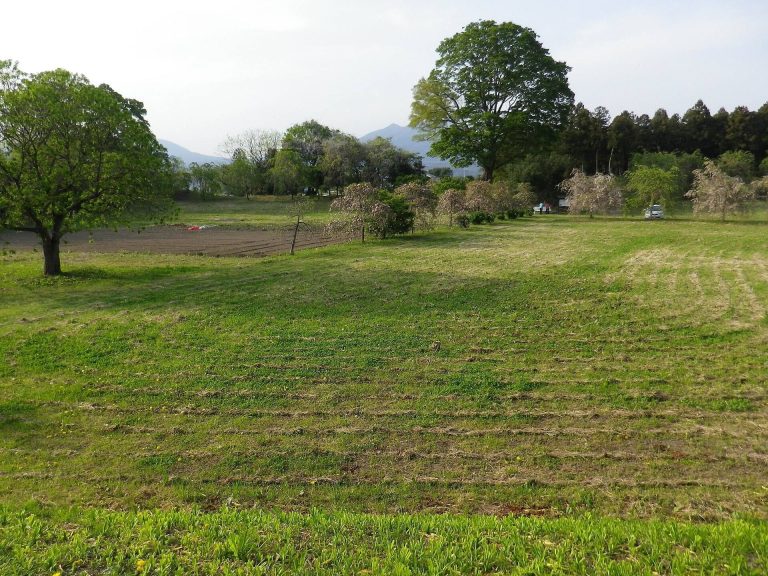
Nagurumi Castle occupies a cliff along the right bank of the upper Tone River. It is a mountain castle without a keep, and steep natural barriers flank both sides. Across the river to the northeast stood Meitokuji Castle. The principal enclosures follow a linear, linked arrangement, extending from a horse-sortie enclosure through the third enclosure, second enclosure, main enclosure, and Sasa enclosure.
Defensive Features and Excavated Foundations
The surviving site includes earthen ramparts, a crescent-shaped moat, entrances, and internal paths. Archaeological excavation identified foundations for gates and buildings supported by posts, helping define the construction and organization of the castle. The former Nagurumi-yakata is identified with the Hannya enclosure, which is now used as a parking area. Because the castle underwent little alteration after its abandonment, its original earthworks and other remains survive comparatively well, although the castle itself is ruinous.
Memorial Monument
A stone monument titled Monument to the Nagurumi Castle Ruins stands at the center of the main enclosure. The Nagurumi Castle Preservation Association erected it in March 1924, and Tokutomi Sohō wrote its inscription.