Tatsuno Castle: A Mountain Fortress and Domain Residence in Japan


Site at a Glance
- Rating
- 4
- Popularity
- Low
- Country
- Japan
- Primary era
- Early Modern
- External website
- Open
- Eras represented
- Early Modern
- Civilizations
- Tokugawa
- Site type
- Military
- Remains
- Castle
On this page10 sections
History
Tatsuno Castle is a historic castle in Tatsuno, Japan, founded in 1499 by Akamatsu Murahide of the Tatsuno Akamatsu clan. Its original form was a medieval mountain fortress on Mount Keirō, where it served as the clan’s base for controlling the Ittō and Issai districts of Harima Province.
The Akamatsu fortress
The Akamatsu had previously been based at Shioya Castle. After Murahide established Tatsuno Castle, the succession continued through Akamatsu Masahide, Hiro Sada, and Hirohide. The fortress remained associated with the Akamatsu until 1577, when Toyotomi Hideyoshi’s campaign to pacify Harima brought the castle into the sphere of the Toyotomi regime. The castle surrendered without a fight and passed to Hideyoshi. After Hideyoshi established Himeji Castle as his base, he appointed Hachisuka Masakatsu to Tatsuno.
Changes of lordship
Tatsuno then passed through several lordships during the political changes of the late sixteenth century. Fukushima Masanori held it from 1587 to 1589, followed by Kinoshita Katsutoshi from 1589 to 1594 and Koide Yoshimasa from 1594 to 1595. From 1595 to 1600, the castle was held as Toyotomi government land, with Ishikawa Mitsumoto serving as castle keeper.
The Ikeda family controlled Tatsuno from 1600 to 1617 through Terumasa, Toshitaka, and Mitsumasa, with Arao Narifusa and Ikeda Nagaaki serving as castle deputies. Honda Masatomo held the domain from 1617 to 1626, followed by Ogasawara Nagatsugu from 1626 to 1632, Okabe Nobukatsu from 1633 to 1636, and Kyōgoku Takakazu from 1637 to 1658.
The Wakizaka reconstruction
When Kyōgoku Takakazu was transferred to Marugame in 1658, the original castle was dismantled. In 1672, Wakizaka Yasumasa moved to Tatsuno from the Iida domain and rebuilt the castle at the foot of Mount Keirō. The hilltop fortress was abandoned, while the new complex centered on a residence and administrative headquarters in the lower area. This smaller fortified residence was a jinya, a domain headquarters generally less heavily fortified than a full castle.
The rebuilt castle was deliberately given a palace-like character rather than a strongly military appearance, reportedly to avoid arousing the suspicions of the shogunate. Wakizaka Yasumasa directed the construction and major changes. The Wakizaka family governed the Tatsuno domain for ten generations, from 1672 until 1871. They were medium-ranking tozama daimyō, territorial lords classified as outsiders by the Tokugawa shogunate, with an assessed income of 53,000 koku, a traditional rice-based measure of domain income.
Abolition and reconstruction
The castle was abolished in 1871 after the han domain system was ended. Its buildings were dismantled, and during the Meiji and Taishō periods the grounds were successively used for an old-style middle school and Hyōgo Prefectural Tatsuno Girls’ High School. Reconstruction began in the 1970s, including a major five-year project from 1975 and the rebuilding of the main palace in 1979. The work used period plans to restore a historical impression of the castle, although the reconstructed buildings were not exact replicas. Since 1988, the site has housed the Tatsuno Municipal Museum of History and Culture, while other parts of the grounds are occupied by public institutions. Tatsuno Castle is not designated as a historic site, but the former Ōte Gate, now the gate of Innenji Temple, is a designated municipal tangible cultural property.
Remains
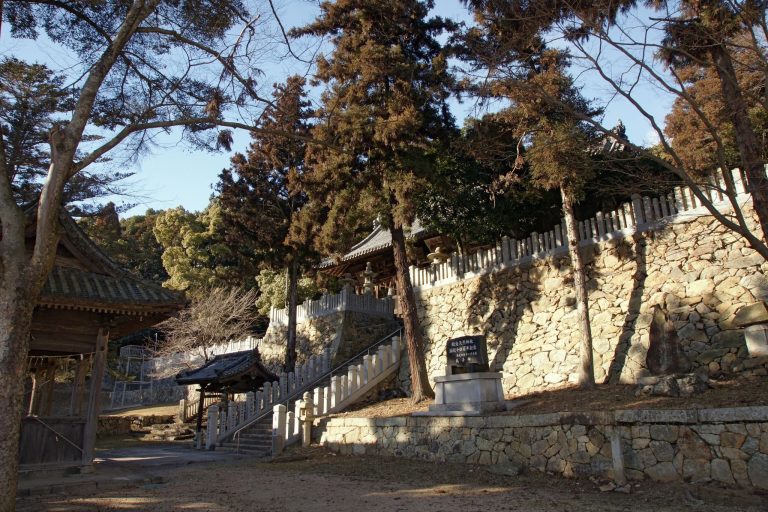
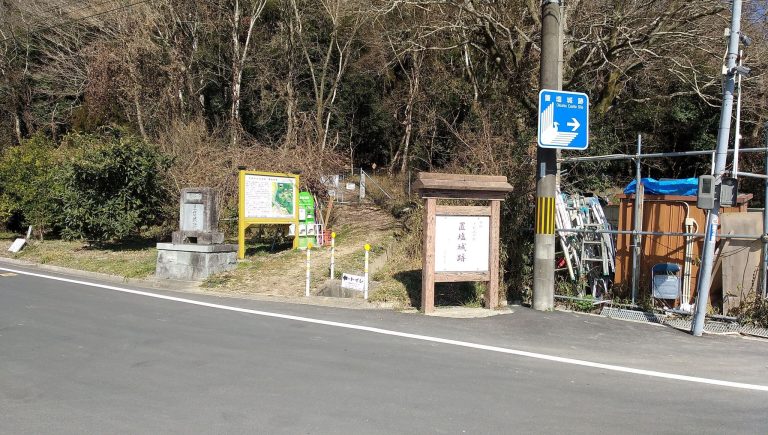
Tatsuno Castle occupies both the summit and lower slopes of Mount Keirō, although the surviving complex is centered on the foothill area developed after 1672. The original mountain fortress stood approximately 200 metres above sea level. The later enceinte included walls, moats, watchtowers, and residential buildings. Stone walls form the principal historical remains, while reconstructed buildings, gates, whitewashed walls, and sections of moat convey the organization of the later castle. The site had no main keep.
Mountain fortress and foothill complex
The first castle occupied the summit of Mount Keirō and functioned as a fortified base for the Akamatsu clan. After the Wakizaka rebuilding, the hilltop enclosures were no longer used. The castle instead spread across the lower slopes and foot of the mountain, where the residential complex and defensive works were arranged together. This change preserved the association with Mount Keirō while transforming the site from a mountain stronghold into a domain residence and administrative center.
Reconstructed castle buildings
The reconstructed Honmaru Palace forms the central palace element of the present complex. Other reconstructed features include a weapons tower, a corner tower, the Tamon Tower, the Uzumi Gate, additional gates and walls, and sections of moat. The Uzumi Gate is a small two-storey tower gate, and the reconstructed walls are whitewashed. Together these elements represent the palace-like character of the rebuilt castle rather than the heavily fortified appearance of the earlier summit fortress.
Upper residence and Jūentei
The restricted space around the main residence led to the construction of a secondary residence, or upper mansion, on the slope above it. The surviving Jūentei tea-house building and its associated garden belong to this upper-residence area. Wakizaka Yasuori, the ninth daimyō of the Wakizaka line, received the tea house from Emperor Kōmei and had it moved to Tatsuno in recognition of his major service as an administrator of Kyoto.
Relocated gates
The former East Gate was moved to Jōeiji Temple in Ibo River Town, where it survives as the temple gate. The former Ōte Gate was likewise relocated to Innenji Temple and now serves as that temple’s gate. The gates of Kōhenji Temple in Ibo River Town and Renkoji Temple in Jōzen, Taishi Town, are traditionally said to have been transferred from Tatsuno Castle, although their original positions within the castle are uncertain.