Tonokōri Castle: An Itō Clan Hill Fortress in Japan


Site at a Glance
- Rating
- 4.1
- Popularity
- Low
- Country
- Japan
- Primary era
- Medieval
- External website
- Open
- Eras represented
- Medieval
- Civilizations
- Ashikaga shogunate
- Site type
- Military
- Remains
- Castle
On this page12 sections
History
Tonokōri Castle was a Japanese hill castle in Saito, Miyazaki Prefecture, Japan, built by the Itō clan in 1337 in the yamajiro tradition of castles established on hills or mountains. Also known as Ukibune Castle, it formed part of the Itō network of 48 fortifications in Hyūga Province and stood with Sadowara Castle as one of the clan’s principal strongholds.
Foundation and Itō rule
Itō Sukemochi, head of the main Itō family, established the castle after Ashikaga Takauji granted him estates in the area. Construction is associated with 1335 or 1337, with 1337 specifically given as the foundation date. Under Sukemochi’s son, Itō Sukeshige, the stronghold was substantially rebuilt and became the principal base of the Itō clan.
From the Nanboku-chō period, the fourteenth-century conflict between rival Northern and Southern Imperial Courts, through the Sengoku period of competing regional warlords, the Itō expanded their control across much of Hyūga. Tonokōri served as the base from which this regional power developed.
Warfare and changing control
The castle suffered four fires caused by warfare and accidents. On March 5, 1504, a fire that began within the castle spread into the castle town, destroying most of its buildings and equipment.
In 1577, the Itō were defeated by Shimazu Yoshihisa at the Battle of Kizaki and driven from Hyūga with assistance from Ōtomo Sōrin, a Christian-converted regional warlord in northern Kyushu. The Shimazu then occupied Tonokōri. The castle later served as a forward base during Toyotomi Hideyoshi’s campaign in Kyushu and the Battle of Taka Castle.
Abandonment and later memory
After the Shimazu defeat at the Battle of Neshirasaka, the clan was expelled from Hyūga, leaving Tonokōri without a lord and effectively abandoned. During the Edo period, the site came within Sadowara Domain, ruled by a cadet branch of the Shimazu family.
The Tokugawa shogunate formally abandoned the castle in 1615 under its one-castle-per-domain policy, which required each feudal domain to retain only one principal castle. The main Itō house subsequently ruled Obi Domain from Obi Castle.
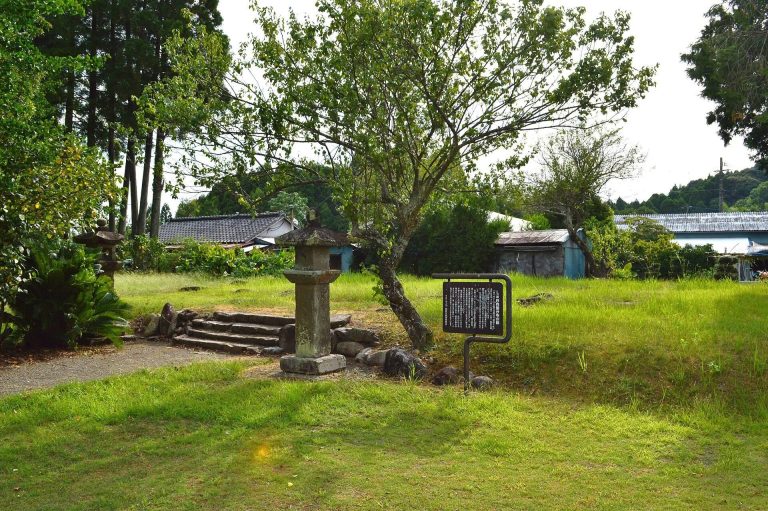
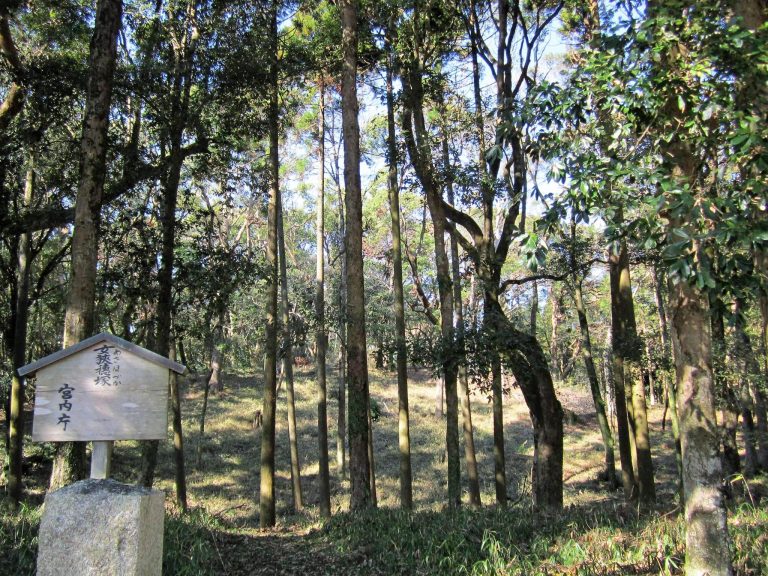
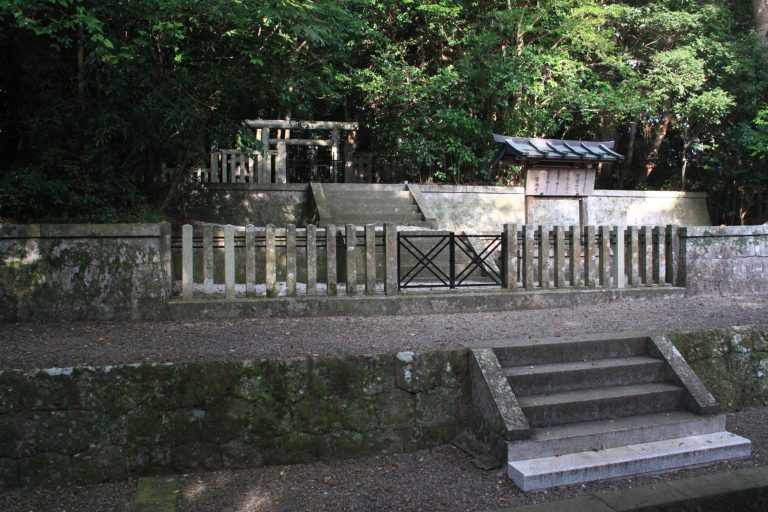
The main enclosure is traditionally identified by the Imperial Household Agency as Takaya-no-Yama-no-E-no-Misasagi, the reputed tomb of Hohodemi no Mikoto, also called Yamasachihiko, a figure of Japanese mythology associated with the imperial ancestral tradition. Tonokōri was designated a National Historic Site on September 6, 2000, and archaeological investigations connected with improvement and preservation began in 2001. Itō Mansho, also known as Sukemasu, was born at the castle. A statue commemorating him stands at the site.
Remains
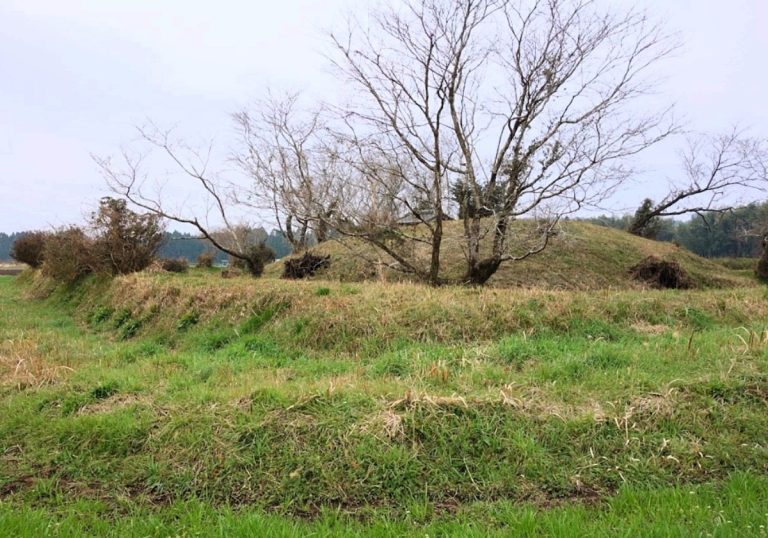
Tonokōri Castle occupies a plateau about 100 meters above sea level on the right bank of the Sanzai River, a tributary of the Hitotsuse River. Steep cliffs enclosed the plateau, while the Sanzai formed an outer moat along the western and northern sides. The central fortress was organized into five earthen-rampart enclosures, or kuruwa, separated by deep moats. Together they extended about 400 meters from east to west and 260 meters from north to south. The area is locally known as the “Five Castles.”
Central enclosures and defenses
Main and secondary enclosures
The Main Enclosure covered approximately 3,500 tsubo, a traditional Japanese unit of area. The Second Enclosure covered about 1,200 tsubo>, while the Third, Rear, and Western Enclosures each covered approximately 600 tsubo. Earthen ramparts and deep separating moats defined these five principal precincts.
Outer terraces and water defenses
More than ten belt and waist enclosures, secondary fortified terraces around the principal precincts, extended beyond the central group. Water moats and ponds with a combined length of approximately four kilometers surrounded the main castle, samurai residences, temple and shrine precincts, and the townspeople’s district. The Sanzai River formed part of this defensive system. The name Ukibune Castle reflects a tradition that the castle walls appeared in the river’s reflection, preventing ayu from swimming upstream beyond the site.
Outlying forts and castle-town precincts
Seven hill forts
Seven outlying forts occupied the ends of neighboring hills: Hinokage Castle, East Castle, Izumi Castle, South Castle, Mukae Castle, Mukō Castle, and Nakao Castle. Their positions at hill ends and along major routes suggest guard-post functions, with some structures possibly resembling watchtowers.
Hinokage Castle stood approximately 1.3 kilometers east of the five central enclosures on a ridge connected to them. South Castle, also called Taka Castle, covered about 1,500 tsubo. Mukae Castle covered approximately 600 tsubo and was later abandoned, while Mukō Castle covered about 900 tsubo and was initially called Mae Castle.
Religious precincts
The castle town contained eight shrines and approximately twenty temples. Their precincts also served as defensive positions during emergencies. The shrines included Wakamiya Gongen, the former site of Taki Tenjin, Aratake Shrine, Iwasaki Inari, Tonokōri Inari, Haramuko Inari, the former site of Shiogama Shrine, and Keibu Gongen. Gongen was a Buddhist-Shinto title for a deity understood as a manifestation of a Buddha or bodhisattva.
The temples included Daianji, also called Sōshōin, Kōshōji, Kuronuki-ji, and the former sites of Gakusōji, Anyōji, Bairinji, Yōjuin, Shuden’in, Nagamochi or Daichūji, Hon’eiji, Enkōin, Daiyōji, Kinjoji or Shōkakuin, Jōtokuin, Daiyūji or Tokuōji, Tokusenji, Hanatateji, Ichijōin, Tōkōan, and Jōrakuin.
Archaeological evidence
The castle survives as an archaeological ruin, with the enclosures heavily overgrown. Excavations have exposed numerous postholes, revealing that buildings were repeatedly rebuilt during approximately two centuries of Itō control. Fragments of imported ceramics dating from the fifteenth and sixteenth centuries have also been recovered, adding material evidence for the castle’s connections and activity during its later medieval occupation.