Shikano Castle: A Japanese Hilltop Fortress in Tottori


Site at a Glance
- Rating
- 4.2
- Popularity
- Low
- Country
- Japan
- Primary era
- Early Modern
- External website
- Open
- Eras represented
- Early Modern
- Civilizations
- Tokugawa
- Site type
- Military
- Remains
- Castle
On this page13 sections
History
Shikano Castle is a Japanese hirayama-style castle in Tottori, Japan, built on a hill while extending its facilities toward flatter ground. Its foundation date is unknown, but historical references begin in the sixteenth century, when the site was associated with the local Shikano clan. The castle’s history reflects the rivalry of regional warrior families in Inaba Province and its later transformation under Kamei Korenori into an early-modern stronghold connected with the Shikano Domain.
Medieval stronghold
In 1544, Amago Haruhisa attacked Shikano Castle during his invasion of Inaba. The castle lord, Shikano Nyudo, and more than 300 defenders were reportedly killed. In 1563, Yamana Toyokazu, the military governor of Inaba, withdrew to the castle after Takeda Takanobu attacked his seat at Fuse-Tenjin-yama Castle.
The castle was also connected with the Mori clan’s administration of Inaba during the medieval period. Earthworks extending across the hills south of the present castle site may represent the larger medieval mountain castle that served as the Mori base in the province, rather than the smaller early-modern fortification alone. A separate fortified site dating from 1580 survives at Koseiji Temple and is known as the Sugihara earthwork.
Kamei Korenori and the early-modern castle
During Toyotomi Hideyoshi’s first attack on Tottori Castle in 1580, Shikano became an Oda-aligned stronghold. Kamei Korenori, formerly a retainer of the Amago clan, became its commander. Kamei later served Hideyoshi and supported Tokugawa Ieyasu at the Battle of Sekigahara, the 1600 conflict that established Tokugawa dominance over Japan. He retained his holdings and became a feudal lord assessed at 38,000 koku, a measure of agricultural productivity used to rank domains and their rulers. Under Kamei, Shikano was transformed into an early-modern castle associated with the Shikano Domain.
Kamei’s authorization to conduct overseas trade under a Tokugawa red-seal permit shaped the castle’s names and identity. Tradition holds that he renamed the castle Ousha Castle after Rajgir, a Buddhist sacred city in India. The castle town was called Rokuyaon, referring to the deer park associated with the Buddha’s first sermon, while the mountain behind the castle became Jūbusen and the river below it Battai River. Two turrets were known as the Holland Turret and the Korean Turret.
Transfer to Tottori and dismantling
After Kamei Korenori died, his heir Kamei Masunori was transferred to Tsuwano Domain in 1617. Shikano Castle then passed to the Ikeda clan of Tottori Domain, and Hioki Tadatoshi, the chief retainer of Ikeda Mitsumasa, became its lord. A fire in the castle town in 1628 damaged part of the castle and destroyed the Small Room of Foreign Wood, a chamber made from fragrant timber obtained through Kamei’s overseas trade.
From 1640 to 1662, Ikeda Teruzumi, formerly lord of Yamazaki Castle, lived at Kourinji Temple in the castle town. He had been dispossessed after the Shiso Disturbance in Harima Province and received an allowance of 10,000 koku. His garden is said to survive. After Ikeda Mitsunaka entered Tottori in 1632, he sent the magistrate Sato Tomoyuki to Shikano. A diary records that the castle was dismantled in February 1644. Its hilltop fortifications were removed during the early Edo period, when the shogunate limited the number of castles permitted to each domain.
The Shikano branch domain
In 1868, the government of a 30,000-koku branch of the Tottori Ikeda family was nominally placed at the Shikano administrative residence. This branch was commonly called the Shikano Domain, but it remained formally attached to Tottori. Its lord did not reside at Shikano, and no independent administration was established there. The branch abolished itself in 1869 and was absorbed into Tottori Domain.
Shikano Castle is now a historic site designated by Tottori City. Its surviving early-modern remains represent the reconstruction associated with Kamei Korenori, while the wider hills preserve evidence connected with the castle’s medieval role and the Mori administration of Inaba.
Remains
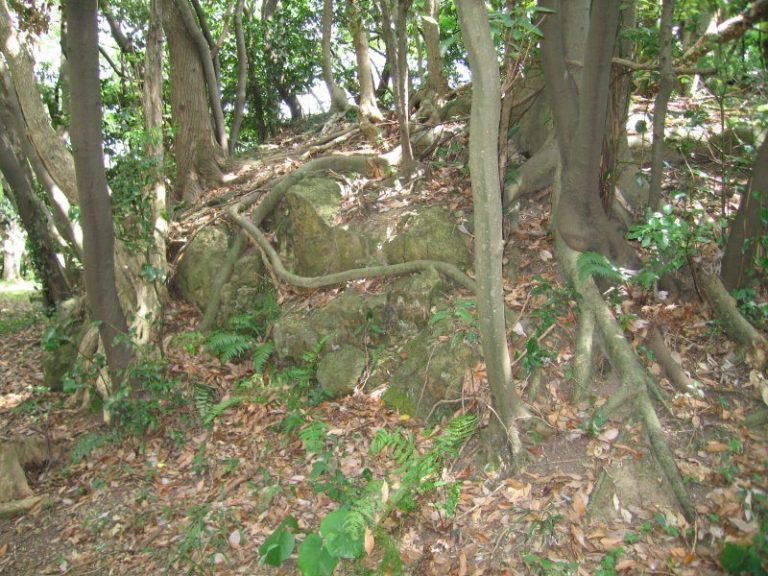
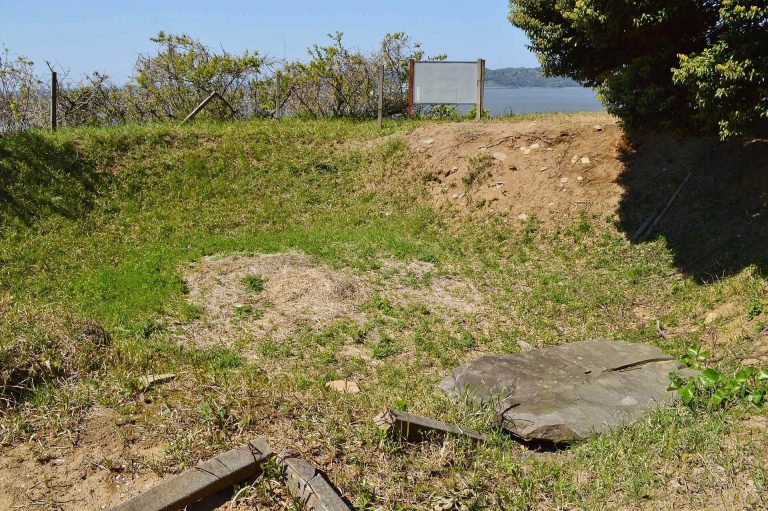
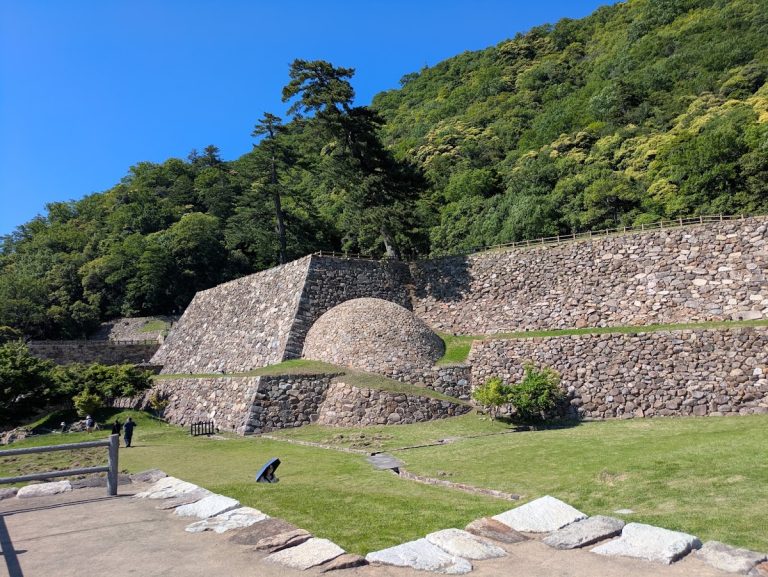
The surviving castle occupies a hilltop centered on a main bailey at approximately 148 meters above sea level. The second and third baileys descend below it in stepped terraces, while earthen banks, stone wall sections, wall fragments, steps, and parts of the moat remain across the former castle area. The site is now a park. Shikano was reportedly the only early-modern castle in Tottori Prefecture to include a bailey specifically called the west bailey.
Hilltop fortifications
Main bailey
A small platform survives in the main bailey. A keep of about two stories is thought to have stood on this raised area, although its exact form is unknown. Sections of stone walling and other defensive remains help define the elevated center of the castle.
Secondary baileys and turrets
The second bailey reportedly contained the Korean Turret and the Holland Turret. No castle plans survive, so the detailed forms of these structures are unknown. Their names are unusual among Japanese castles and preserve the connection between Kamei’s rule and the overseas trade conducted under his red-seal authorization.
Materials and surviving evidence
Roof tiles and wall finishes
Excavations have recovered roof-end tiles bearing the crest of the Inaba Ikeda clan, an ageha-butterfly design, and chrysanthemum motifs, together with skirt tiles. These finds suggest that some castle walls may have used namako walling, a finish in which raised sealed joints between tiles or masonry form a grid-like surface. During Kamei’s brief rule, gray roof tiles carried his simplified family crest, a circle crossed by one horizontal line. Examples of these tiles survive as Kamei clan artifacts in Tsuwano, the family’s later domain.
Gardens and the foreign-wood chamber
Kamei is also said to have planted exotic trees in the castle gardens. The Small Room of Foreign Wood, made from fragrant imported timber, was destroyed in the 1628 fire that affected the castle and its town. The survival of Kamei’s garden at Kourinji Temple preserves another physical association with the period when the castle town was under his family’s rule.
Images and wider archaeological area
A depiction of the castle survives in Inshu-ki, an illustrated travel diary produced during the first year of the Bunkyū era by a member of another domain. Beyond the main castle area, the Sugihara earthwork at Koseiji Temple dates from 1580. Additional remains across the southern hills may belong to the medieval mountain castle linked with the Mori clan, showing that the archaeological landscape encompasses more than the early-modern fortification centered on the surviving keep platform.