Ueshi Castle: A Medieval Mountain Fortress in Japan


Site at a Glance
- Rating
- 4.2
- Popularity
- Low
- Country
- Japan
- Primary era
- Medieval
- External website
- Open
- Eras represented
- Medieval, Modern
- Civilizations
- Ashikaga shogunate
- Site type
- Military
- Remains
- Castle
On this page13 sections
History
Ueshi Castle is a medieval Japanese mountain castle in Yurihama, Japan, founded by Nanjo Sadamune in 1366. Built on Mount Ueshi above the San’in Road and Lake Togo, it became the principal stronghold of the Nanjo clan in eastern Hoki Province. The castle occupied the upper reaches of the Ueshi River and controlled a strategic position during the conflicts that repeatedly brought the Nanjo, Amago, and Mori clans into opposition.
Foundation and Nanjo rule
A local tradition explains the choice of the mountain through an omen. The Nanjo clan is said to have first planned its castle near the settlement of Jumanji. When a swallow fell into a nearby pond, Sadamune interpreted the event as a sign and moved the project to Mount Ueshi. A large fortified site has been identified north of Jumanji, and archaeological investigation there began in 2019.
From the Eiroku through Tensho periods, Ueshi Castle served as the Nanjo family’s main base. The Nanjo were a regional warrior family whose authority extended across part of Hoki Province. Their position was challenged by the Amago and Mori, powerful military houses competing for control of the San’in region.
Amago and Mori conflicts
In 1524, the castle reportedly fell during the Great Collapse of the Fifth Month, a campaign traditionally associated with the Amago conquest of Nanjo territory. Ueshi Castle then came under Amago control, and Nanjo Munekatsu, who was known at that time as Nanjo Kuniyoshi, fled to the Yamana clan. Recent research has questioned whether the Great Collapse of the Fifth Month took place, so the circumstances of this episode remain uncertain.
In 1546, Kuniyoshi, later Munekatsu, left the Amago side and withdrew from Ueshi Castle at the request of Takeda Kuninobu. After the Mori clan destroyed the Amago clan in 1562, Munekatsu returned to the castle. His return restored the Nanjo connection with the stronghold during a period when control of eastern Hoki was again being contested.
In 1575, Munekatsu paid homage to Kikkawa Motoharu and other leaders at Gassan Toda Castle. Motoharu was a major Mori commander. Munekatsu died of illness while traveling home, and his son Nanjo Mototsugu succeeded him.
War with the Mori and Hashiba alliance
Mototsugu believed that his father’s death had resulted from a Mori plot. In 1579, he broke with the Mori side and joined the forces of Hashiba Hideyoshi, the military leader whose campaigns reached the Tottori region and who was later known as Toyotomi Hideyoshi.
The alliance brought Ueshi Castle directly into the military struggle. In 1581, Kikkawa Motoharu camped at Mount Uma-no-yama and ordered his son, Kikkawa Motonaga, to attack the castle. After Hideyoshi’s army captured Tottori Castle, it confronted Motoharu’s forces at Uma-no-yama. Both sides eventually withdrew.
In 1582, Ueshi Castle fell to an attack led by Yamada Shigenao, a commander serving under Motoharu. Two years later, a peace agreement between the Oda and Mori clans awarded the three eastern districts of Hoki to the Nanjo clan. The settlement returned the territory to Nanjo control, although the castle’s position remained tied to the wider military balance of western Japan.
Abandonment and later recognition
Mototsugu died of illness in 1591 and was succeeded by his son, Nanjo Mototada. Mototada supported the Western Army in the conflict of 1600, a decisive struggle that ended with the defeat of that coalition. Ueshi Castle was abandoned after Mototada’s defeat.
The castle site became a prefectural historic site in 2001. It was recommended for national historic-site designation in 2025 and formally listed through a government notification in 2026. Descendants of the Nanjo clan living in Osaka erected a first representative keep on the summit in 1931. The structure was rebuilt in 1990, and the access road was improved to the middle slope at the same time. The modern tower is a mock keep, meaning a representative structure built to resemble a castle tower rather than a surviving historical keep.
Remains
Ueshi Castle occupies the steep 372-metre summit of Mount Ueshi. The fortress was arranged as a chain of linked enclosures, using the mountain’s slopes and cliffs together with stone walls, ditches, and other constructed defenses. More than 90 small fortified enclosures extend in steps along the northern and western ridges from the main enclosure. The eastern ridge was more exposed because attackers could advance along its crest, while the southern side depended chiefly on precipitous cliffs and had relatively few artificial defenses.
Summit enclosures
Main Enclosure
The main enclosure occupies the summit in an elongated rectangle measuring approximately 66 metres from east to west and 20 metres from north to south. Its western end now carries the three-tier, three-story mock keep erected in 1990. Whether a historical keep once stood there remains uncertain. A jar thought to have been placed as a foundation deposit was recovered during test excavations connected with construction of the modern structure.
The entrance to the main enclosure was on the western side. It included a fortified entrance passage strengthened by stone walls. The castle’s buildings generally appear to have used wooden shingles or boards for roofing, because investigations recovered no roof tiles.
Belt Enclosure
One level below the summit, a belt enclosure surrounds the main enclosure. This narrow fortified terrace helped organize the defenses around the higher summit area. Test excavations at its northern end revealed postholes and fence holes, indicating that a lookout tower and a plank fence once stood there. An arbor-like viewing shelter now occupies the western end.
Routes and water features
Two routes approached the main enclosure, one serving as the principal entrance and the other as a rear entrance. Along the main route, a cliff approximately five metres high formed a defensive barrier known as the Natural Rampart. A well called the Tea-Water Well lies beside this route and is thought to have supplied water to the castle.
On the rear approach, beneath the main enclosure, stands Hagoromo Rock. Tradition identifies it as the place where a celestial maiden hung her feather robe. The large stone also served as a fortified position, giving the rear approach a defensive feature as well as a place connected with local legend.
Ridges and associated fortifications
The eastern ridge contained several enclosures and cut ditches, which are ditches excavated across a ridge to obstruct attackers. This side was the direction from which the castle fell in 1582. The northern and western ridges carried the larger series of stepped enclosures, while the southern defenses relied more heavily on the mountain’s natural cliffs.
Several subsidiary forts supported the wider defensive network around Ueshi Castle. They included Shiraishi Fort, Kawaguchi Castle, Tajiri Castle, Takanomiya Castle, Matsuzaki Castle, Banjo, and Ueyama Fort.
Jumanji fortified site
South of Ueshi Castle, the Jumanji fortified site occupies a 423-metre summit. Its principal enclosure measures approximately 70 metres east to west by 50 metres north to south. Extensive earthen ramparts, cut ditches, dry moats, and cut cliffs surround the level enclosure, while the ridge defenses display features associated with a medieval mountain castle.
The site contains extensive field fortifications, but its precise date and function remain uncertain. Tradition and archaeological interpretation connect it with a temporary field fortification. The lack of local castle traditions has been taken to suggest that an outside army built it for a siege and soon abandoned it. The area is locally associated with a place called Taiko-ga-naru, which may indicate an encampment by Hashiba Hideyoshi during his attack on Tottori Castle. Its relationship to another site bearing the same name near Momodani in Tottori remains uncertain.
Residence and archaeological finds
The Nanjo clan’s residence is traditionally placed in a comparatively large enclosure above Hachiman Shrine on the mountainside, although that identification remains uncertain. Excavations there recovered fragments of Haji-type earthenware, an unglazed low-fired Japanese pottery, together with Bizen ware and white and celadon porcelain. Bizen ware is a Japanese stoneware, while celadon is porcelain with a blue-green glaze. During peacetime, the Nanjo residence is thought to have been at Shikadani, north of the Ueshi settlement.
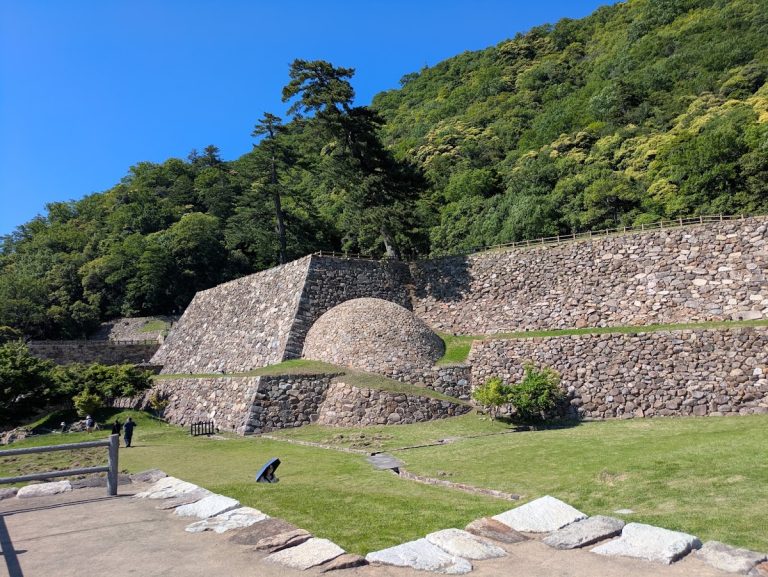
The summit contains the present mock keep and a monument commemorating successive lords of Ueshi Castle. Surviving archaeological features include stone walls and wells, which remain part of the mountain fortress’s physical record.