Odawara Castle: A Japanese Hill-and-Plain Fortress in Kanagawa


Site at a Glance
- Rating
- 4.2
- Popularity
- Very High
- Country
- Japan
- Primary era
- Early Modern
- External website
- Open
- Eras represented
- Medieval, Early Modern, Modern
- Civilizations
- Japanese, Later Hōjō, Tokugawa
- Site type
- Military
- Remains
- Castle
On this page17 sections
History
Odawara Castle is a Japanese hirayama castle in Odawara, Japan, combining a hilltop position with defenses on adjacent level ground. It developed from medieval fortifications into the political center of the Later Hojo clan during the Sengoku period, the age of prolonged warfare among regional military powers, and was later rebuilt as an early-modern castle under the Tokugawa shogunate.
Medieval origins and the rise of the Later Hojo
During the Kamakura period, the era of Japan’s first shogunate, Odawara was a stronghold of the Doi clan. A fortified residence associated with their collateral Kobayakawa branch stood approximately where the castle is located today. Another interpretation places an earlier castle of the Omori period nearer the Tokaido, around what is now the northern moat of the third bailey. Remains from the fifteenth century have been excavated there.
After the Uesugi Zenshu Revolt of 1416, Odawara came under the control of the Omori clan of Suruga. Ise Moritoki, later known as Hojo Soun and regarded as the founder of the Later Hojo clan, defeated the Omori and took Odawara in 1495. Other evidence places the transfer between 1496 and 1501. Moritoki continued to use Nirayama Castle as his base, while his son Ise Ujitsuna, later known as Hojo Ujitsuna, is regarded as the first member of the family to make Odawara his principal base, probably after 1518 or 1519.
Over five generations, the Later Hojo developed Odawara as the political center of a domain covering much of the Kanto region. The castle remained the clan’s principal seat under Hojo Ujitsuna, Hojo Ujiyasu, Hojo Ujimasa, and Hojo Ujinao, making Odawara a major political center of southern Kanto. The Later Hojo were distinct from the Hojo regent family that had dominated the Kamakura shogunate.
Sengoku expansion and military conflict
The Hojo repeatedly enlarged and strengthened Odawara during the Sengoku period. Extensive rebuilding followed the conflicts and possible earthquake damage of the late fifteenth century. Further work took place from 1566 to 1569 in response to pressure from the Uesugi and Takeda, followed by successive large-scale building campaigns from 1569 through 1590. The outer defenses were extended to include the castle town and surrounding rural areas as the Hojo prepared for a direct confrontation with Toyotomi Hideyoshi.
Uesugi Kenshin attacked Odawara in 1561. Military chronicles describe a month-long siege by an army of 113,000, but the siege is now understood to have lasted about ten days. Takeda Shingen surrounded the castle from 9 to 12 November 1569 as a military demonstration rather than a full invasion. After withdrawing, his forces defeated pursuing Hojo troops at the Battle of Mimase Pass.
In 1590, Toyotomi Hideyoshi attacked the Hojo during his campaign to complete the unification of Japan. After a three-month siege, the use of overwhelming supplies, and the destruction of Hojo strongholds elsewhere, Hideyoshi forced the castle to surrender without a major assault. He ordered most of the fortifications destroyed and transferred the former Hojo holdings to Tokugawa Ieyasu. The prolonged Hojo debate over surrender or continued resistance gave rise to the expression “Odawara deliberation,” meaning indecision.
Tokugawa reconstruction and domain rule
After completing Edo Castle, Tokugawa Ieyasu assigned Odawara to his senior retainer Okubo Tadayo. Tadayo rebuilt the castle on a substantially smaller scale, fitting it within what had formerly been the third bailey of the Sengoku-period Hojo complex. The resulting early-modern castle and the older mountain castle at Hachimanyama continued to exist as distinct systems.
The Okubo family’s rule was interrupted when Okubo Takachika was dispossessed by the shogunate in 1614. Odawara was assigned to Abe Masatsugu from 1619 to 1623, after which it reverted to tenryo, land administered directly by the Tokugawa shogunate. A palace was built in the inner bailey as a proposed retirement residence for Shogun Tokugawa Hidetada, but he remained in Edo and died before the plan could be realized. A castle governor held office at Odawara during part of this interval.
In 1632, Inaba Masakatsu received Odawara Domain, valued at 85,000 koku. This historical measure assessed a domain’s agricultural revenue and was conventionally associated with the rice needed to support one person for a year. The domain was re-established, and the Inaba clan undertook extensive reconstruction. In 1686, the Inaba were transferred elsewhere, and the Okubo family returned to Odawara. The domain was then increased to 103,000 koku. Apart from the seventeenth-century interruption, the Okubo family governed Odawara until the Meiji Restoration.
Tokugawa Iemitsu visited Odawara Castle in 1634. Inaba administration also included extensive rebuilding after the 1633 earthquake. Work affected the castle, the domain lord’s residence, and urban infrastructure, including a shogunal road, reorganized temple and shrine lands, additional samurai housing, flood-control works on the Sakawa River, a new irrigation channel, and agricultural improvements. The river works had been completed by about 1609.
Earthquakes, abolition, and modern preservation
The 1703 Genroku earthquake caused major damage, destroying or collapsing the keep and many towers. The keep was rebuilt by 1706, while reconstruction elsewhere continued until about 1721. Further extensive damage followed in the 1782 Tenmei earthquake and the 1853 Kaei earthquake. During the Boshin War, Okubo Tadanori allowed pro-imperial forces of the Satcho Alliance to pass through Odawara toward Edo without opposition.
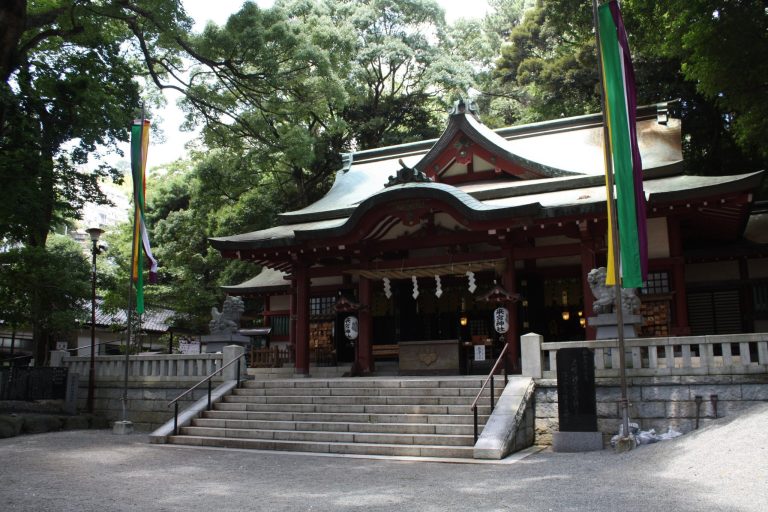
Under the Meiji government’s order to abolish former feudal fortifications, nearly all of Odawara Castle’s buildings were demolished between 1870 and 1872. In 1893, the former keep’s stone foundation was reused for Okubo Jinja, a Shinto shrine dedicated to the spirits of successive Okubo lords. An imperial villa was established within the former inner and second baileys in 1901, but the Great Kanto Earthquake of 1923 destroyed it. The earthquake also brought down the surviving low tower and caused much of the castle’s stone facing to collapse.
Stone walls were repaired in 1930 and 1931, although the repairs reduced their height. Two yagura, Japanese castle towers used for defense, observation, or storage, were restored at half scale in 1934 and 1935. The castle site became a National Historic Site in 1938, and its protected area was expanded in 1959 and again in 1976 after further archaeological investigations.
Restoration of the former keep foundation began in 1950, and the site was developed as Odawara Castle Park. A reconstructed reinforced-concrete keep was completed on 25 May 1960. It was renovated from July 2015 through April 2016 for seismic strengthening and repairs to its roof tiles and walls, and it reopened on 1 May 2016. Reconstruction projects later sought to recreate the central grounds in a form closer to the late Edo-period castle. The Tokiwagi Gate was rebuilt in 1971, Sumiyoshi Bridge in 1990, the Akagane Gate in 1997, and the Umadashi Gate in 2009. The reconstructed castle was selected as one of the 100 Fine Castles of Japan by the Japan Castle Foundation in 2006.
Remains
Odawara’s surviving remains combine the level-ground early-modern castle with the older Hachimanyama mountain fortification. The Sengoku defenses used elevation, water-filled moats on lower ground, dry moats on the hillside, banks, walls, cliffs, and large earthworks. The central castle was arranged through successive defensive systems, while a much wider outer enclosure extended around the town and toward the sea.
Outer defenses and Hachimanyama
Outer enceinte
The principal outer enceinte, a continuous defensive enclosure around the castle town and wider territory, stretched from Hachimanyama toward the sea for approximately 9 kilometers. It consisted of linked dry and water-filled moats with earthen banks. Many level-ground water moats have been covered or disappeared, while banks survive especially near Hayakawaguchi and around Renjoin. Remains of the outer defenses are particularly evident in the northwest.
Hachimanyama Old Castle
Hachimanyama Old Castle formed the rear or final stronghold of the wider complex. From east to west, its principal areas were the East Bailey, Main Bailey, and West Bailey, together with three further named areas. The South Bailey lay south of the Main Bailey, and the Kaji Bailey lay north of the West Bailey. Hojo Ujimasa is said to have established his camp there during the 1590 siege, although its identification as the original Omori-period castle remains uncertain.
Most of Hachimanyama has since been urbanized. Part of the East Bailey is a historic-site park, while the Main and South Baileys are residential areas. Odawara High School occupies the West Bailey and Fujiwarahira, a tennis court occupies the Kaji Bailey, and the westernmost area contains a reservoir and Shiroyama Park. These later uses have left little of the historical appearance visible across the mountain section.
Central castle layout
The level-ground castle was largely built with stone walls under Okubo Tadayo and Inaba Masakatsu, an unusual feature in the Kanto region, where many castles relied primarily on earthen banks. During one period of Okubo dispossession, areas outside the main bailey were dismantled. A surviving plan from that interval records major changes to the inner layout and a semicircular umadashi, an advanced enclosure or gate complex projecting from a larger defensive line, in front of the main entrance.
The Main Bailey formed the center of the inner layout. The Second and Third Baileys lay to the east, while the Screen Rock Bailey was west of the Main Bailey, the Komine Bailey was to its south, and the Gokumai Bailey was to its north. Four smaller baileys provided additional umadashi spaces, one between Komine and the Second Bailey, two south of the Second Bailey, and one north of it.
Main Bailey
The Main Bailey contained the keep and the Tokiwagi Gate. The gate included a square-plan defensive enclosure. The former keep stood on a stone foundation, and the present reinforced-concrete reconstruction occupies that foundation. Its observation level was added at the top and was not part of the historically accurate form.
Second Bailey
The Second Bailey contained the residential palace, the Akagane Gate, and a low tower. The castle is thought to have had approximately thirteen gates and eight towers, while three coastal gun batteries were added during the late Edo period.
Keep, gates, and bridges
Castle keep
The Edo-period keep was a compound-style, three-tiered tower with four principal floors. It was constructed in 1633 and rebuilt in 1706 after the Genroku earthquake. The present keep is a three-tiered reinforced-concrete reconstruction completed in 1960, based partly on a surviving model of the former structure. Its exterior is not a fully faithful recreation, and the observation level was added at the insistence of municipal tourism authorities.
Reconstructed gates
The Tokiwagi Gate is an exterior reconstruction. The Akagane Gate and Umadashi Gate were rebuilt in wood and intended to follow the appearance of the late Edo-period castle more closely. Odawara Castle Park also includes the reconstructed Ninomaru low tower and Sumiyoshi Bridge.
Moats, gardens, and archaeological remains
The Third Bailey’s defenses incorporated the moat along the Tenjinyama ridge and the large Komine dry cut, the largest surviving feature of the medieval castle. The wider central defenses included the moat of the outer enclosure, the Third Bailey moat, and the Second Bailey moat. A medieval shoji moat, a dry moat fitted with earthen partitions or ridges that hinder movement, has also been identified near the former Sannomaru Koda Gate in present-day Sakaecho. One section is approximately 20 meters wide and another approximately 7 meters wide.
Archaeological work in 2013 uncovered a moat, a Hojo-period pond, and garden remains in the former Gokumai Bailey. In 2018, the moat was completely drained and cleaned for the first time in about thirty-eight years. The Gokumai Bailey, formerly used as a ball field and temporarily as a parking area, is undergoing restoration.
Later uses of the castle grounds
The baileys have acquired several later uses while retaining parts of the former castle layout. The bailey between Komine and the Second Bailey contains the city library and local history museum. Hotoku Ninomiya Shrine occupies the Komine Bailey, an amusement park occupies the Screen Rock Bailey, and the Benten Bailey has been incorporated into a residential district that also includes Asahioka High School. Odawara Castle Park includes an art museum, local history museum, city library, amusement park, and zoo.
A gate traditionally identified as the former Koda Gate of the Second Bailey survives at a private house in Nakai, Kanagawa Prefecture. Its identification remains unconfirmed because little original material appears to survive and its dimensions differ from those expected. Another relocated castle gate at a house in Odawara has been altered so extensively that its identification is also uncertain. Together, the foundations, stone walls, banks, moats, large cuts, baileys, and shoji-moat remains preserve the principal physical fabric of a castle that has been progressively restored while much of its wider defensive system has been urbanized or adapted to modern uses.
Nearby sites