Ōyama-dera Temple: A Historic Shingon Buddhist Temple in Japan


Site at a Glance
- Rating
- 4.4
- Popularity
- Medium
- Country
- Japan
- Primary era
- Modern
- External website
- Open
- Eras represented
- Modern
- Civilizations
- Japanese
- Site type
- Religious
- Remains
- Monastery
On this page10 sections
History
Ōyama-dera Temple is a Buddhist temple in Japan, located in Isehara, Kanagawa, on Mount Ōyama. Traditionally founded in 755 as an imperial vow temple of Emperor Shōmu, it developed as a mountain sanctuary combining esoteric Buddhism with older traditions of sacred mountain worship. The temple formally belongs to the Daikakuji branch of Old Shingon Buddhism and is also known as Ōyama Fudō or Ōyama Fudōson.
Mountain Worship and Foundation
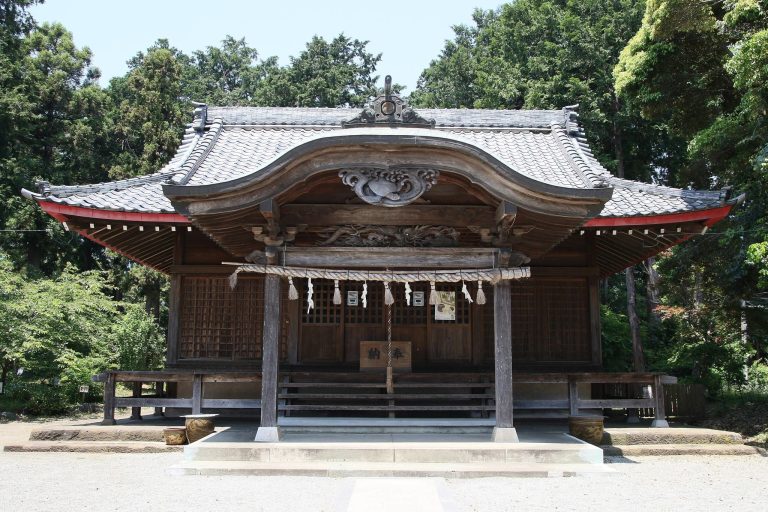
Mount Ōyama rises to 1,252 metres at the eastern end of the Tanzawa Mountains. Its religious importance reaches back to prehistoric and ancient periods, although the beginning of Ōyama worship cannot be dated precisely. The shrine later known as Afuri Shrine appears in the early tenth-century Engishiki, a court register of shrines, among the thirteen shrines of Sagami Province. Because the register drew on an eighth-century record, the shrine’s origins have been placed as early as the first half of the eighth century, when its deity was called Afuri no Kami.
The mountain’s sacred rock seat came to be revered as Sekison Gongen and identified with the bodhisattva Eleven-Headed Kannon. The mountain also became a sacred precinct devoted to Fudō Myōō, a wrathful Buddhist deity associated with immovable resolve and the protection of Buddhist teachings, as well as to Shugendō, a tradition of mountain asceticism. The identification of the principal deity with Ōyamatsumi became associated with Afuri Shrine only after the Meiji period.
Tradition attributes the temple’s foundation to Rōben in 755. It was said to have been established as an imperial vow temple of Emperor Shōmu, with a wooden image of Fudō Myōō carved by Rōben as its principal image. Another tradition states that Gyōki ordered a monk named Kōzō to make a Fudō image for the main hall in 762. Temple tradition later counted Kūkai as the third head of the institution.
Rebuilding and Medieval Patronage
An earthquake-related fire destroyed the temple in 878, and tradition holds that the monk Annen revived it in 884. Ōyama-dera subsequently grew into a mountain temple where exoteric and esoteric Buddhist practices were combined. By the end of the Heian period, Ōyama had been incorporated into Kasuya Estate, which was controlled by the Kasuya clan. The estate was donated to Anrakuju-in in 1154, after which Ōyama formed part of the holdings of Fujiwara no Nariko, empress of Emperor Toba, and later of her daughter Princess Akiko, also known as Hachijō-in.
During the Kamakura period, the Kasuya clan became vassals of Minamoto no Yoritomo, bringing the temple under the protection of the Kamakura shogunate. In 1192 Yoritomo offered a sacred horse to temples and shrines in Sagami Province, including Ōyama-dera. A related tradition connects him with the offering of a sword for a prayer for victory, an association regarded as the origin of the custom of dedicating swords at Ōyama.
The temple later experienced a temporary decline. During the Bun’ei era, from 1264 to 1275, the monk Kenjō helped revive it. He had contributed to the restoration of Tōji in Kyoto and is said to have undertaken one hundred days of ascetic practice on Ōyama while praying before an iron image of Fudō Myōō supplied by his teacher Raiken. After experiencing a vision of an enraged Fudō opening his eyes, Kenjō made two iron images based on it. One became the Trial Fudō associated with Dairakuji and now held by Kakuonji, while the other became the iron Fudō at Ōyama-dera.
Muromachi and Warring States Periods
In the Muromachi period, Ōyama-dera initially appears to have retained the protection of the Muromachi shogunate and the Kamakura provincial government. Later, the mountain’s religious community increasingly relied on local patronage, itinerant fundraising, and preaching. In 1486, Dōkō, a monzeki, or high-ranking Buddhist cleric often drawn from the imperial or aristocratic court, stayed on the snow-covered mountain. He composed Chinese poems and Japanese waka during his visit, which indicates that a substantial community of yamabushi, or Shugendō mountain ascetics, was present to receive him. The Ōyama-dera Engi Emaki was also produced in the later Muromachi period.
During the Warring States period, Ōyama came under the control of the Hōjō clan of Odawara. The clan sought to employ the mountain’s religious forces, while the yamabushi community was probably affiliated with Shōsen-in, later called Jūshin-in, of the Honzan branch. When Toyotomi Hideyoshi attacked Odawara in 1590, Ōyama’s religious forces supported the Hōjō and fought fiercely.
Tokugawa Reorganization
At the beginning of the early modern period, Tokugawa Ieyasu undertook a major institutional reform. He granted Ōyama-dera 57 koku in 1608 and another 100 koku in 1610. A koku was a historical land-revenue measure conventionally based on the amount of rice that land could produce. Ieyasu expelled non-Shingon religious personnel, including Shugendō practitioners and married monks, and restricted residence on the mountain to celibate Shingon monks.
Ieyasu also brought the previously non-sectarian mountain institution under Old Shingon Buddhism. He appointed Jitsuyū, the abbot of a temple at Ōyama, as its first head of learning and required him to reside there. The third shogun, Tokugawa Iemitsu, provided funds to repair the temple buildings, while Kasuga no Tsubone made two pilgrimages as his representative.
pilgrimage and Meiji Transformation
From the latter half of the eighteenth century, pilgrimage to Ōyama became increasingly popular among people praying for good harvests, commercial prosperity, and other worldly benefits. Ōyama confraternities formed throughout the Kantō region, and pilgrimage roads were improved. Former Shugendō practitioners served pilgrims as guides and religious hosts, while lodging temples in the foothill settlements of Isehara and Hadano prospered around the religious traffic.
An early Meiji-period record lists 15,700 Ōyama confraternities and approximately 700,000 affiliated household parishioners. The spread of the Ōyama-dera Engi Emaki and publication of the Ōyama Fudō Reigenki in 1792 helped popularize devotion. The pilgrimage became sufficiently familiar to appear in rakugo under the title “Ōyama Pilgrimage.”
The Meiji government’s suppression of Buddhism and separation of Buddhism from Shinto transformed the temple’s physical and institutional setting. The Fudō Hall on the mountainside was demolished and became Afuri Shrine’s present Lower Shrine. Reconstruction of a Fudō Hall began in 1876 at the former site of Raigō-in, where the revived institution was called Myōō-in from 1885. In 1915, Myōō-in merged with Kannon-ji, allowing the name Ōyama-dera to be restored.
Ōyama-dera was recognized in 2016 as a component cultural property within a Japan Heritage designation. It is also counted among the Three Great Fudō temples of the Kantō region, the first temple on the Kantō Thirty-Six Fudō pilgrimage, and the sixtieth site on the Kantō Eighty-Eight Sacred Places pilgrimage.
Remains
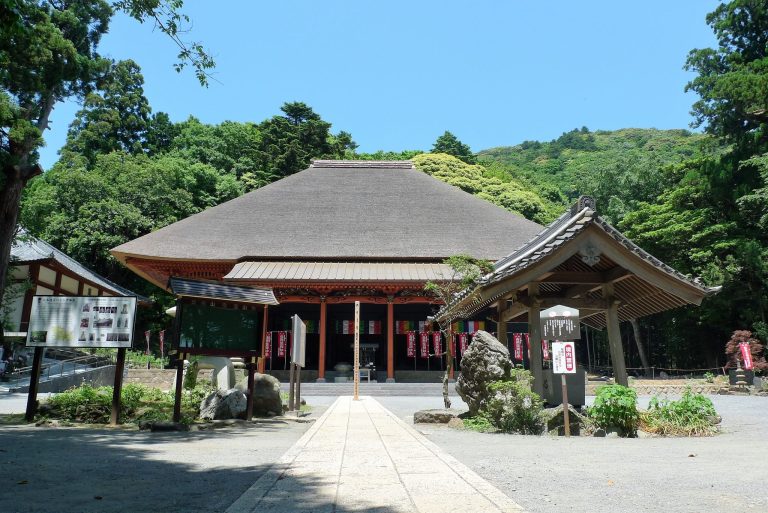
Ōyama-dera occupies the former site of Raigō-in on Mount Ōyama, while the earlier Fudō Hall stood higher on the mountainside. The mountain’s summit area preserves a sacred rock seat associated with older worship traditions, and archaeological finds near the summit extend the site’s physical history into prehistoric and ancient periods. The present temple represents the institution’s nineteenth-century re-establishment at its current location.
Mountain Archaeology
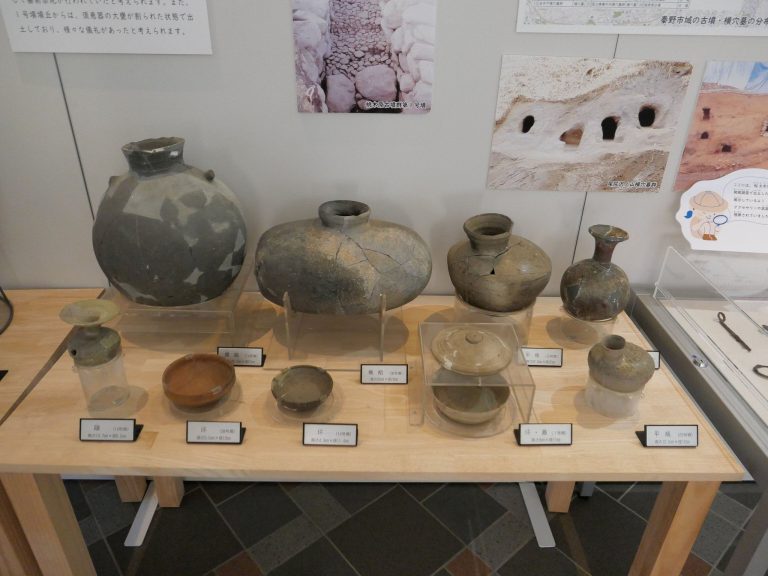
Excavations near the summit recovered pottery fragments attributed to the later Jōmon period, an era of prehistoric Japanese culture, together with Sue ware and Haji ware from the Kofun period. Sue ware is a high-fired ancient ceramic, while Haji ware is a lower-fired earthenware tradition associated with the same broad ancient context. The interpretation of the Jōmon material remains uncertain because the excavation’s chief representative concluded that it had been brought to the mountain during the early Edo period.
Temple Buildings
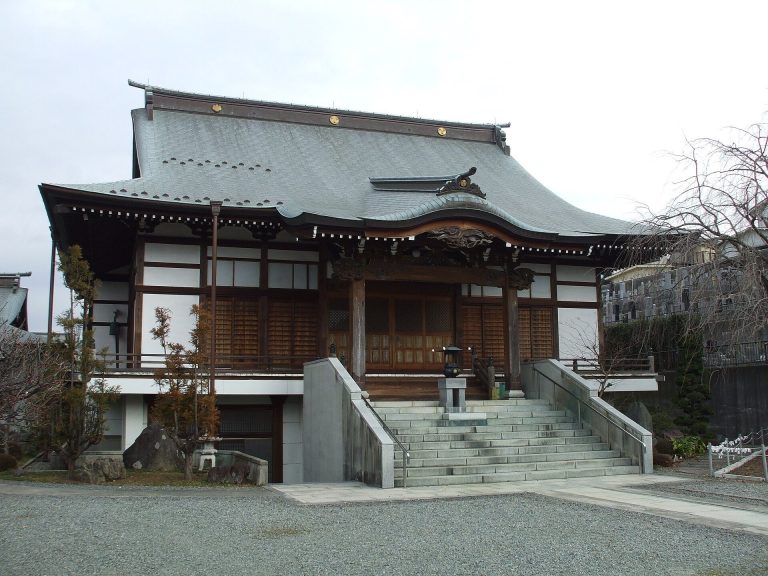
The former Fudō Hall stood midway up Mount Ōyama. Its demolition during the Meiji separation of Buddhism and Shinto converted the site into the Lower Shrine of Afuri Shrine. The present Ōyama-dera was rebuilt on the former Raigō-in site, where reconstruction of its Fudō Hall began in 1876 and the institution was re-established in 1885.
Iron Fudō Group
The principal image is an iron statue of Fudō Myōō accompanied by two child attendants. The group is regarded as one of the finest works among Kamakura-period iron Buddhist images. The three figures differ in technical execution: the attendant statues show flaws such as displacement between sections of their moulds, while the principal Fudō is considered the stronger work. The iron Fudō group is designated an Important Cultural Property of Japan.