Daikaku-ji Temple: A Shingon Buddhist Temple and Former Imperial Residence in Kyoto


Site at a Glance
- Rating
- 4.4
- Popularity
- Medium
- Country
- Japan
- Primary era
- Early Modern
- External website
- Open
- Eras represented
- Medieval, Early Modern, Modern
- Civilizations
- Ashikaga shogunate, Japanese, Tokugawa
- Site type
- Religious
- Remains
- Monastery
On this page14 sections
History
Daikaku-ji Temple is a Shingon Buddhist temple in Kyoto, Japan, whose origins date to 814, when Emperor Saga had a palace built on the site during the Heian period. The palace later became his retirement residence, known as the Saga Rikyu imperial villa. The temple’s history therefore links imperial residence, Buddhist practice, and the culture of the Japanese court.
From Imperial Villa to Temple
Tradition connects the site with the copying of the Heart Sutra, a short Mahayana Buddhist scripture centered on the teaching of emptiness. During a serious epidemic, the monk Kobo Daishi, also known as Kukai, is said to have advised Emperor Saga to copy the text by hand. After the emperor completed the manuscript, the epidemic was believed to have ended. The original remains associated with Daikaku-ji and is displayed once every sixty years. It was last shown in 2018 and is next scheduled for display in 2078. Pilgrims continue to copy the sutra, and their manuscripts are kept with the imperial original.
In 876, thirty-four years after Emperor Saga’s death, his daughter Princess Masako, consort of Emperor Junna, converted the imperial complex into a temple and named it Daikaku-ji. The institution became a monzeki temple, meaning that it was traditionally headed by a member of the imperial family. It also served as a retirement residence for emperors Go-Saga, Kameyama, and Go-Uda.
Imperial Rule and Medieval Reconstruction
During the thirteenth and fourteenth centuries, some retired emperors associated with Daikaku-ji entered religious orders while continuing to exercise political authority through cloistered rule. This system allowed a retired sovereign, often living as a monk, to govern from a separate residence. Daikaku-ji thus remained connected to both religious life and the exercise of imperial power.
The temple was burned in 1336 during the upheaval that accompanied the transition from the Kamakura period, associated with the rise of samurai government, to the Muromachi period. It was later rebuilt under Ashikaga rule, preserving the institution through a major change in Japan’s political order.
Edo-Period Changes and Later Associations
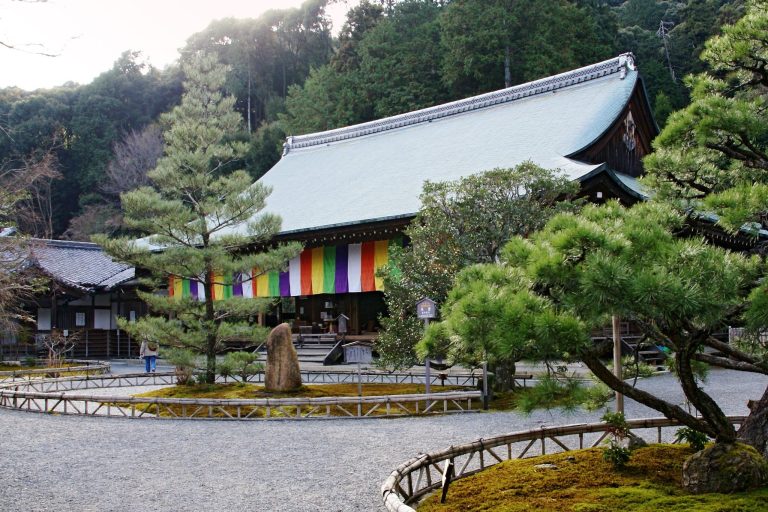
During the Edo period, the era of Tokugawa rule, Emperor Go-Mizunoo transferred buildings from the Kyoto Imperial Palace to Daikaku-ji. These included the main hall and the Founder’s Hall, which were arranged around a graveled courtyard beside Ōsawa Pond.
Daikaku-ji’s religious and cultural traditions continued into the modern period. In 1936, the temple invited Tsujii Kōshū, a disciple of Ohara Unshin of the Ohara school, to establish the Saga Go-ryū school of ikebana, or Japanese flower arrangement. The temple remains associated with Heart Sutra copying, while its garden hosts a three-day autumn moon-viewing observance around the harvest moon, featuring costumed dancers, musicians, and Heian-style dragon boats. Paintings in the Okanmuri-no-ma room of the Shōshinden are designated Important Cultural Properties.
Remains
Daikaku-ji combines a large artificial lake and its surrounding garden with temple buildings arranged around a separate graveled courtyard. The landscape preserves the setting of the former imperial villa, while the surviving halls, gates, paintings, and Buddhist images represent later phases of construction and adaptation.
Ōsawa Pond and Landscape Garden
Artificial Lake
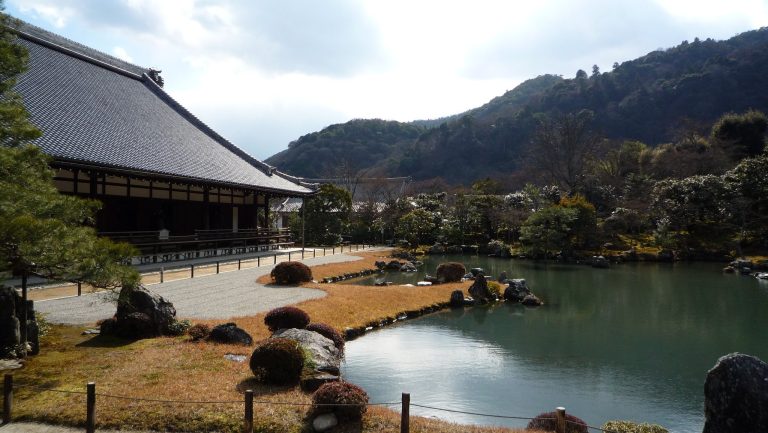
Ōsawa Pond predates the temple. The 2.4-hectare artificial lake was created by Emperor Saga either during his reign, from 809 to 823, or between his retirement and his death in 842. A stream flowing from Nakoso Waterfall was dammed to form it. The pond was designed as a boat-viewing garden in the chisen-shuyu style, a garden intended primarily to be experienced from boats. Its design was comparable to imperial Chinese gardens of the period, and its outline is said to reflect Dongting Lake in China.
Two islands occupy the northern end of the pond, one large and one small. The smaller island is known as Chrysanthemum Island. Several rocky islets between them represent Chinese junks at anchor. The lake was also arranged for viewing the rising moon from boats and is associated with viewing cherry blossoms around its shore.
Dry Cascade and Courtyard Garden
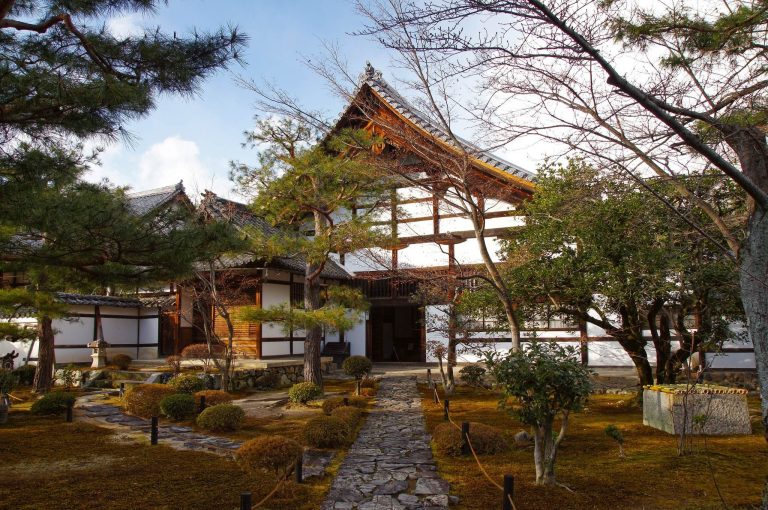
On a hillside north of the lake is a karedaki, or dry cascade, formed from stones arranged to suggest a waterfall without flowing water. The garden was celebrated in Heian-period poetry, including poems associated with the Kokinshū and the Hyakunin Isshu. A large courtyard garden lies between the temple buildings in addition to the landscape surrounding Ōsawa Pond.
Temple Buildings and Interior Art
Shōshinden
The Shōshinden is an Azuchi-Momoyama-period building, dating to the late sixteenth-century era before the Edo period. In its Okanmuri-no-ma room, sliding-door paintings by Kanō Sanraku and Shikō Watanabe depict peony trees and red and white plum blossoms. The room also contains an Indian-ink hawk motif and a hare painted on the wooden beam above the doors.
Principal Images
The temple’s principal images are the Five Wisdom Kings, esoteric Buddhist guardian deities, with Fudō, the immovable king, at the center. These images express the temple’s Shingon Buddhist character, a tradition founded by Kobo Daishi that emphasizes esoteric teachings and ritual practices.
Chokushi-mon
The Chokushi-mon, a gate intended for imperial messengers, was rebuilt between 1848 and 1854. Its surviving form belongs to the late Edo period and reflects Daikaku-ji’s continuing connection with the imperial institution.
Shingyōden and Shingyō-hōtō
The Shingyōden, also rendered Shinkyō-den, was built in 1925. It houses the emperor’s handwritten Heart Sutra copies, including the manuscript associated with Emperor Saga, as well as a statue of Yakushi Nyorai, the Buddhist Medicine Buddha associated with healing and protection. The Shingyō-hōtō was built in 1967 to commemorate the 1,150th anniversary of Emperor Saga’s copying of the Heart Sutra.
Transferred Imperial Buildings
The main hall and the Founder’s Hall were moved from the Kyoto Imperial Palace to Daikaku-ji during the Edo period. They were positioned beside Ōsawa Pond around a graveled courtyard, joining the temple’s Buddhist buildings to its inherited imperial landscape.
Nearby sites