Miikedaira Kofun: A Keyhole-Shaped Burial Mound in Japan


Site at a Glance
- Rating
- 4
- Popularity
- Very Low
- Country
- Japan
- Primary era
- Classical
- External website
- Open
- Eras represented
- Classical
- Civilizations
- Japanese
- Site type
- Burial
- Remains
- Burial Mound
On this page8 sections
History
Miikedaira Kofun is a keyhole-shaped burial mound in Shizuoka, Japan, built around the beginning of the fifth century during the early-middle Kofun period. The Kofun period was an era when powerful chiefs and members of the ruling elite were buried in large monumental mounds. Miikedaira is considered the tomb of a powerful local chief in the Ihara region, based on its burial facility and unusual grave goods.
An Early Chiefly Tomb
The mound belongs to a group of burial mounds concentrated in the Ihara River basin during the first half of the Kofun period. It has been associated with the Ihara clan, a local lineage traditionally connected with governance in the Ihara region during that period. The tomb’s burial facility has no known parallel farther east than Miikedaira Kofun. Gōdoyama No. 3 Kofun, another keyhole-shaped mound, lies approximately one kilometre to the southwest, while Miikedaira is regarded as a powerful chiefly burial following sites such as Yatsuyama Kofun.
Discovery and Protection
Miikedaira Kofun was discovered in 1956 during agricultural work in a mandarin-orange grove. The former Ihara Village excavated the site in 1958, revealing the burial chamber, sarcophagus, and associated objects. The former Shimizu City designated the mound a historic site on November 20, 1992. It became a Shizuoka Prefecture Historic Site on March 15, 2001, and restoration and site-improvement work was completed in 2009.
Remains
Mound and Setting
Keyhole-Shaped Mound
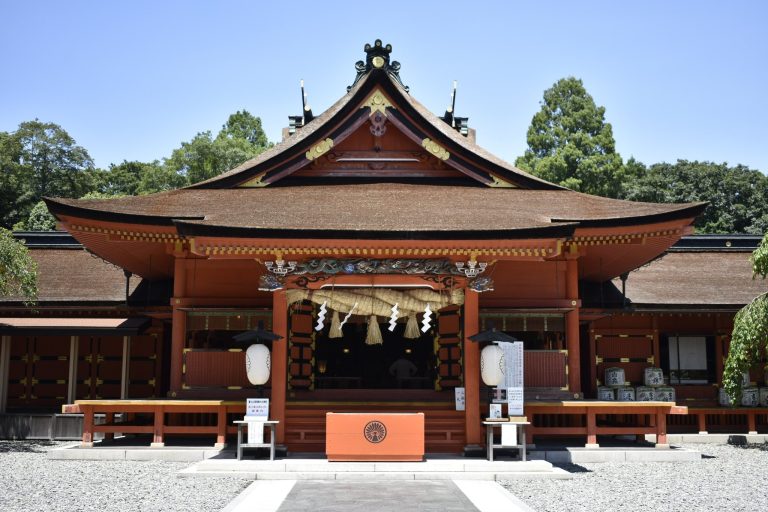
Miikedaira Kofun stands at an elevation of 55 metres above sea level on a flat part of a hill ridge between the Yamakiri River to the east and the Ihara River to the west. It lies north of Shizuoka Municipal Shimizu Ihara Junior High School, on the hill occupied by Togashika Jinja, a Shinto shrine and place of worship in Japan’s indigenous religious tradition.
Viewed from above, the tumulus combines a circular rear section with a rectangular front section. The mound is 65 metres long. Its circular rear section measures 43 metres in diameter and 5 metres high, while the rectangular front section is 36 metres wide, 3.2 metres high, and faces southeast. The mound was constructed in three tiers, although the lowest tier survives only partly on the southwest side. A moat follows the base on the northern and eastern sides, and stone paving remains along part of the base. Jar-shaped haniwa, clay objects placed on or around burial mounds, were set on the mound.
Burial Chamber
A vertical-shaft stone burial chamber was placed at the top of the circular rear section, with its main axis running from northeast to southwest. Builders formed it by stacking flat stones, covered it with seven ceiling stones, and lined its interior with clay. Inside was a split-bamboo-shaped stone sarcophagus made of andesite. Its interior was painted vermilion and contained the skeletal remains of a relatively young man.
Grave Goods
Wheel-shaped stones, stone bracelets, small beads, tubular beads, and other ornaments accompanied the burial. A shelf-like space between the chamber and sarcophagus was created by shifting several of the chamber’s flat stones. This space held two bronze mirrors, one with a modified square pattern and four deities, and another decorated with four animal motifs.
The same space also contained cylindrical bronze vessels, spindle-wheel-shaped and scallop-shaped stone artifacts, and iron weapons including swords, knives, and arrowheads. Iron agricultural tools included axes, sickles, and hoe blades. The excavated artifacts are preserved and displayed at the Shizuoka City Buried Cultural Properties Center.
Nearby sites