Chōgen-in Temple: A Sōtō Zen Temple in Shizuoka


Site at a Glance
- Rating
- 3.9
- Popularity
- Very Low
- Country
- Japan
- Primary era
- Early Modern
- Eras represented
- Early Modern, Modern
- Civilizations
- Japanese, Tokugawa
- Site type
- Religious
- Remains
- Monastery
On this page18 sections
History
Chōgen-in Temple is a Sōtō Zen temple in Shizuoka, Japan, founded in 1488 by the monk Kakuzan Kenchi. Its formal name is Daishinzan Chōgen-in, and it belongs to Hōdai-in at Kunmisan in Kasama, Ibaraki Prefecture. Sōtō Zen emphasizes seated meditation, disciplined monastic practice, and realization through everyday activity. The temple stands at the northwestern foot of Yatsuyama in the Kutsunoya district and is dedicated principally to Shō-Kannon, the Japanese Buddhist form of Avalokiteshvara associated with compassion.
Foundation and Asahina patronage
The temple’s founding patron was Asahina, a senior retainer of Imagawa Ujichika. He donated the land, helped complete the monastic buildings, and was buried at Chōgen-in after his death on August 3, 1518. The temple honored him as its founding patron, and his grave monument remains within the grounds.
Kakuzan Kenchi died on January 16, 1523. In later generations, eminent monks associated with Chōgen-in established new temples, creating a network of more than twenty branch temples across Japan. This expansion gave the temple an institutional influence that extended well beyond its original grounds.
Loss of protection and Tokugawa connections
Chōgen-in lost its principal protectors in 1567, when Imagawa Ujizane fled Suruga and the Asahina family declined. Its fortunes later became closely linked with Tokugawa Ieyasu, who was based at Sunpu Castle. Ieyasu stopped at the temple while hawking sometime between 1596 and 1615. A local tradition connects his remark about going “to the mountainside” with the name Yamawaki for the surrounding area.
On May 3, 1612, Ieyasu granted Chōgen-in the right to collect twenty koku from Kutsunoya Village. A koku was a historical measure of agricultural production, conventionally linked to the rice needed to support one person for a year. The grant also permitted the temple to use timber and bamboo from its mountain forests and exempted it from various obligations near its gate. These privileges depended on the continued observance of the temple’s Buddhist rites and practices.
The relationship with Ieyasu is also associated with the monk Taigaku Zean, who delivered Buddhist lectures to him. Zean reportedly declined Ieyasu’s offers of land and instead received a collection of 600 volumes of Prajnaparamita scriptures and an image of the Sixteen Good Deities attributed to Chō Densu. Ieyasu is also said to have designated Chōgen-in as Suruga Province’s foremost prayer temple. The temple’s main hall preserves a memorial tablet for Tōshō Daigongen, the posthumous sacred title under which Ieyasu was worshiped. Ieyasu founded the Tokugawa shogunate, which ruled Japan from 1603 to 1868.
Rebuilding after repeated fires
In 1628, the wife of Matsudaira Shigenari, a resident of Sunpu Castle and daughter of Matsudaira Ietada, rebuilt the temple buildings. She was regarded as a reviving founder under the posthumous Buddhist name Yūshin. On January 2, 1629, fire destroyed the guest hall, corridors, gate structures, and other buildings. The ninth abbot, Kyōzan Bonshun, oversaw their reconstruction.
Further fires struck in 1743 and 1774. After the 1743 fire, the buildings were rebuilt in 1751. The 1774 blaze destroyed nearly the entire complex and left only one gate standing. The main hall was rebuilt in 1781, while other buildings and the living quarters were restored by 1796. A cadastral plan from 1791 records the extent and arrangement of the temple’s land and buildings during this period of recovery.
Modern repairs and historical preservation
Sunpu Castle governor Toki Tomomasa contributed to the reconstruction of the main hall and other buildings in 1861. Registers survive from 1862 through the Meiji Restoration, although the dates and biographies of successive abbots are not consistently known. Fires and the early Meiji anti-Buddhist movement left Chōgen-in with relatively few old documents, encouraging the publication of a temple history in 1993 and a collection of source materials in 1996.
Donations from parishioners financed major repairs in 1938, including work on the main hall roof and interior. The buildings and grounds were further organized and repaired in 1952 and 1953, and the bell was recast in 1957. After a serious incident in September 1981, the kitchen, study, and other parts of the temple deteriorated. Large-scale repairs and improvements to the buildings, grounds, access routes, gardens, cemetery, and rear hillside began in 1988 and continued for more than five years.
A major earthquake on August 11, 2009, caused a landslide on the hillside behind the main hall, after which retaining-wall work was carried out. Later projects included a new approach stairway in 2013, the Yamawaki Hall complex in 2015, the consolidation of successive abbots’ graves in 2016, the rebuilding of the guest hall and living quarters in 2017 and 2018, and repair of the gate after typhoon damage in 2019.
Cemetery and cultural memory
Chōgen-in’s cemetery is associated with the Asahina family, Tokugawa retainers, Sunpu Castle officials, former hatamoto samurai and attendants, scholars, artists, and families who moved from Edo to Sunpu. Identified burials include Kakuzan Kenchi, the poet and linked-verse master Sōchō, the court noble Yamashina Tokitsugu, the monk Zaisen Kensaku, Sunpu Castle officials, the urban planner Hikosaka Kyūbei Mitsumasa, and members of the Imai, Ushiki, and other established families.
The temple also preserves artistic works associated with nineteenth-century artists, including a Nirvana painting dated 1798, sliding-door landscapes by Fukuda Hanko, crane paintings by Shibata Taizan, and an ink painting of plum blossoms by Kawamoto Gekka. A stone monument commemorating Yokoyama Hōsuke, lyricist of the former Hokkaido Imperial University dormitory song “Miyako zo Yayoi no Kumo Murasaki ni,” was unveiled at Chōgen-in on February 29, 1992.
Remains
Chōgen-in occupies a temple compound at the northwestern foot of Yatsuyama. Its surviving layout combines the Sanmon gate, principal worship buildings, halls for teaching and memorial rites, service buildings, a bell tower, gardens, and a cemetery. A 1791 cadastral plan shows the historical arrangement, including a guest hall, founder’s hall, abbot’s quarters, monks’ dormitory, corridors, kitchen and living quarters, wood store, meditation hall, bell tower, privy, storehouse, lotus pond, and subsidiary residence. The plan also lists roof types, eave heights, and floor areas for many buildings.
Gate and main hall
Sanmon gate
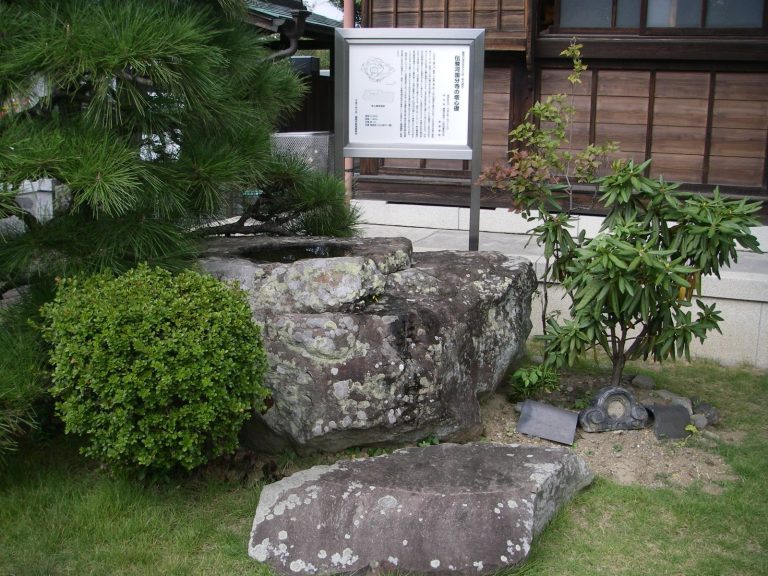
The Sanmon is the main gate of a Zen temple and is understood as the gate of the three liberations, representing entry into Buddhist practice. In front of Chōgen-in’s gate stands a saw-shaped stone monument bearing inscriptions attributed to Tokugawa Ieyasu, including “Omoriyama Yamawaki” and “Chōgen Zen’in.” These inscriptions connect the entrance with the temple’s historical association with Ieyasu and the Yamawaki name.
Main hall
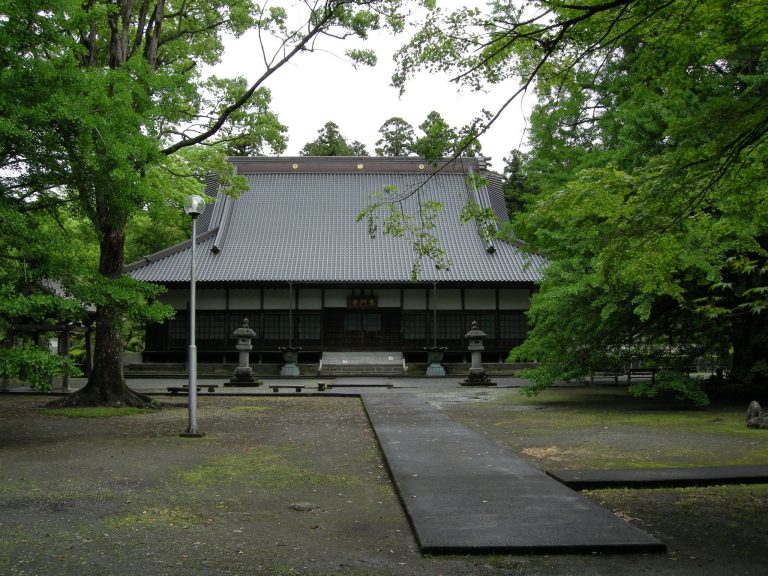
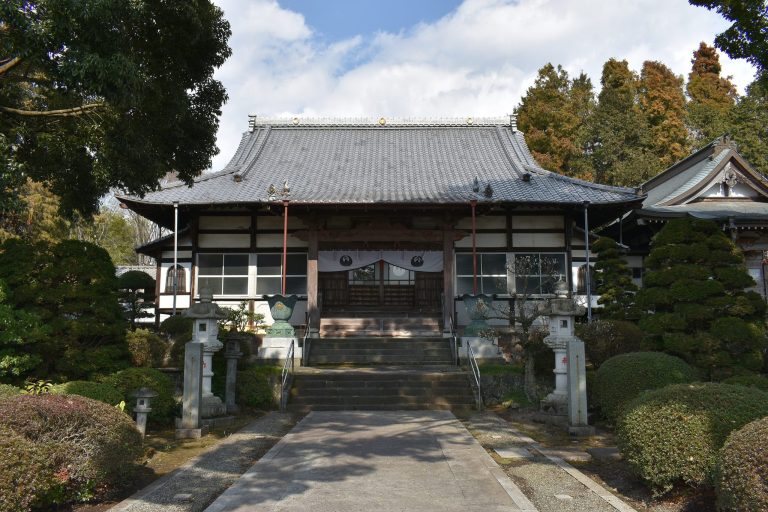
The main hall, rebuilt in 1781 after the fire of 1774, contains the memorial tablet for Tōshō Daigongen. It also preserves a lacquered medicine case presented by Ieyasu to his favored retainer Yamada and later donated to the temple. A palanquin traditionally associated with abbots’ visits to Sunpu Castle hangs from the ceiling together with a storage chest bearing a paulownia crest. The hall was repaired in 1938 and again as part of later work on the temple complex.
Religious and residential buildings
Study and Jizō Hall
The study consists of two adjoining rooms, each measuring ten tatami mats. It was included in the comprehensive restoration of the buildings and grounds that began in 1988. The Jizō Hall contains a protective Jizō statue at the front, a seated statue of Kōbō Daishi on the left, and a gilded standing Kannon on the right. Jizō is a protective bodhisattva commonly associated with travelers, children, and the removal of suffering. Kōbō Daishi is the posthumous title of Kūkai, founder of the Shingon Buddhist tradition.
Guest hall and living quarters
The guest hall and living quarters were rebuilt and completed in June 2018. Their reconstruction formed part of the continuing renewal of buildings affected by long-term deterioration and earlier disasters.
Bell tower
The bell tower and bell remain part of the temple complex. Records concerning the bell’s history and inscription were preserved by Kitahori Kan’ichi, abbot of Kyūenji, during the tenure of Chōgen-in’s thirty-fifth abbot, Tōkan Jitsugen. The bell itself was recast in 1957.
Yamawaki Hall and garden
Yamawaki Hall
Completed in March 2015, the Yamawaki Hall complex contains a hall for Buddhist teachers, a ceremonial hall, and a mortuary-tablet hall. The teachers’ hall enshrines Dōgen and Keizan Jōkin, the two principal founders of Sōtō Zen in Japan, together with a statue of Kakuzan Kenchi. It also houses memorial tablets for successive abbots. The ceremonial hall contains Shakyamuni Buddha, Samantabhadra, and Manjushri. The mortuary-tablet hall houses approximately one thousand memorial tablets.
Garden and approach
The grounds include a garden called “Keisen Hōseki no Niwa,” translated as “the garden where a valley spring embraces a stone.” The approach stairway completed in 2013 has ninety-nine steps. The temple’s hillside setting also includes the land above the Yamawaki Hall where the graves of successive abbots were consolidated in 2016.
Cemetery and surviving memorial objects
The cemetery contains Asahina’s grave monument and numerous tombs associated with Sunpu Castle officials and Tokugawa retainers. One prominent burial is that of Hikosaka Kyūbei Mitsumasa, who helped design Sunpu’s urban layout under Ieyasu’s orders. The grounds also preserve the graves of the successive abbots and burials connected with established families, scholars, artists, and other residents of the historic Sunpu community.
Three fires since the temple’s foundation destroyed much of its former collection of relics, treasures, and records. The surviving objects specifically associated with Ieyasu include the memorial tablet, the donated lacquered medicine case, the palanquin, the paulownia-crested storage chest, and the stone inscriptions positioned before the gate.