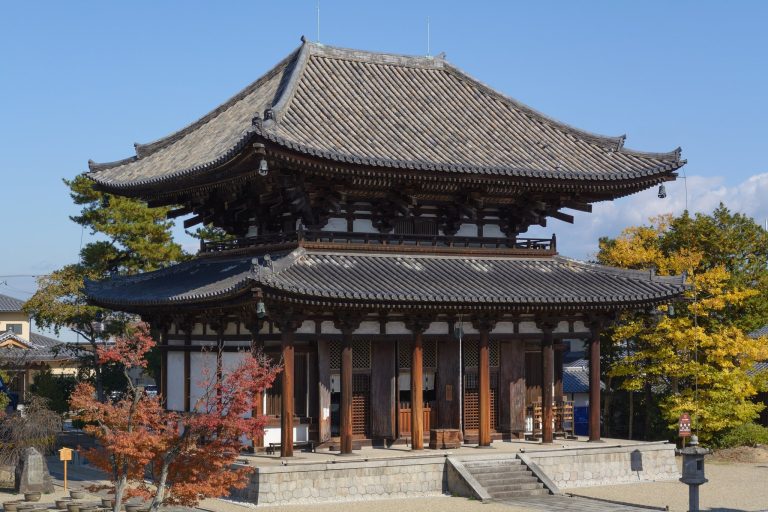
Chōkyū-ji Temple: A Buddhist Temple and Kamakura-Period National Treasure in Japan


Site at a Glance
- Rating
- 4.2
- Popularity
- Low
- Country
- Japan
- Primary era
- Medieval
- External website
- Open
- Eras represented
- Medieval
- Civilizations
- Kamakura shogunate
- Site type
- Religious
- Remains
- Temple
On this page11 sections
History
Chōkyū-ji Temple is a Buddhist temple in Ikoma, Nara Prefecture, Japan, traditionally established around 728–730 and now centered on a Kamakura-period Esoteric Buddhist hall. It belongs to the Shingon Risshu tradition, which combines Shingon teachings with the strict monastic discipline of the Risshu school, and bears the mountain name Mayumi-yama. Its principal image is a statue of Eleven-Headed Kannon, a compassionate bodhisattva whose multiple faces express expanded spiritual awareness.
Foundation traditions
The temple’s foundation date remains uncertain, although local tradition places its establishment in the years around 728–730 and regards the Nara-period monk Gyoki as its founder. The story connects the temple with a tragedy during a hunt accompanying Emperor Shomu, an eighth-century ruler closely associated with state-supported Buddhism in Japan. Ono Mayumi Takeyumi, a local notable, was accidentally killed by an arrow shot by his son Nagamaro. Moved by the death, Emperor Shomu ordered Gyoki to establish a temple at the place, where an image of Eleven-Headed Kannon became the principal object of worship.
The same tradition links the names Chōkyū-ji and Mayumi-yama with the bow in the foundation story. One version says that the Buddha face placed above the Kannon image was carved from Emperor Shomu’s bow. Another holds that parts of the sacred image came from the bow and that the remainder was buried at Mayumizuka, a mound about 1 km from the temple in a settled mountainous area.
Heian-period traditions and changes
Traditions about the temple’s early development differ. One attributes its revival and enlargement to Fujiwara no Yoshitsugu, who is said to have developed the precinct and installed large images of Amida, Shaka, and the Four Heavenly Kings. Yoshitsugu died before Emperor Kanmu came to the throne, however, making that attribution chronologically inconsistent. Another tradition instead credits Fujiwara no Otsugu with the foundation during the early Heian period.
Temple tradition also holds that Kukai, the monk associated with the establishment of Shingon Buddhism in Japan, encountered the Dragon King of Good Women at Chōkyū-ji. During the late Heian period, Emperor Horikawa repaired the temple buildings and donated a six-hundred-volume collection of the Great Perfection of Wisdom Sutra. A fire damaged the temple during the reign of Emperor Antoku, also in the late Heian period. The event appears in a Todaiji materials register, while the intervening medieval history is otherwise unclear.
Medieval revival and later losses
The present main hall was built in 1279, according to an inscription on one of its structural timbers. Its construction formed part of a medieval revival associated with Eison, the monk who founded the Shingon Risshu tradition. The temple is traditionally said to have had twenty subtemples at its height.
During disturbances connected with the Onin War, a fifteenth-century conflict among rival military factions, men associated with the Western Army of Yamana Sozen entered Chōkyū-ji in 1473 and destroyed important treasures. In 1577, the warlord Oda Nobunaga confiscated extensive portions of the temple’s landholdings. The anti-Buddhist movement of the Meiji period later reduced the number of surviving monastic units to four.
Religious organization and the shrine precinct
The main temple has no resident chief priest. Three of its subtemples take turns maintaining the main hall, and Chōkyū-ji is the ninth station of the Yamato Thirteen Buddhas pilgrimage. On the eastern side of the precinct stands the shrine now called Izanagi Shrine, formerly known as Gozu Tenno Shrine. Temple tradition attributes its establishment as Chōkyū-ji’s guardian shrine to Emperor Shomu.
Buddhist and Shinto worship were practiced together at the shrine until the Meiji separation of the two traditions, after which it became independent of the temple. The main hall is a National Treasure. The Eleven-Headed Kannon and its black lacquered shrine are Important Cultural Properties.
Remains
Precinct layout
The precinct extends toward the main hall at its rear. Izanagi Shrine and a Medicine Buddha subtemple occupy the eastern side, while two other subtemples lie to the west. A fourth subtemple’s Jizo Hall stands to the south, and a torii, the gateway traditionally marking a Shinto sacred precinct, marks the entrance to the temple approach. Mayumizuka, the mound associated with the foundation tradition, lies approximately 1 km away in the surrounding settled mountain area.
Main hall and sacred images
Main hall
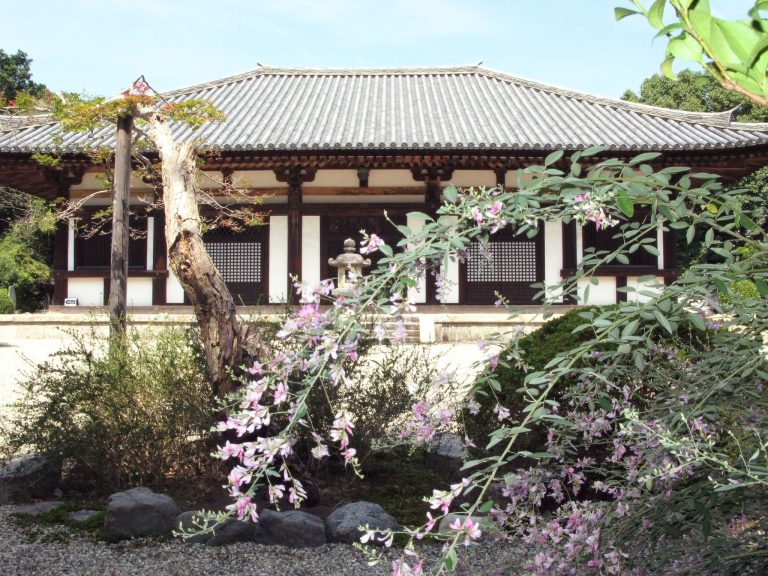
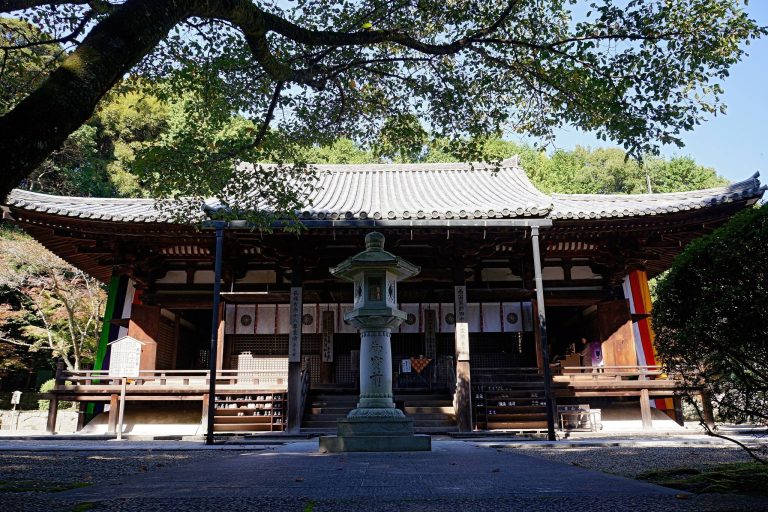
Built in 1279, the main hall is a representative Kamakura-period Esoteric Buddhist building and a notable example of Japanese-style temple architecture. It measures five ken, or bays between supporting columns, across its front, approximately 15 m, and six bays in depth, approximately 14.6 m. Its roof combines sloping planes with gabled ends, and a projecting canopy shelters the entrance. The construction date is preserved by black-ink writing on a structural timber.
Eleven-Headed Kannon shrine
The principal image is a 1.20 m-high wooden statue from the late Heian period. Carved from a single block of wood, it has raised eyes, a deeply modelled body, and other archaic features characteristic of the sculpture. The image stands within a black lacquered shrine. Its inner doors carry a Womb Realm Mandala and a standing Fudo Myoo on the left, with a Diamond Realm Mandala and a standing Trailokyavijaya on the right. The mandalas are diagrammatic representations of the Buddhist cosmos and its deities. The image is publicly shown for a limited period in January.
Jizo statue and stone basin
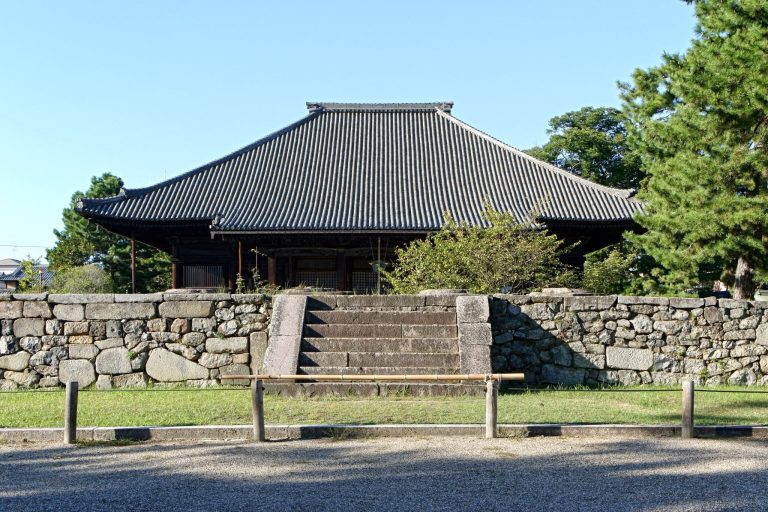
A Jizo statue carved from a single pine trunk is dated 1315. It is regarded as the work of the father-and-son sculptors Koshun and Kosei, who were master sculptors associated with Kofukuji. Below the main hall, on the left side at the foot of the stone staircase, is a stone handwashing basin. Its size is said to have allowed it to serve as a steam-bathing vessel in earlier times.