Inarizuka Kofun: An Octagonal Burial Mound in Tokyo


Site at a Glance
- Rating
- 4
- Popularity
- Very Low
- Country
- Japan
- Primary era
- Medieval
- Eras represented
- Medieval
- Civilizations
- Yamato
- Site type
- Burial
- Remains
- Burial Mound
On this page11 sections
History
Inarizuka Kofun is a late Kofun-period burial mound in Tokyo, Japan, constructed during the first half of the seventh century. A kofun was a large Japanese burial mound built mainly between the third and seventh centuries for members of ruling and elite groups. The person buried at Inarizuka is unknown because the stone chamber had already been looted.
The Wada Kofun Group
Inarizuka formed part of the Wada Kofun Group, which extends along both banks of the Okuri River, a tributary south of the Tama River. The group was built mainly from the middle of the sixth century to the middle of the seventh century. It includes Usuidzuka Kofun, Koshinzuka Kofun, the Tsukahara Kofun Group, the Nakawada Horizontal-Burial-Cave Group, and the Manzoin-dai Kofun Group. Numerous dwelling remains and pottery from the Kofun period have also been found in the wider group, while many mounds have been levelled and surrounding areas remain archaeologically uninvestigated.
Inarizuka is the second-largest known seventh-century kofun in Tokyo, after Kitaotani Kofun in Hachioji, in the same Minami-Tama area. The two mounds are separate, and their relationship is unknown, although their construction dates and stone-chamber structures share several features.
Changing Interpretations
The wider history of Tama has sometimes been connected with the Musashi Provincial Governor’s Revolt of 534 described in the Nihon Shoki, an early eighth-century chronicle. Its account says that Kasahara no Atai Omi, the kuni no miyatsuko, or hereditary regional chieftain, of Musashi defeated Oki with support from the Yamato court, the early Japanese political centre that expanded its authority over regional rulers. Kasahara then offered four areas, including the Tahi imperial domain, to the court. Some interpretations identify Tahi with the present Tama region.
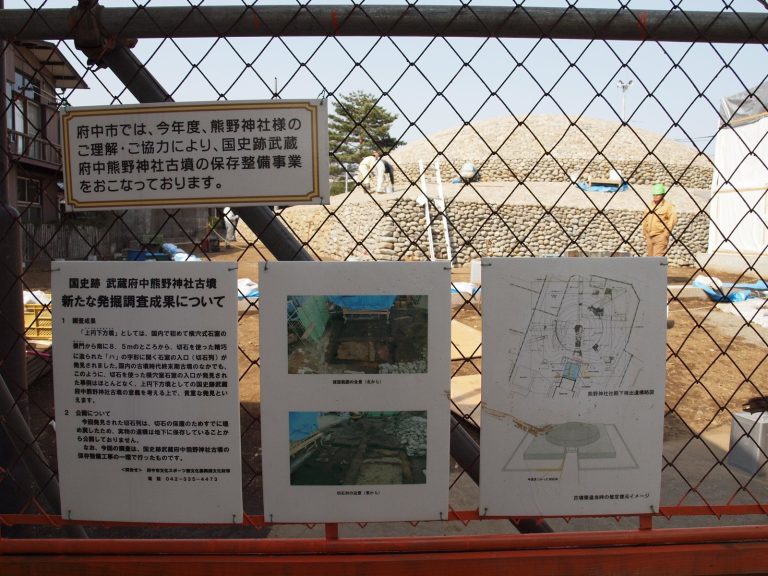
For much of the twentieth century, Inarizuka was considered circular. Reinvestigations carried out from the 1980s through the first half of the 1990s established that its plan is octagonal. An octagonal kofun has a mound with eight sides, an uncommon form among Japanese burial mounds and one previously unconfirmed in eastern Japan. The discovery altered the earlier view that octagonal mounds were characteristic of imperial tombs built from the middle of the seventh century onward, including tombs attributed to Emperor Tenji and to Emperors Tenmu and Jito. Around fifteen octagonal kofun are known among approximately 150,000 kofun in Japan.
Religious Change and Investigation
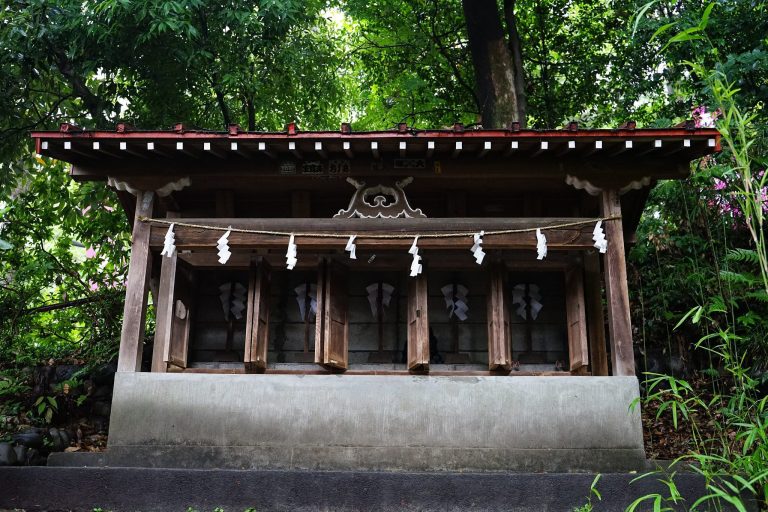
During the Edo period, the temple Saifukuin stood east of the mound. In the early Meiji period, the separation of Buddhism and Shinto, together with the accompanying anti-Buddhist movement, led to the construction of Koiji Inari Shrine on the mound. This work cut down the upper part of the mound and removed most of the ceiling stones. The burial chamber was reportedly robbed of its grave goods during this alteration.
An excavation in November 1952, led by a teacher from Tama Municipal Tama Middle School with technicians from the Tokyo National Museum and students from the school, clarified the structure of the chamber and surviving mound. The site was designated a Tokyo Metropolitan cultural property and historic site in 1953. The chamber was once open to the public but was later reburied for protection. Panels, a reconstruction model of the chamber, and a section removed from its floor are displayed at the Parthenon Tama History Museum.
Remains
Mound and Burial Facility
Octagonal Mound
The mound has an octagonal plan and measures approximately 38 metres overall, including a surrounding ditch about 2 metres wide. The mound itself is approximately 34 metres long and was built in two stages. It may originally have stood about 4 metres high. Construction of Koiji Inari Shrine removed much of the second stage, leaving the mound about half its former height.
Stone Burial Chamber
The burial facility is a cut-stone, horizontal-entry chamber made of tuff, a relatively soft rock formed from compacted volcanic ash. The passage enters the mound from the side and leads through three connected parts over a total length of approximately 7.7 metres. The entrance passage is about 1.6 metres long and 1.2 metres wide, the front chamber about 2.3 metres long and 1.7 metres wide, and the main chamber about 3.8 metres long and 3 metres wide.
A single stone approximately 1.6 metres high and 1.2 metres wide forms part of the rear wall of the main chamber. Large stones, including a doorway pillar about 1.7 metres high, separate the main and front chambers. The walls of both chambers curve outward like the body of a traditional three-stringed instrument. This arrangement is a multi-chambered, bulging-wall structure, meaning that the burial space is divided into an entrance passage, a front chamber, and a main chamber whose walls have a pronounced outward curve.
Interior Surface and Protection
Floor Treatment
The chamber floor was covered with benigara, a red pigment made from iron oxide, and scattered with rounded paving stones approximately the size of a clenched fist. These surviving floor materials form part of the evidence used to understand the chamber’s construction and treatment.
Buried Preservation
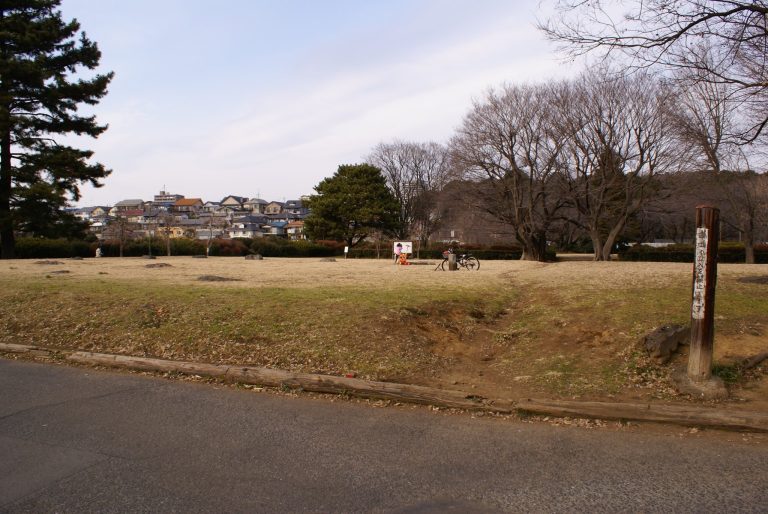
The chamber is protected underground rather than exposed. Blocks of different colours mark its position, outline, and approximate dimensions above ground, allowing the buried structure’s plan and scale to be indicated while preserving the chamber below the surface.