Ōsen-ji Temple: A Shingon Buddhist Temple in Kawasaki


Site at a Glance
- Rating
- 4.1
- Popularity
- Low
- Country
- Japan
- Primary era
- Medieval
- External website
- Open
- Eras represented
- Medieval
- Civilizations
- Ashikaga shogunate
- Site type
- Religious
- Remains
- Monastery
On this page7 sections
History
Ōsen-ji Temple is a Buddhist temple in Kawasaki, Japan, associated with the Buzan branch of Shingon Buddhism, an esoteric tradition centered on ritual practice, mantras, and mandalas. Its exact foundation date is unknown, although a 1650 origin record places its beginnings in 757. The temple later served as an imperial prayer temple for the protection of Japan’s eastern provinces and developed into a major center for the study of Shingon teachings.
Origins and re-foundation
The 1650 record states that a small golden image of Shō-Kannon, a Buddhist bodhisattva associated with compassion, was found in Musashi Province after appearing in a dream of Emperor Kōken, an eighth-century Japanese sovereign. The discovery is placed at Nihonmatsu in Tsuzuki District, although Hikarigaya is also named. The image became the temple’s principal object of worship.
Temple tradition places a major re-foundation in 917, when a monk from Mount Kōya, described as the institution’s third-generation leader, received the name Ōzen-ji from Emperor Daigo, who ruled Japan in the late ninth and early tenth century. The temple came to be regarded as the “Mount Kōya of the East” and served as an imperial prayer temple for the eastern provinces. In 921, another monk from Mount Kōya is said to have reorganized it as a Shingon Buddhist temple.
Medieval development and destruction
During the Kamakura period, the shogun granted Ōsen-ji substantial temple estates. In 1214, a self-sown persimmon tree was discovered at the temple by a monk of Enmei-in, a subtemple of Shōmyō-ji in present-day Kanazawa. The monk had been searching the hills for timber to rebuild his temple. He later helped spread the tree’s cultivation among nearby farmers, giving rise to the persimmon cultivar known as Zenjimaru.
The temple was burned and destroyed in 1333 during the warfare surrounding Nitta Yoshisada’s attack on Kamakura. Nitta Yoshisada was a medieval military commander. Ōsen-ji was rebuilt in 1370 and later expanded into an educational institution for Shingon esoteric Buddhism, with a seven-hall monastic complex and numerous subtemples. It had no parishioners and was administered as the head temple of 36 nearby branch temples, whose payments supported it.
Early modern administration and religious change
During the Sengoku period, Japan’s era of prolonged civil warfare from the fifteenth to the late sixteenth century, Hōjō Ujinao confirmed the temple’s entitlement to thirty kan of silver. Under the Edo period, the Tokugawa government granted it thirty koku, a unit used to assess agricultural land revenue, through a vermilion-seal authorization. The temple also enshrined memorial tablets for Tokugawa Ieyasu, founder of the Tokugawa shogunate in 1603, and the next thirteen Tokugawa shoguns. The Tokugawa family authorized its use of the three-leaf hollyhock crest.
Before the Meiji Restoration, Ōsen-ji combined Buddhist practice with the worship of kami, the spirits or deities of Japanese religious tradition. For a period, it also held the position of bettō, an administrative supervisory office, over Kamakura Hachimangū and Hachimangūji. Hachimangūji was later abolished under the Meiji government’s anti-Buddhist policies.
Ōsen-ji is formally affiliated with the Buzan branch of Shingon Buddhism, whose historical center was the Hasedera temple tradition in Nara. It is also associated with the former Thirty-Three Kannon pilgrimage circuit of the Kozukue domain, where it was listed as site number 22. The national government registered the original Zenjimaru persimmon tree as a Registered Monument in 2007.
Remains
Temple precincts and former complex
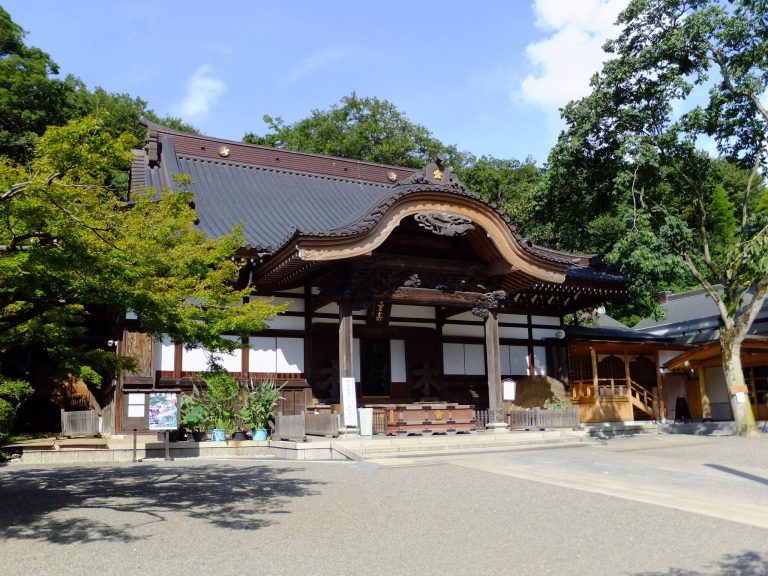
The surviving precincts preserve elements of Ōsen-ji’s historical setting. A historical picture shows the former seven-hall monastic complex, a traditional Buddhist arrangement organized around seven principal halls, together with its numerous subtemples. Part of the former grass horse-racing course also survives within the grounds. The area continues to be known locally as Baba, meaning “horse grounds.”
Worship and named features
The principal object of worship is a golden image of Shō-Kannon measuring one sun and eight bu. The temple’s name incorporates separate mountain and temple designations, while the precincts retain the Zenjimaru persimmon tree associated with the cultivar’s discovery and early cultivation. The three-leaf hollyhock remains the temple’s distinctive crest.