Alexandria on the Caucasus: A Hellenistic Colony and Kushan Capital in Afghanistan
Site at a Glance
- Rating
- 4.5
- Popularity
- Very Low
- Country
- Afghanistan
- Primary era
- Classical
- Eras represented
- Classical
- Civilizations
- Achaemenid, Kingdom of Macedon
- Site type
- City
On this page11 sections
History
Alexandria on the Caucasus was a Hellenistic fortified colony in Afghanistan, founded by Alexander the Great in March 329 BC in the southern foothills of the Hindu Kush. The city stood in the ancient region of the Paropamisadae, at a communications crossroads linking eastern and western cultural centers. Its name reflects the Greek use of “Caucasus” for several distant mountain ranges, including the Hindu Kush. The settlement is associated with modern Bagram, although its exact identification remains debated and Charikar has also been proposed.
Persian settlement and Alexander’s refoundation
The area’s first settlement date is unknown. Around 500 BC, Cyrus II, commonly called Cyrus the Great, destroyed an earlier city during a campaign against nomadic groups and established a garrison there. Darius I, his successor, later rebuilt the settlement. Alexander’s foundation was therefore a refoundation on or near an Achaemenid Persian settlement traditionally identified as Kapisa. The Achaemenid Empire was the Persian imperial state that ruled much of western and Central Asia before Alexander’s conquest.
Alexander established a new fortified colony and settled it with veterans and other members of his army. One estimate gives a population of 7,000 Macedonians, 3,000 mercenaries, and several thousand local inhabitants. The settlement’s planned form and defensive character reflected its role at an important route junction and on the edge of Alexander’s expanding eastern territories.
Seleucid and Indo-Greek rule
After Alexander’s death in 323 BC, the city came under Seleucus I Nicator, founder of the Seleucid Empire, the Hellenistic kingdom created from part of Alexander’s former territories. In 305 BC, the settlement became involved in negotiations between the Seleucid and Mauryan empires. The Mauryan Empire was the major Indian state founded by Chandragupta Maurya, and its expansion brought territory south of Bagram under Mauryan control. The city marked the eastern limit of the Seleucid Empire. In 206 BC, Indian groups were defeated near it during the eastward invasion of Antiochus III, a Seleucid king who expanded the kingdom during the late third and early second centuries BC.
During the Indo-Greek period, approximately 180 BC to AD 10, Alexandria was one of the kingdom’s capitals and held an important political and economic position. The Indo-Greek kingdoms were Hellenistic states established in parts of Central and South Asia after the breakup of Alexander’s empire. Around 140 BC, the Yuezhi displaced Greek rulers from Bactria, and the city became a capital associated with the Eucratid rulers. Eucratides I was a Greco-Bactrian king of the second century BC.
Religious life combined traditions from the Greek world with later developments. Coins associated with the city during the reign of Eucratides I depict Zeus, the chief god of the ancient Greek pantheon, suggesting that he was a principal or major civic deity. The Greek pantheon remained the primary religious tradition, while Hinduism also developed in the city during a later period.
Buddhist and Kushan-era capital
During the reign of Menander I, Alexandria had a flourishing Buddhist community led by Greek-speaking or Greek monks. Buddhist tradition identifies the monk Mahadharmaraksita as originating from “Alasandra,” probably Alexandria on the Caucasus. The tradition also records his participation, with 30,000 monks, in the foundation ceremony of the Great Stupa at Anuradhapura in Sri Lanka. Buddhism is a religious tradition centered on teachings about suffering, ethical conduct, meditation, and liberation.
Later called Kapisa or Bagram, Alexandria became part of the Kushan imperial capital during the first century AD. The Kushan Empire controlled a broad Central and South Asian trading zone that included Bagram. Kushan armies launched southward campaigns from the region and conquered Peshawar. The city’s position on routes between eastern and western cultural centers supported extensive commercial exchange. The Begram Treasure reflects this activity through objects connected with Greek, Roman, Chinese, Indian, Egyptian, and Syrian artistic traditions. Although these works circulated together, they generally retained distinct stylistic identities rather than displaying extensive cultural mixing.
Late antique and early medieval phases
Alexandria later became part of the Sasanian Empire, the pre-Islamic Persian imperial state that ruled Iran and neighboring regions from the third to the seventh century AD. After the Hephthalite invasion, the city became the capital of the small Nezak kingdom. The Hephthalites, also known as the Iranian Huns, were a Central Asian power that expanded into the region during late antiquity, while the Nezaks were a smaller polity associated with their successors or related rulers.
In the seventh century, the Chinese Buddhist pilgrim and scholar Xuanzang described Kapisa as a capital and recorded a cult centered on an elephant-associated deity. Turkic Shahis already ruled the area by this time. The city was probably an important mint under the Indo-Greeks, Kushans, Sasanians, and possibly the Iranian Huns. A mint was an authorized place where rulers produced coins.
Archaeological rediscovery
Charles Masson gathered archaeological evidence related to the lost city during the nineteenth century, including coins, rings, seals, and other small objects. In the 1930s, Roman Ghirshman directed excavations near Bagram. These investigations produced evidence used to interpret the city’s commercial connections and the westward movement of imports from India. The remains suffered slight damage from shelling during the Afghan war of the twenty-first century.
Remains
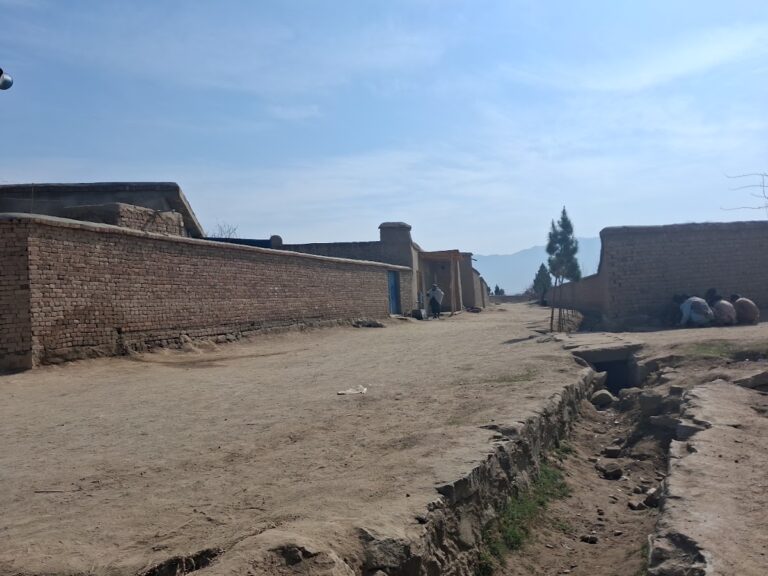
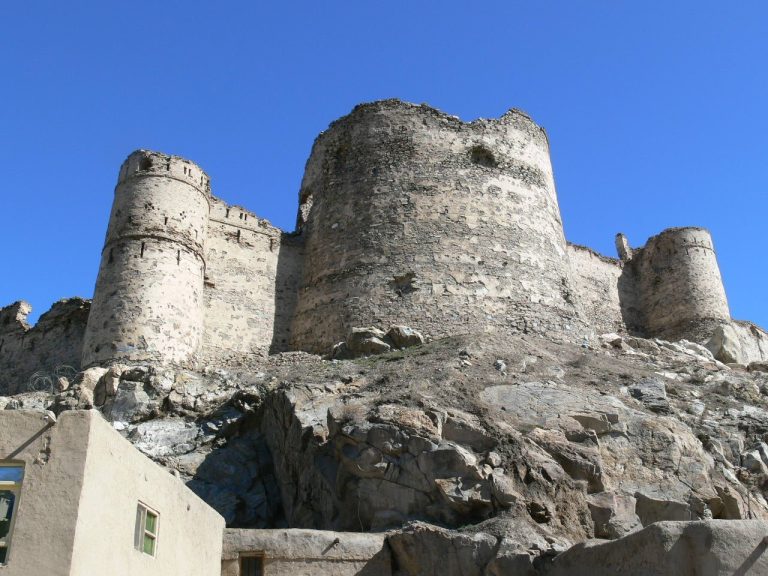
The surviving remains consist of a rectangular archaeological mound, or tell, and a nearby circular citadel. A tell is a mound formed by accumulated remains from successive occupation, while a citadel is a fortified stronghold within or adjoining a settlement. The rectangular tell measures approximately 500 by 200 metres. Together, these features preserve the outline of a planned fortified settlement associated with the site identified as Alexandria on the Caucasus, later Kapisa and Bagram.
Urban plan and defenses
Planned streets and commercial area
The settlement followed the Hippodamian plan, a regular urban grid in which intersecting streets form rectangular blocks. Three longitudinal streets ran from east to west and crossed perpendicular streets running north to south. A central road gave access to shops and workshops, indicating a planned area for commerce and craft production within the colony.
Fortifications and citadel
Walls enclosed the settlement and were reinforced by towers at the corners. Alexander’s defenses replaced or incorporated an earlier Persian fortification established after Cyrus II destroyed the preceding city. The circular citadel lies near the rectangular tell and represents a separate fortified element in the surviving archaeological landscape.
Objects and artistic remains
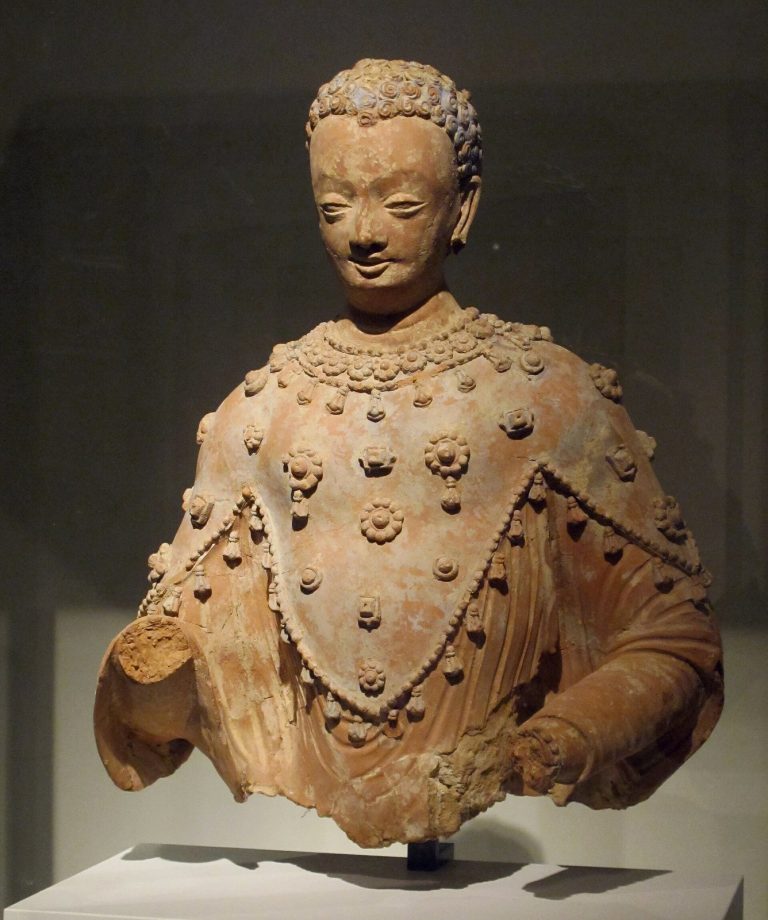
Finds associated with Bagram include coins, rings, seals, Egyptian and Syrian glassware, bronze statuettes, bowls, statues, and Indian ivories. The collection also includes figures of Harpocrates, a Hellenistic form of the Egyptian god Horus, and Serapis, a Greco-Egyptian deity whose cult spread through the Hellenistic and Roman worlds. Other objects include a youthful figure of Alexander, a glass vessel depicting a gladiator, and a vessel showing Zeus carrying off Ganymede in the form of an eagle.
Additional material includes pottery fragments with a battle scene and plaster disks depicting Eros and a Greek soldier. A Bagram medallion, possibly showing Alexander, is held by the National Museum of Afghanistan. A bronze figure of Alexander and a figure of Aphrodite are also associated with the archaeological material from the site. These remains reflect the range of artistic traditions that circulated through the city during its long history as a political and commercial center.