Paitava: A Buddhist monastery near Kapisa

Site at a Glance
- Rating
- 3.3
- Popularity
- Very Low
- Country
- Afghanistan
- Primary era
- Unclassified
- Eras represented
- Unclassified
- Civilizations
- Unclassified
- Site type
- Religious
- Remains
- Monastery
History
Paitava is a Buddhist monastery in Afghanistan that developed under Kushan influence and was active by the third century CE. It lay with the contemporary monastery of Shotorak around the city of Kapisa, which served as the Kushan Empire’s northern capital; the site stood 40 kilometres north of Kabul and roughly 7 kilometres from Begram. Kushan coins recovered at Paitava indicate an early Kushan presence.
Some sculpture dates to the third century CE, including a relief known as the Twin Miracle that combines water and fire, while other works are assignable to the Kidarite period, about 320–467 CE. Devotional production therefore continued across those centuries.
In the seventh century the Chinese pilgrim Xuan Zang visited and located Paitava beside a large city he called Si‑pi‑to‑la‑fasse, which he described as Kapisa’s principal urban centre. Paitava and Shotorak share a visual convention that shows the Buddha with flames issuing from his shoulders in the Miracle of Sravasti, a motif also used on Kushan royal coin portraits.
Remains
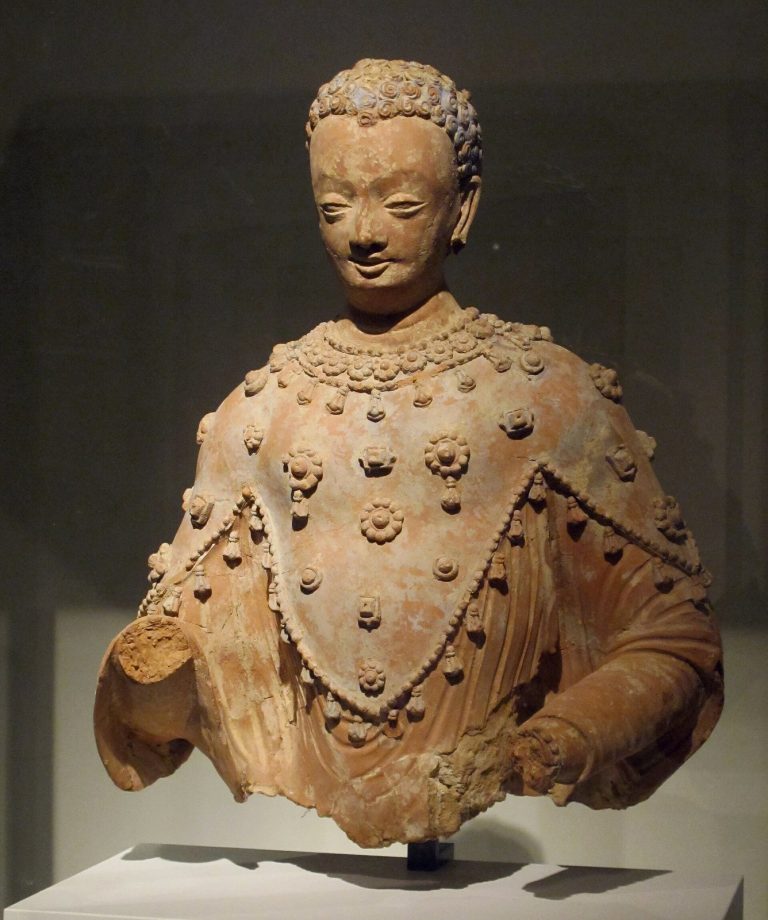
The site survives as a Buddhist monastic complex containing important and varied sculptural and numismatic remains. Notable finds include carved donor figures presented in Kushan-style dress, narrative reliefs depicting the Miracle of Sravasti, and a depiction pairing the Buddha with figures identified as Heracles and Tyche. The Twin Miracle scene is among the best-known pieces and is assigned to the third century CE. Multiple Kushan coins recovered within the complex testify to early occupation and help date its phases. The artworks demonstrate the mingling of Hellenistic and local imagery within monastic contexts around Kapisa.