Mes Aynak: A Buddhist and Copper-Mining Settlement in Afghanistan
Site at a Glance
- Rating
- 4.8
- Popularity
- Very Low
- Country
- Afghanistan
- Primary era
- Medieval
- Eras represented
- Bronze Age, Classical, Medieval
- Civilizations
- Kushan
- Site type
- City
On this page9 sections
History
Mes Aynak is a major Buddhist and copper-mining settlement in Afghanistan, about 40 kilometres southeast of Kabul in Logar Province. Its name means “little source of copper,” reflecting the mineral resources that helped shape its history. The settlement reached its greatest prosperity between the fifth and seventh centuries AD, during a period associated with the Kushan cultural tradition and later influences from Tang China and the Uyghur world.
Early mining and Buddhist settlement
Activity at Mes Aynak began long before the Buddhist settlement. Bronze Age remains beneath the later levels may be about 5,000 years old, while some recovered objects are more than 3,000 years old. Evidence of earlier civilizations may extend to the third century BC. Ancient copper workings and a smelting furnace show that people were extracting and processing metal in the area before the Buddhist complex developed.
Buddhists appear to have begun settling at Mes Aynak nearly two millennia ago, probably in connection with the copper resources. Religious communities grew beside an industrial landscape that included mining, smelting, commerce, and housing. The settlement’s archaeological remains therefore preserve evidence of both Buddhist life and organized copper production.
Prosperity and later decline
Coins of Khingila and Mehama, rulers of the Alchon Huns, indicate an Alchon presence in the area around AD 450 to 500. The Alchon Huns were a Hunnic ruling group active in parts of Central and South Asia during late antiquity. Their coins place Mes Aynak within the political and economic networks of the period, when the settlement was entering its most prosperous phase.
The settlement began a gradual decline in the eighth century and was abandoned approximately two centuries later. Its Buddhist remains are associated with the Kushan period and also reflect later Tang and Uyghur influences. Sculptures and inscriptions from the site belong to the artistic tradition of Gandhara, a Buddhist art form that combined South Asian religious subjects with Hellenistic and Central Asian influences.
Rediscovery and the mining threat
Copper deposits at Mes Aynak were known before the archaeological complex was identified by Russian and Afghan geologists in 1973 and 1974. The site came to be regarded as a major historical-heritage location, and the French archaeologist Philippe Marquis described it as one of the most important points along the Silk Road.
In November 2007, Afghanistan granted the China Metallurgical Group a 30-year lease for copper mining. The agreement, valued at US$3 billion, was described as the country’s largest foreign investment and private business venture. The Afghan Mining Ministry estimated that the deposit contained approximately six million tons of copper, with a potential value of tens of billions of dollars. Plans also included a railway, a 400-megawatt power plant, and a coal mine. Allegations arose that the then-minister of mines had obstructed the bidding process and accepted a bribe.
The proposed mine threatened to destroy the archaeological remains and the material buried beneath them. By July 2012, the mining company had not produced an environmental-impact plan, had kept feasibility studies secret, and had not fulfilled some commitments concerning the relocation of villagers. Falling copper prices contributed to delays. The mine project was inaugurated with the start of a road to the mine on 24 July 2024.
Rescue excavation
Because the mining plans were expected to destroy much of the site, a limited rescue-excavation program was established. The program allowed a small team led by the French Archaeological Mission to Afghanistan to recover artifacts that could be removed, but it did not guarantee preservation of the entire complex.
Between May 2010 and July 2011, archaeologists excavated approximately 400 items. A 2012 expert conference concluded provisionally that cooperation between archaeologists and mining engineers might still preserve some cultural remains, although the site was then scheduled for destruction in January 2013.
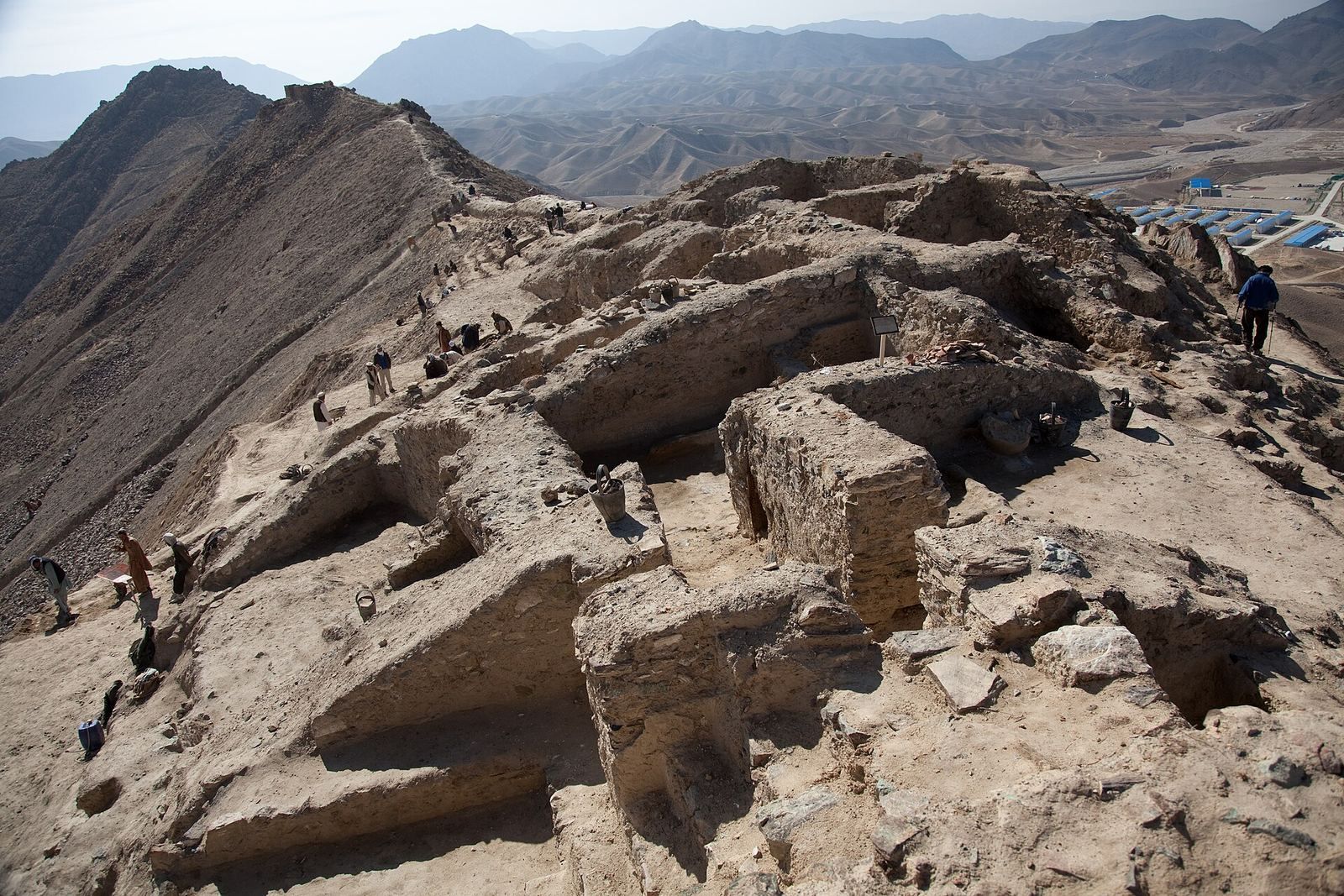
In 2013, an international team of 67 archaeologists, about 550 local laborers, and 200 armed guards worked at Mes Aynak in what was described as potentially the world’s largest rescue excavation. By June 2014, the work continued with a much smaller international and Afghan staff, assisted by seven Tajik archaeologists. Shortages of personnel and security problems continued to affect the project. Ground-penetrating radar, a non-destructive method that uses radar pulses to detect buried structures and changes in soil, was combined with georectified photography and aerial three-dimensional imaging to create a detailed digital map of the ruins. The United States Embassy in Kabul provided US$1 million in military funding to support the effort.
Excavators were denounced as promoting Buddhism and threatened by the Taliban. On 17 May 2020, an attack on a security checkpoint near the Mes Aynak mine killed eight security guards and wounded five others.
Remains
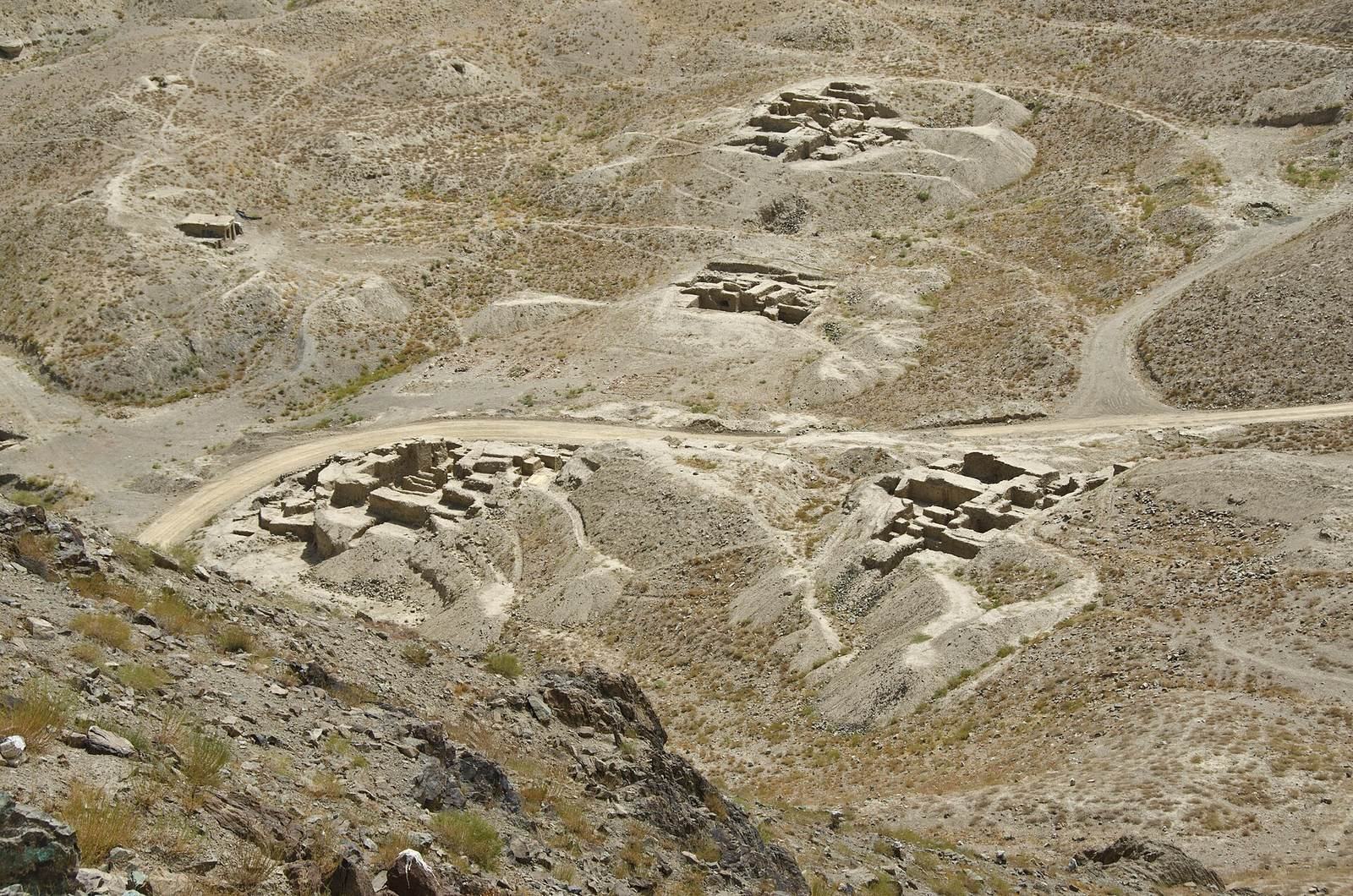
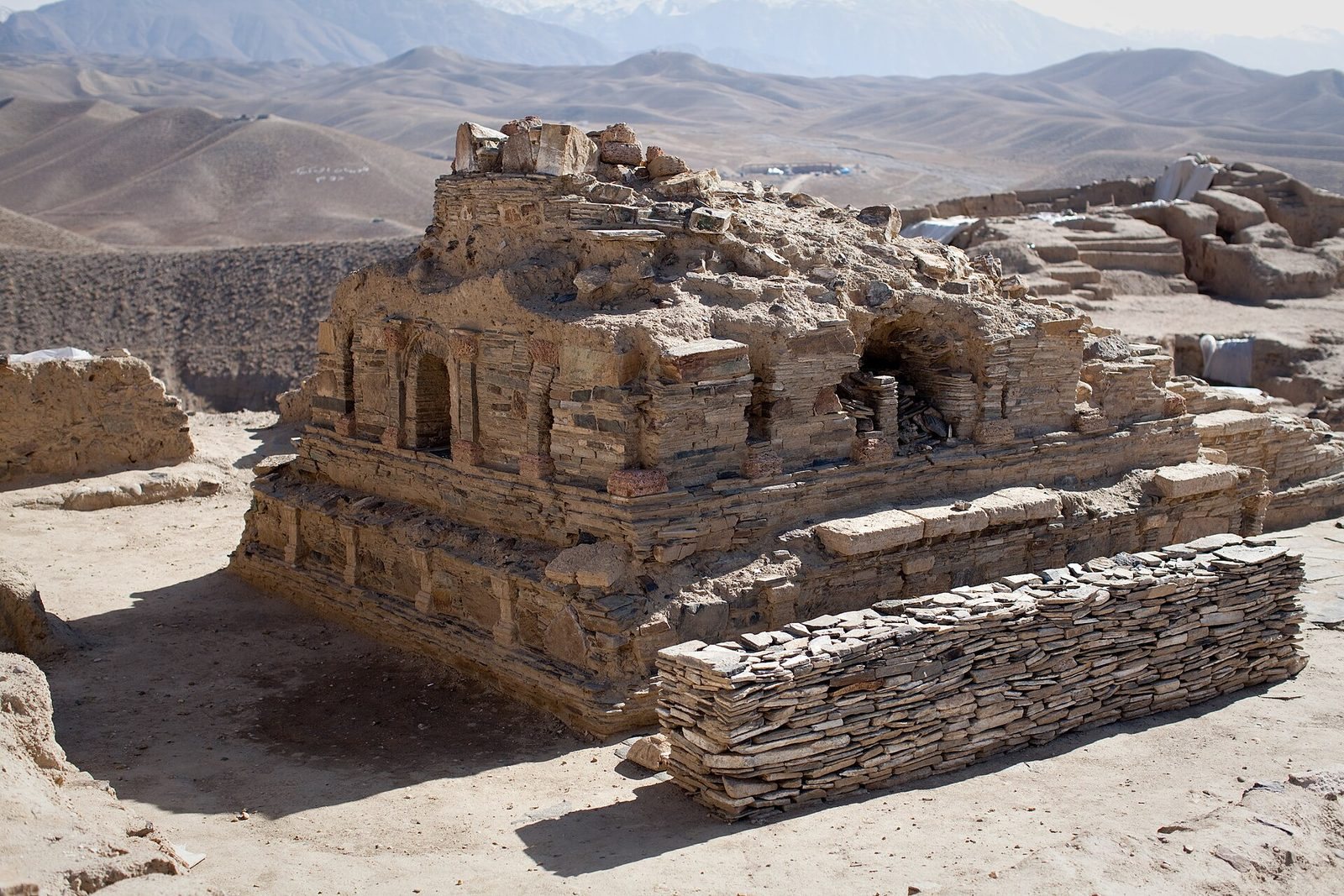
Mes Aynak covers approximately 40 hectares, or about 400,000 square metres, in a barren region of Logar Province. The complex includes Buddhist monasteries, residences, more than 400 Buddha statues, stupas, commercial or market areas, copper workings, smelting installations, a mint, and housing for miners. The valley is thought to contain 19 separate archaeological sites, including two small forts, a citadel, four fortified monasteries, several stupas, and a Zoroastrian fire temple.
Settlement and religious complex
The surviving settlement combines religious, residential, defensive, and commercial areas. Its monasteries formed the principal Buddhist architectural group, while the forts and citadel provided defended spaces within the wider valley. A stupa is a Buddhist monument usually built as a reliquary or commemorative structure, and the stupas at Mes Aynak belong to the religious remains associated with the settlement’s long period of Buddhist activity. Residences and market areas show how monastic and industrial functions existed alongside one another.
Copper workings and production areas
Ancient copper workings extend beneath and around the Buddhist levels. Smelting workshops, an ancient copper-smelting furnace, a mint, and housing for miners preserve evidence of extraction, metalworking, production, and labor. The Bronze Age workings and furnace provide a physical link between the earliest known metallurgy at Mes Aynak and the later industrial activity that helped sustain the settlement.
Sculpture, inscriptions, and objects
The complex has yielded coins, glass, tools associated with their production, sculptures, and inscriptions. Some of this material dates back thousands of years, and the coins of Khingila and Mehama connect the site with the Alchon Huns around AD 450 to 500.
A stone statue or stele discovered in 2010 has been identified as Prince Siddhartha before his enlightenment. Siddhartha Gautama is the historical figure traditionally regarded as the founder of Buddhism, and the identification has supported the possibility that Mes Aynak included a monastic cult devoted to his life before enlightenment. The sculptures and inscriptions are also important examples of Gandhara art, preserving the religious and artistic character of the settlement within its wider Central and South Asian setting.