Fondukistan Monastery: An Early Eighth-Century Buddhist Monastery in Afghanistan
Site at a Glance
- Popularity
- Very Low
- Country
- Afghanistan
- Primary era
- Medieval
- External website
- Open
- Eras represented
- Medieval
- Civilizations
- Unclassified
- Site type
- Religious
- Remains
- Monastery
On this page6 sections
History
Fondukistan Monastery was a Buddhist monastery in Afghanistan, built on a hill beside the Ghorband Valley in what is now Parwan Province during the early eighth century CE. Its art is generally dated to around 700 CE, following numismatic evidence that places activity after 689 CE. This date is regarded as the only secure chronological point for this artistic period in the Hindu Kush and provides an important reference for its study.
Turk Shahi Buddhist Culture
The monastery belonged to the period of Buddhist Turk Shahi rule, a dynasty that controlled parts of the Hindu Kush and neighboring Central Asian regions during the seventh and eighth centuries. Its artistic program reflects the continued development of Buddhist art, possible Hephthalite influence, and the cultural inheritance of the Sasanian Empire, the major Iranian imperial state that ruled from 224 to 651 CE. It also represents the last stages of Greco-Buddhist art, which combined Buddhist subjects with forms shaped by interaction with the Hellenistic world.
Fondukistan developed within a wider movement of religious and artistic exchange. The Tang Empire, the Chinese dynasty that ruled from 618 to 907 CE, promoted Buddhism across Central Asian kingdoms, including Afghanistan. Indian monks also moved north into Central Asia in search of protection. These movements helped produce hybrid Indian and Chinese-influenced styles associated with Fondukistan and Tapa Sardar, another Buddhist archaeological site in Afghanistan. Similarities have also been noted between Fondukistan’s art and contemporary Chinese works at Tianlongshan, a Buddhist cave-temple site.
Rediscovery and Excavation
Charles Masson visited the Ghorband Valley in 1836 and described numerous ruins during his travels through Afghanistan, Baluchistan, and the Punjab. The monastery was excavated in 1936 by Joseph Hackin of the French Archaeological Delegation in Afghanistan, with further work conducted in 1937 by Jean Carl. Most of the recovered artworks were divided between the Musée Guimet in Paris and the National Museum of Afghanistan. Many pieces were later lost during the destruction and disorder that affected Afghanistan in recent decades.
Remains
The monastery occupied the summit of a conical hill beside the Ghorband Valley, approximately 50 kilometers northwest of Kabul. Its complex contained small shrines packed closely with sculpted figures set against brightly painted backgrounds. This arrangement created a theatrical sequence of religious images, sometimes described as a “religious peep-show.” The surviving evidence combines Buddhist imagery with clothing, armor, crowns, and other features showing Central Asian and Iranian cultural connections.
Sculpture and Painting
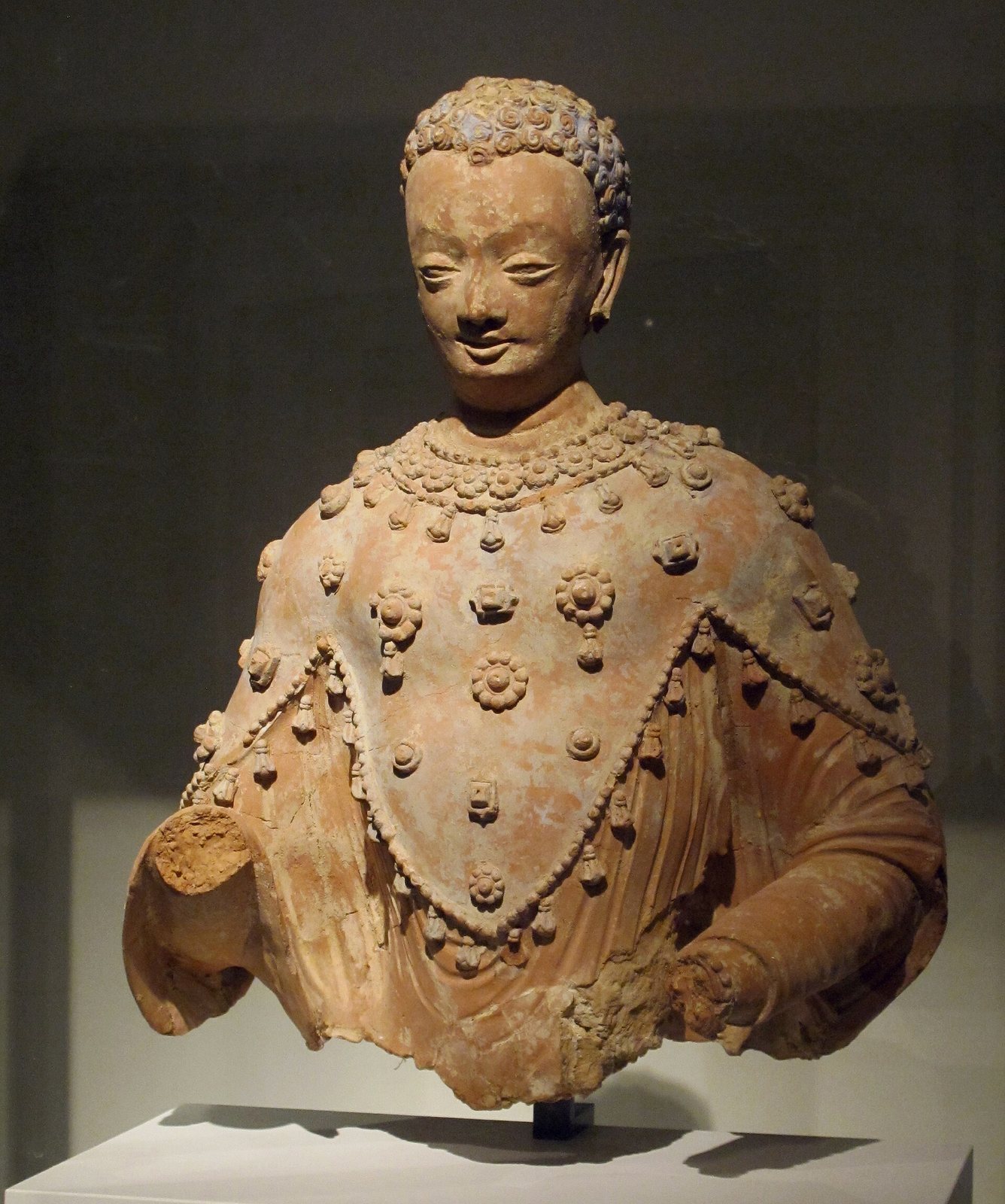
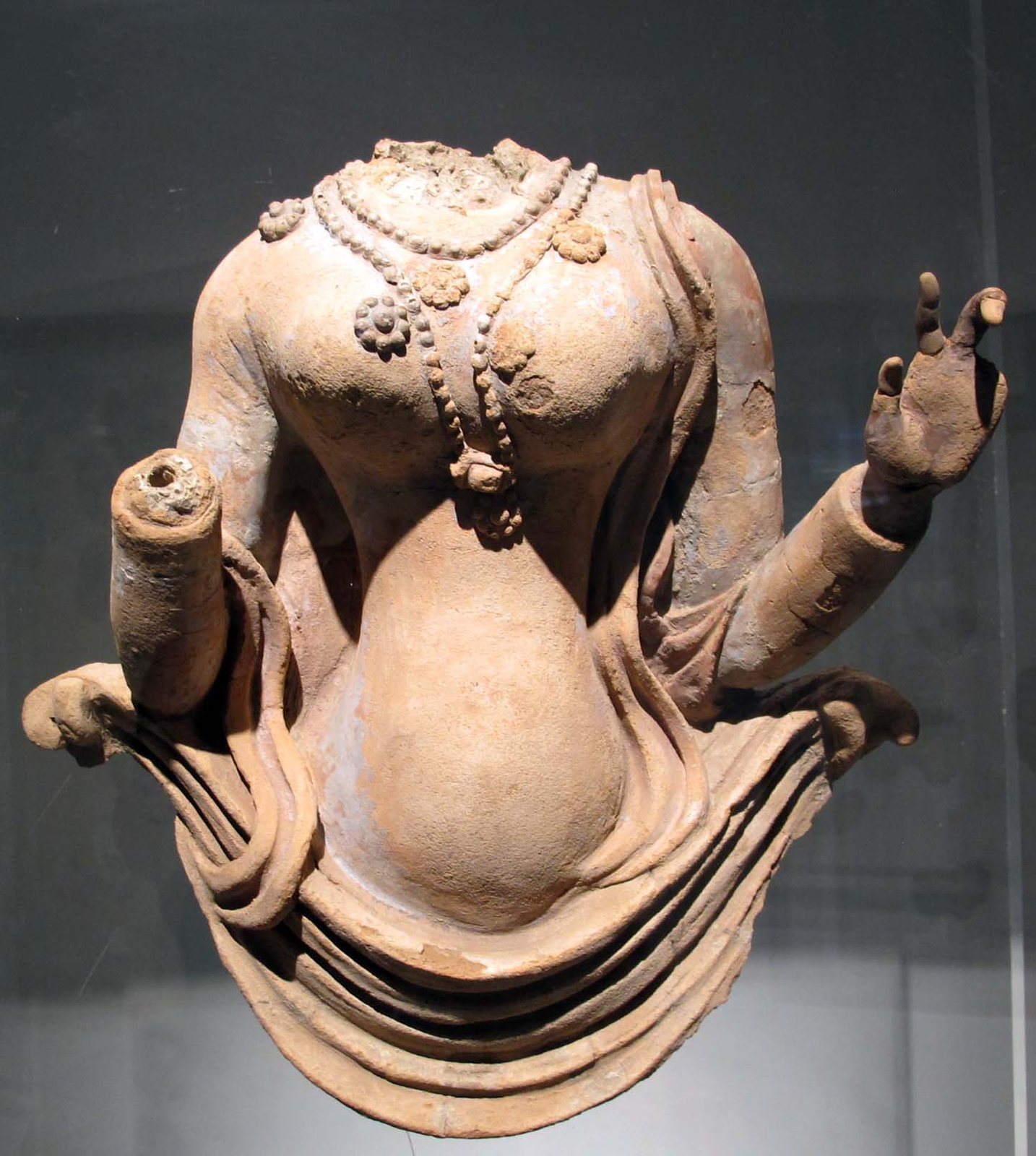
Excavated sculptures include seated Buddhas, seated and other Bodhisattvas, Naga kings, a female bust, and a royal couple. A Bodhisattva is a being who postpones final Buddhahood to aid others, while Naga kings are serpent-associated figures in Buddhist and South Asian religious traditions. One Buddha wears an Iranian-style three-pointed chamail, a distinctive item of dress identified in the sculpture. Other figures wear double-lapel caftans, boots, and armor, while some crowns are decorated with lunar crescents.
The royal couple presents contrasting regional styles. The queen wears Indian-style dress, while the prince is shown in a richly decorated Central Asian double-lapel caftan and boots. A painting of Maitreya, the future Buddha, dating to around 700 CE is held by the National Museum of Afghanistan. A seated Bodhisattva from approximately the same date is in the Kabul Museum, and the female bust is in the Musée Guimet.
Coin Deposit Beneath the Royal Couple
Dedications containing Buddhist Turk Shahi coins were placed beneath the statues of the royal couple. The coins were deposited in a cremation urn buried under the figures. The urn contained a Sasanian coin of the type associated with Khusrow II, the Sasanian ruler who reigned from 590 to 628 CE. It bears the Arabic legend “Bismillahi,” local countermarks, and a final strike date given as 686 CE.
The deposit also included a gold bracteate, a thin usually one-sided coin or medallion, bearing a ruler’s portrait, together with three early copper Turk Shahi coins classified as Göbl Type 236. Their Bactrian-script legend, “Srio Shaho,” means “Lord King.” This coin type is associated with the early Turk Shahi ruler Barha Tegin, whose portrait is dated to approximately the period when the monastery was established. The urn’s contents provide separate chronological indications, with the 689 CE terminus post quem marking the earliest possible date for the relevant activity and the 686 CE final strike belonging to the Sasanian coin itself.