Chagar Bazar: A Multi-Period Settlement Mound in Syria


Site at a Glance
- Rating
- 4.6
- Popularity
- Very Low
- Country
- Syria
- Primary era
- Bronze Age
- Eras represented
- Stone Age, Bronze Age
- Civilizations
- Babylonian
- Site type
- City
On this page12 sections
History
Chagar Bazar is a settlement mound in Syria, first established by communities of the Halaf culture around 6000 BC. It lies in the Khabur Basin on the Wadi Dara, a tributary of the Khabur River, approximately 30 to 35 kilometres north of Hasakah and near the ancient city of Nagar at Tell Brak. Its occupation continued through Neolithic, Chalcolithic, Early Bronze Age, and Middle Bronze Age phases, although the settlement was abandoned and reoccupied several times before permanent abandonment around the middle of the second millennium BC.
Halaf and Chalcolithic settlement
The earliest settlement belonged to the Halaf period, a Neolithic culture of northern Mesopotamia known for elaborately painted pottery and small figurines. Chagar Bazar may have been an important production centre for painted ceramics during this phase. The earliest occupation was concentrated at the northern end of the mound, where successive deposits accumulated over the prehistoric settlement.
Occupation continued into the Late Chalcolithic, including the northern Uruk phase. The Uruk period was associated with expanding urban settlements, administrative institutions, and early writing traditions in Mesopotamia. At Chagar Bazar, Late Chalcolithic activity shifted towards the southern part of the site. The settlement was later abandoned before being occupied again at the beginning of the third millennium BC during the Ninevite V phase, an early third-millennium tradition identified especially through its distinctive painted pottery.
Third-millennium developments
During the third millennium BC, occupation extended across the settlement. One phase corresponded with the Akkadian Empire, a major Mesopotamian state of the later third millennium BC, while a later phase followed the empire’s political collapse. A substantial building in area D belongs to this post-Akkadian phase, probably dating to the final century of the third millennium BC.
The Middle Bronze Age settlement corresponded to the Old Babylonian period, approximately 2004 to 1595 BC. This was the age of Amorite-led kingdoms in Mesopotamia and Syria, including Mari, Babylon, and the Kingdom of Upper Mesopotamia. Chagar Bazar’s second-millennium occupation was concentrated mainly on the northern mound, which covered about 5 hectares.
Ašnakkum and the Old Babylonian kingdoms
Chagar Bazar has been proposed as the Old Babylonian city of Ašnakkum, although no inscription from the site identifies it by that name. If the identification is correct, Ašnakkum belonged to Ida-Maraṣ, a regional political area of northern Mesopotamia, together with Ašlakkā, Ilān-surā, Kahat, Susā, and Šunā. The city appears in a year name of Naram-Sin, a ruler of Eshnunna, and in correspondence preserved at Mari, the ancient Euphrates kingdom known for its diplomatic and administrative archives.
In the early eighteenth century BC, the town formed part of the Kingdom of Upper Mesopotamia under the Amorite ruler Shamshi-Adad I and his son Yasmah-Adad. Its administrator was Sin-iqišam. His household included two principal wives, five secondary wives, and thirty-three songstresses, some of whom may also have been concubines.
Chagar Bazar later came under the control of Mari during the rule of Zimri-Lim. After Hammurabi of Babylon destroyed Mari, the surrounding region passed under Babylonian control. It subsequently became part of the Mitanni Empire, a Hurrian-associated kingdom that dominated parts of northern Mesopotamia and Syria during the second millennium BC. Old Babylonian evidence also indicates large-scale pig herding at the settlement. Personal names from the site contain a substantial Hurrian element, with Hurrian names making up approximately 29 percent of the recorded names, and Hurrian occupation of the city is reported for this period.
Excavation and interpretation
Trial trenches were opened at Chagar Bazar in 1934. The first major excavations followed from 1935 to 1937 under the British Museum and the British School of Archaeology in Iraq, with the British archaeologist Max Mallowan directing the work and Agatha Christie participating in the expedition. Excavation resumed in 1999 through cooperation among the British School of Archaeology in Iraq, the University of Liège, and Syria’s Directorate-General of Antiquities and Museums.
The renewed project examined the settlement’s long occupation, including periods of expansion and abandonment. Fieldwork continued until 2010, although results from seasons after 2002 had not yet been published. Excavation identified fifteen occupational layers and a substantial abandonment interval between the fifth and sixth layers. Investigations also took place at the nearby mounds of Tell Germayir and Tell Arbit, where remains from the third and fourth millennia BC were found.
Chagar Bazar is publicly owned and treated as an archaeological settlement site in Hasakah Governorate. Material from the excavations is held in several museum collections, and many finds were transferred to the British Museum.
Remains
Mound and occupational sequence
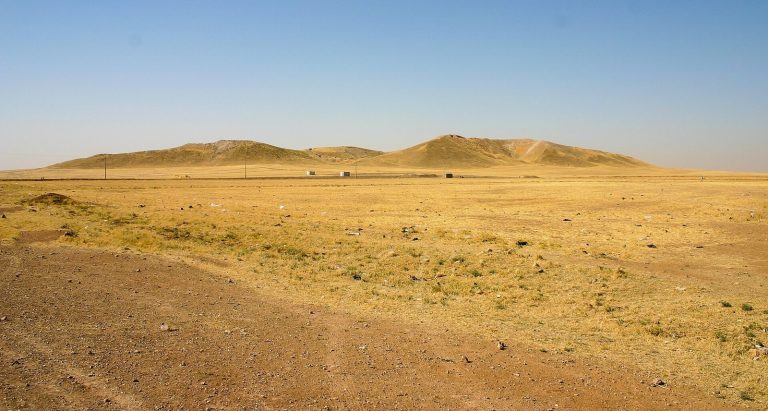
Chagar Bazar is a tell, an archaeological mound formed by successive building, occupation, abandonment, and rebuilding layers. It covers approximately 12 hectares and consists of two principal mounds: a smaller, higher southern mound and a larger, lower northern mound. The distribution of occupation changed over time. Halaf settlement was concentrated at the northern end, Late Chalcolithic activity was located at the southern end, and third-millennium occupation spread across the site. Second-millennium remains were largely confined to the northern mound.
A deep excavation known as the Prehistoric Pit penetrated the full occupational sequence. It reached virgin soil approximately 16 metres below the mound surface, where pottery of the Sakje Geuzi, or Coba Höyük, type was found. The sequence provides a vertical record of the settlement’s changing occupations from its prehistoric beginnings through later Bronze Age phases.
Buildings and administrative areas
Post-Akkadian building
A substantial building in area D dates to the post-Akkadian phase, approximately the final century of the third millennium BC. It belongs to the period that followed the political collapse of the Akkadian Empire and forms part of the architectural evidence for renewed third-millennium occupation across the mound.
Middle Bronze Age structures
A large structure, possibly palatial, was partly excavated within the Middle Bronze Age settlement. Other buildings from the second millennium BC were connected with grain storage. A nearby palace or palace-like building yielded administrative archives concerning household accounts, messengers, and dignitaries, revealing the bureaucratic activities associated with the settlement’s ruling or administrative institutions.
Cuneiform archives
The excavations produced a large group of cuneiform tablets, written in the wedge-shaped script used on clay for administrative, legal, economic, and literary records. Approximately 113 Old Babylonian tablets were recovered during Mallowan’s excavations. More than 200 additional tablets and fragments came from the campaigns between 1999 and 2002, and further tablets appeared in later seasons. Most were administrative texts, including records from an office responsible for institutional beer stocks.
Pottery, seals, textiles, and burials
The earliest ceramic material includes Halaf painted bowls and a painted jar. One Late Halaf example dates approximately to 5600 to 5200 BC. Khabur pottery, a distinctive painted ceramic tradition of northern Mesopotamia during the first half of the second millennium BC, represents the later Bronze Age occupation. Painted figurines, including female examples associated with fertility, were also found, together with a Halaf-period cylinder seal. A cylinder seal is a small engraved cylinder rolled across wet clay to create an identifying or administrative impression.
Old Babylonian textiles from Chagar Bazar contained molluscan purple, a valuable dye produced from marine mollusks. Pottery and other excavated objects are preserved in or associated with collections at the British Museum and the Ashmolean Museum. Intrusive burials from the Roman and Islamic periods were found on the surface of the mound, marking later activity at the ancient settlement.