Oliveira do Mouchão: An Ancient Olive Tree in Portugal
Site at a Glance
- Rating
- 4.7
- Popularity
- Low
- Country
- Portugal
- Primary era
- Unclassified
- External website
- Open
- Eras represented
- Unclassified
- Civilizations
- Unclassified
- Site type
- Civic
On this page10 sections
History
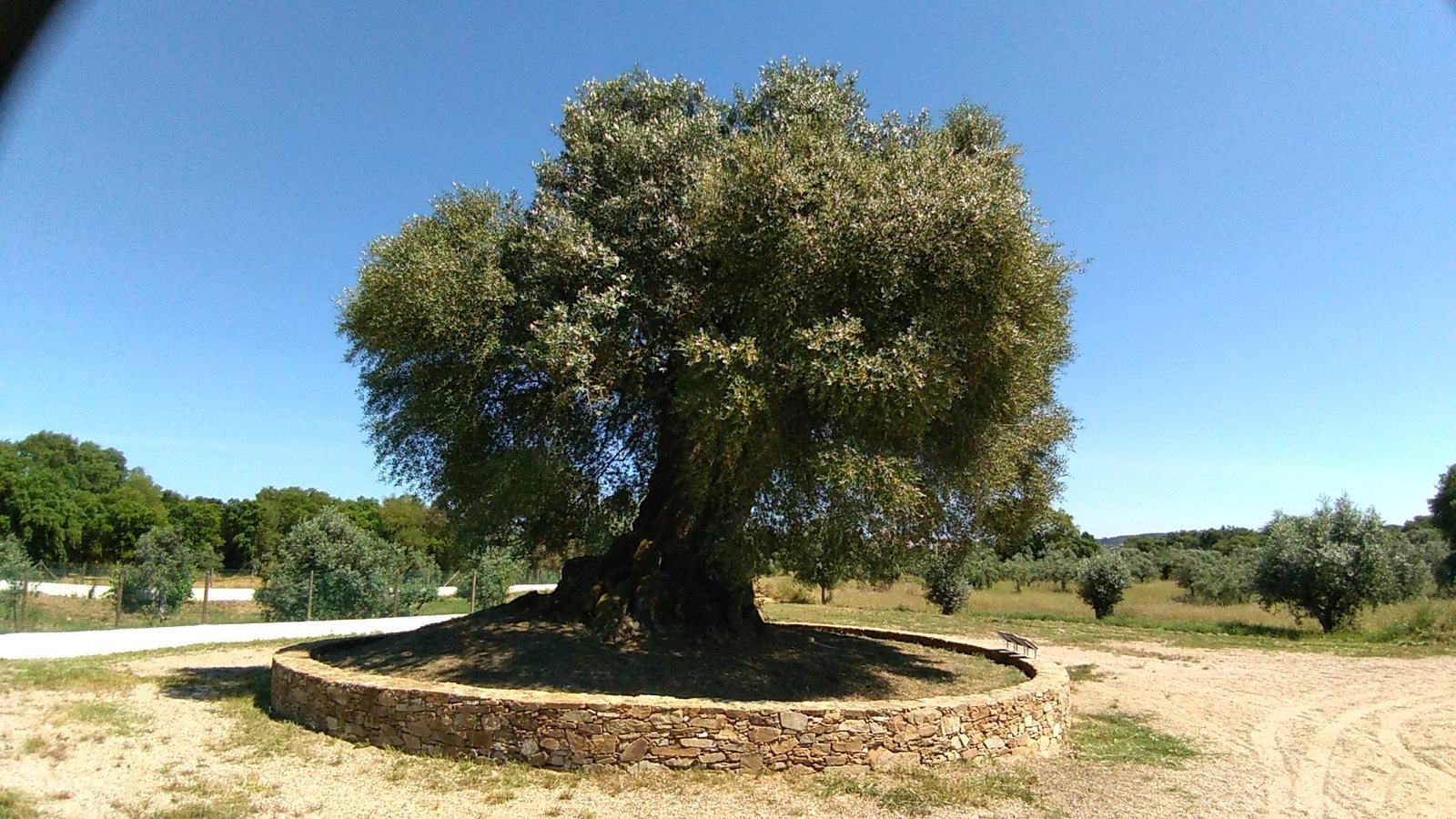
Oliveira do Mouchão is a monumental Olea europaea olive tree in Mouriscas, Portugal, whose estimated planting dates to the Bronze Age. In 2016, researcher José Luís Lousada of the University of Trás-os-Montes and Alto Douro used dendrometry, the measurement of tree dimensions to estimate age and growth, to place the tree at approximately 3,350 years old. With an estimated margin of error of 2 percent, Oliveira do Mouchão is considered the oldest tree in Portugal and one of the oldest olive trees in the world.
Bronze Age origins and age estimate
The estimated age places the tree’s planting in the Bronze Age, the prehistoric period associated with the widespread use of bronze tools and weapons before the Iron Age. It would therefore predate the beginning of written language in Iberia. The precise age cannot be established through dendrometry alone, because ancient olive trees commonly develop hollow trunks and irregular growth rates.
Protection and local association
Oliveira do Mouchão has been classified as a Tree of Public Interest since 2007 by ICNF, the Institute for the Conservation of Nature and Forests. Its name derives from mouchão fishing. From the beginning of the twentieth century, fishermen reportedly gathered beneath the tree before setting out to fish.
Following the age study, the area around the tree was enclosed and fresh soil was added over roots that had become exposed. This intervention helped preserve the immediate ground around the ancient trunk while retaining the tree’s role as a publicly recognized natural monument.
Remains
Oliveira do Mouchão stands in Cascalhos, in the Mouriscas parish of Abrantes municipality, north of the Tagus River. The tree is approximately 10 metres tall and survives within a stone-walled enclosure treated as a public park. Its hollow trunk is cut off slightly more than three metres above ground, and the recorded stem height is 320 centimetres.
Trunk and branches
Measurements and form
The average trunk perimeter at breast height is approximately 652 centimetres, while the average perimeter at the stump is approximately 1,112 centimetres. The trunk is also described as about five metres in circumference. Gnarled branches extend above the hollow bole, and the tree continues to produce olives despite its great age.
Olive variety and grafting
The tree is a Galician-type olive, referring to an olive type associated with Galicia in northwestern Iberia. It was later grafted with a wild olive tree, a process that joins part of one plant to the root system of another so that they grow as a single plant. A colony of bats is said to shelter among its branches.
Enclosure and commemorative markers
Stone enclosure and ground
The tree stands inside a stone wall, with added soil covering roots that had previously become exposed. The enclosure defines the protected ground around the trunk and forms part of the site’s present public-park setting.
Inscription and notice plaque
A granite slab beneath the tree carries an excerpt from Onde by José Luís Peixoto. A notice plaque at the base gives the estimated age of 3,350 years, the 2 percent margin of error, the trunk measurements, and the 320-centimetre stem height. It also identifies the evaluation methodology as Portuguese Patent NP 104183 and names the research teams whose data were used in the assessment.