Pleterje Charterhouse: A Carthusian Monastery in Slovenia


Site at a Glance
- Rating
- 4.6
- Popularity
- Low
- Country
- Slovenia
- Primary era
- Medieval
- External website
- Open
- Eras represented
- Medieval, Modern
- Civilizations
- Habsburg, Holy Roman Empire
- Site type
- Religious
- Remains
- Fortified Monastery
On this page13 sections
History
Pleterje Charterhouse is a Carthusian monastery near Šentjernej in Slovenia, founded in 1403 in the Gothic period by Herman II, a powerful nobleman of the Celje dynasty. It was the fourth and last Carthusian charterhouse established in Slovenia and remains the country’s only active house of the order. It is also described as the only Carthusian charterhouse in Central Europe and as one of 24 Carthusian houses still existing worldwide.
Foundation and medieval development
Herman II issued the monastery’s foundational endowment and charter in 1407. Basic construction was completed that year, while the monastery as a whole was completed around 1410 and incorporated into the Carthusian order in the same year. The monastery church, dedicated to the Holy Trinity, was completed and consecrated in 1420.
Pleterje grew during the continuing involvement of the Counts, and later Princes, of Celje. Nicholas Kempf, a Carthusian mystic and theologian, lived at Pleterje as a monk from 1447 to 1451 and later served as its prior from 1462 to 1467. After Ulrich II of Celje died in 1456 and the Celje dynasty collapsed, the monastery entered a gradual decline.
Ottoman attacks and the end of the first foundation
Military raids and campaigns by the Ottoman Empire affected Pleterje and its surrounding estates. In 1471, Ottoman forces destroyed or burned the monastic buildings, repeatedly devastated the monastery’s lands, and killed or deported dependent peasants. The complex was rebuilt with substantially stronger walls, giving it the character of a fortress.
During the second quarter of the sixteenth century, Uskoks, frontier settlers and soldiers associated with the Habsburg-Ottoman borderlands, were settled on parts of the charterhouse’s estate. This further reduced its property. After a prolonged period of economic and spiritual decline, Pleterje was transferred to the Jesuits of Ljubljana in 1593-95. The transfer ended Carthusian activity there for almost two centuries.
State ownership and Carthusian revival
Following the suppression of the Society of Jesus, the Catholic order also known as the Jesuits, in 1772-73, Pleterje became state property. It passed into private ownership in 1839. The Carthusian order reacquired the former charterhouse in 1899 and re-established its community.
Between 1900 and 1905, the monks built and extensively reconstructed the monastic complex. Their return followed the expulsion of Carthusians from France. In 1904, monks from the Charterhouse of Bosserville came to Pleterje and brought much of their interior equipment and valuable works of art with them.
The monastery suffered severe damage during the Second World War. Members of the White Guard occupied it in autumn 1942, and partisan forces attacked several months later, destroying several monks’ cells during the fighting. In 1943, partisans set fire to the charterhouse.
Continuing monastic life and protection
Carthusian monks continue to live at Pleterje according to a vocation that combines communal worship with a strict solitary life. The community manages about 30 hectares of associated agricultural land, including six hectares of vineyards and six hectares of orchards. Fruit growing, beekeeping, distilling, and wine production form part of its continuing activities.
Products associated with the estate include honey, mead, beeswax candles, fruit brandies, the wine Cviček, and the herbal liqueur Pleterje Bitter. The distinctive Pleterje pear ripens inside a bottle and is then filled with pear brandy. The community also maintains old and resistant varieties of apple and pear trees.
Pleterje received the Stele Award in 2002 for cooperation in preserving and maintaining the complex. It is a Slovenian cultural monument of national importance, and the monastery area was elevated from local to national monument status on 12 March 2026.
Remains
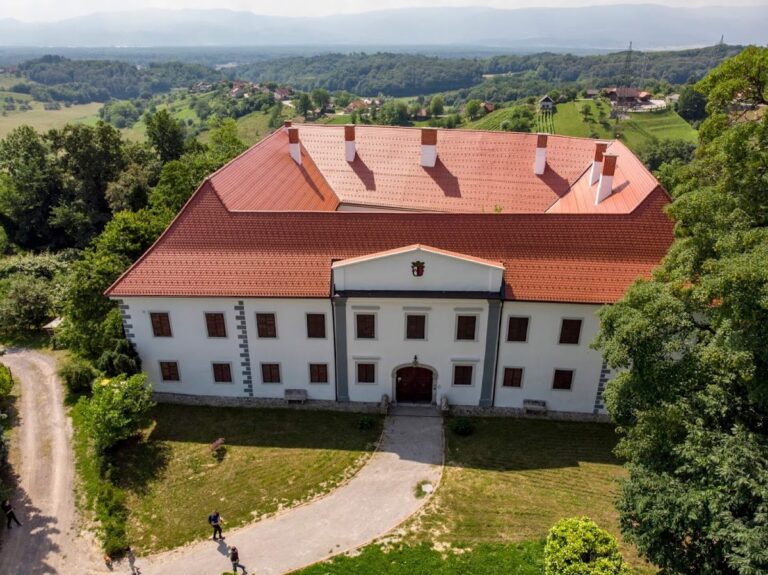
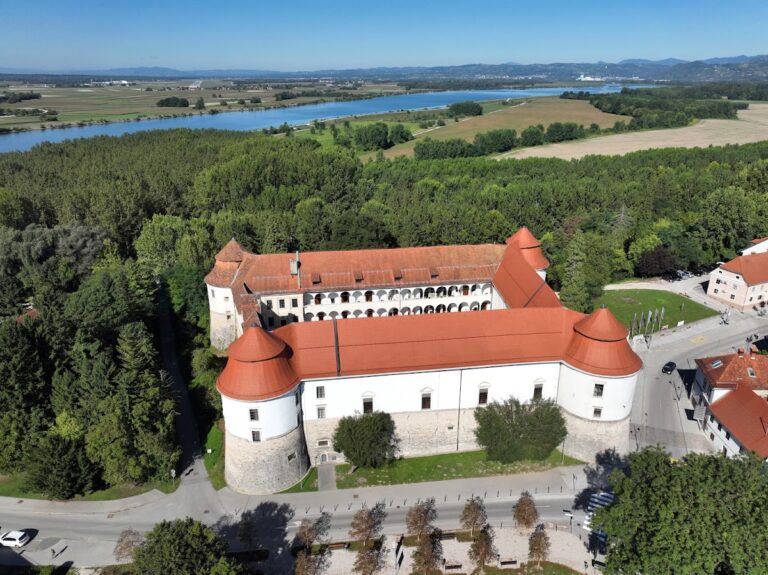
Pleterje stands in a valley at the northern foot of the Gorjanci, also called the Gorjanci-Žumberak mountain range. Most of the present buildings belong to the reconstruction and second foundation of the late nineteenth and early twentieth centuries. The large complex has remained substantially unchanged since the beginning of the twentieth century, while the surviving medieval church preserves the principal building from the first foundation.
Church and monastic buildings
Holy Trinity Church
The Gothic monastery church of the Holy Trinity was completed and consecrated in 1420. It is the principal surviving building from the original foundation. The reconstruction of 1900-05 retained the church, the sacristy, and part of the chapter house, although by 1904 most of the old complex had otherwise been replaced.
Cloister and monks’ cells
Separate houses for the monks are arranged around the large cloister. This layout reflects Carthusian organization, in which individual solitary dwellings are placed around shared liturgical and communal spaces. The monastic buildings form the central architectural group of the complex, whose present appearance is largely shaped by the early twentieth-century reconstruction.
Sacred Art Museum
The eastern part of the complex contains the Charterhouse Museum of Sacred Art, including a collection belonging to the Dolenjska Regional Museum. The former Gothic church also contains a projection presenting Carthusian life.
Collections and agricultural landscape
Paintings and religious furnishings
The monastic community owns a substantial collection of paintings, chiefly dating from the seventeenth and eighteenth centuries and attributed to Flemish, French, Italian, and German artists. Many of these works arrived with the Carthusians from Bosserville in 1904. For security and public display, the paintings are kept on permanent loan at the Božidar Jakac Gallery in Kostanjevica na Krki.
Rural buildings and estate
An open-air museum on the charterhouse’s land, outside the enclosed convent, presents traditional rural buildings and other examples of characteristic Slovenian architecture. These include former farm structures and buildings from the Šentjernej plain.
The agricultural estate contains vineyards, orchards, beekeeping facilities, and areas used for fruit cultivation and distilling. The vineyards cover six hectares and the orchards six hectares within the wider estate of approximately 30 hectares. The maintained varieties of apple and pear trees form part of the estate’s continuing agricultural character.