St George of the Greeks, Famagusta: An Orthodox Cathedral in Cyprus


Site at a Glance
- Rating
- 4.6
- Popularity
- Very Low
- Country
- Cyprus
- Primary era
- Medieval
- Eras represented
- Medieval
- Civilizations
- Kingdom of Cyprus
- Site type
- Religious
- Remains
- Cathedral
On this page7 sections
History
St George of the Greeks is an Orthodox church in Famagusta, Cyprus, built for the city’s Greek Orthodox community around 1300 in the Franco-Byzantine style. It served as the community’s cathedral during the Middle Ages, the later period of Frankish rule, and the Venetian period. The church combined Gothic forms introduced under western rule with the spatial and structural traditions of an Orthodox Byzantine church.
Orthodox Famagusta under Lusignan rule
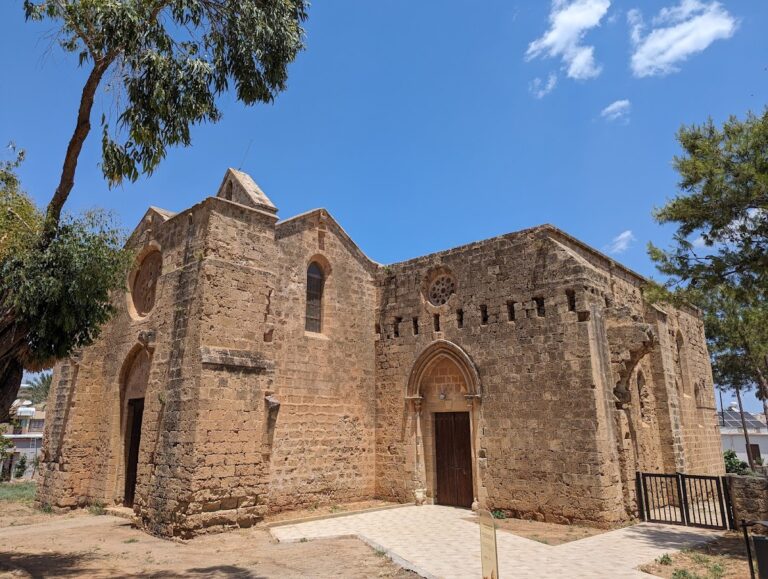
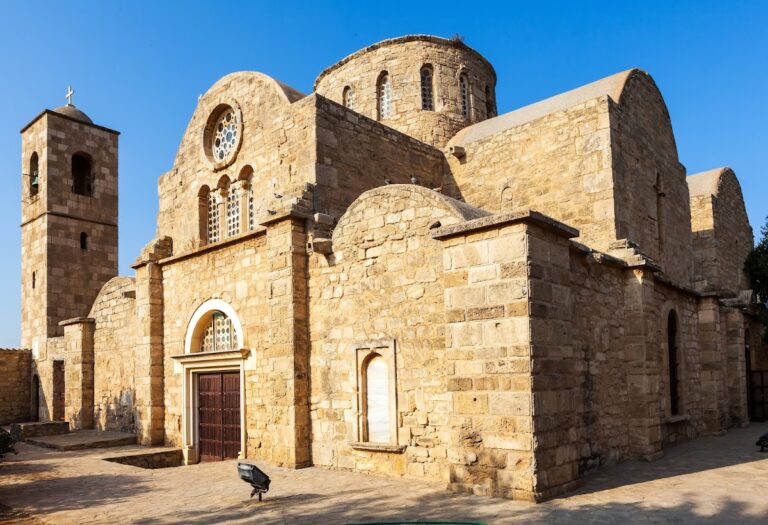
After the Lusignans took Cyprus in 1191, they established a Catholic political order and reduced the power of the Orthodox Church, making it subordinate. Famagusta’s southeastern quarter became the district inhabited by the Greek Orthodox community, as shown by the group of churches that stood close together there. Before St George of the Greeks was built, the smaller and much older Church of St Simeon served as the Orthodox cathedral.
A new Orthodox cathedral was erected northwest of the existing cathedral around 1300, approximately at the same time as the Catholic Cathedral of St Nicholas. Its completion is believed to have taken place after 1360. The two cathedrals may have shared builders, although the church’s form remained connected to Orthodox ecclesiastical traditions.
Cathedral, siege, and later uses
St George of the Greeks remained the cathedral of Famagusta’s Greek Orthodox community through Frankish rule, the period of western, principally Lusignan, control of Cyprus, and the subsequent Venetian period, when Venice governed the island. The church was badly damaged during the Ottoman siege of Famagusta in 1571. Its height above the city walls made it a target for Ottoman bombardment, and it was abandoned after the siege.
The abandoned building continued to acquire traces of later activity. During the British period, the apse was used as a firing gallery, with openings between the apse windows indicating this change of function. In the eighteenth century, sailors scratched drawings of their ships into the plaster. Some of these images survive at the western end of the ruin.
Remains
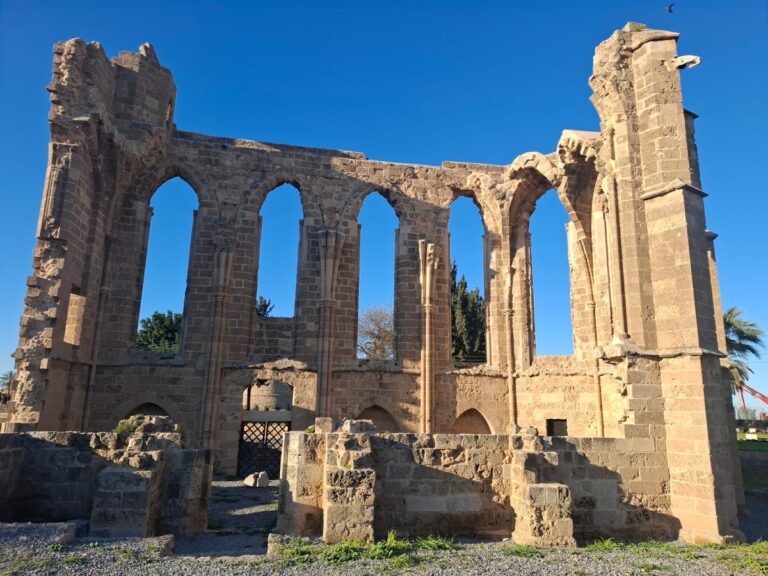
St George of the Greeks stands in the southwestern corner of Famagusta beside the smaller Church of St Simeon. The surviving structure is a large three-naved Gothic church whose heavy pillars once supported the rib vaults of the nave. Its ruined condition preserves the building’s combination of western Gothic construction with the general organization of an Orthodox church.
Naves and vaults
The church is arranged around three naves, divided by substantial pillars. These supports carried rib vaults, vaulted ceilings whose visible ribs form the structural framework. The scale of the building and its Gothic treatment distinguish it from the smaller Church of St Simeon standing beside it, while its ecclesiastical plan reflects its former role as an Orthodox cathedral.
Apses and surviving decoration
Three tall apses, the rounded or polygonal ends of the church behind the altar, retain their Gothic vaults. The vaults remain intact, and traces of the frescoes that once decorated the interior can still be seen, especially in the right apse or niche. The southeastern side of the apse preserves clearly visible openings made by cannon fire, with some cannonballs still lodged in them.
Firing openings and sailors’ drawings
Openings between the apse windows mark the later conversion of this part of the church into a firing gallery during the British period. At the western end, eighteenth-century drawings of ships scratched into the plaster preserve another layer of the building’s history. These marks belong to the church’s period as an abandoned structure rather than to its medieval religious use.