Karanlik Kümbet: A Seljuk Mausoleum in Erzurum


Site at a Glance
- Rating
- 4.6
- Popularity
- Medium
- Country
- Turkey
- Primary era
- Medieval
- Eras represented
- Medieval
- Civilizations
- Ilkhanate, Seljuk
- Site type
- Religious
- Remains
- Tomb
On this page5 sections
History
Karanlik Kümbet is an Islamic mausoleum in Erzurum, Türkiye, completed in 1308 near the end of Seljuk rule and built in the Seljuk architectural tradition. It stands on Gülahmet Street opposite the Derviş Ağa Mosque and is also known as Emir Sadrettin Kümbeti.
Construction under Sadreddin Türkbeg
Construction began in 1307 or 1308 under Sadreddin Türkbeg, the son of an Ilkhanid governor of Khorasan. The Ilkhanids were a Mongol dynasty that ruled Iran and surrounding regions, including areas connected with eastern Anatolia, during the thirteenth and fourteenth centuries. Sadreddin Türkbeg commissioned the mausoleum in memory of his deceased father, Khoja Vecih-id-din, who was probably buried there.
A later burial tradition
The mausoleum later became associated with Sadreddin Konevi, a Sufi mystic linked to the medieval thinker Ibn Arabi. The claim that Konevi was buried there was erroneous, but it was repeated in the Salname-i Vilayet-i Erzurum, a historical book about Erzurum. As a result, the building acquired the additional name Sadrettin Konevi Türbesi.
After falling into disrepair, Karanlik Kümbet was restored in 1954, with some financial support from the Directorate General of Foundations. The intervention helped preserve the mausoleum and its surviving architectural form.
Remains
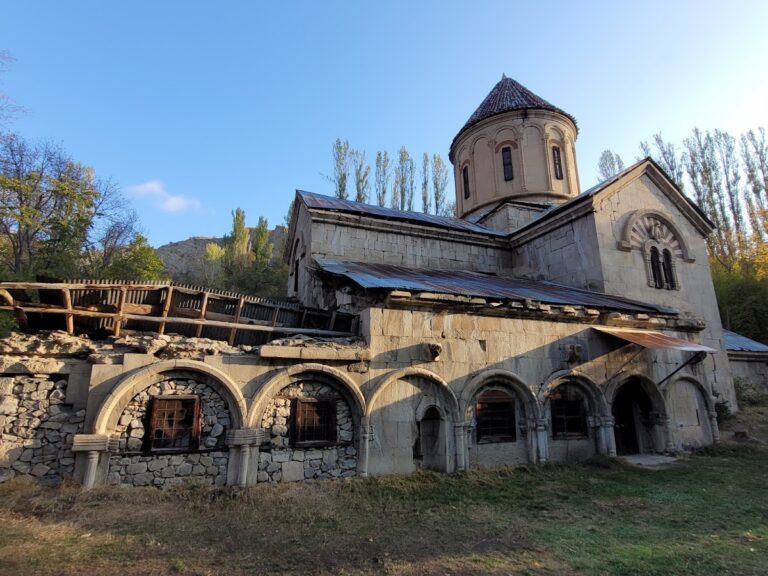
Karanlik Kümbet is a two-level domed tomb built primarily of stone, with brick also used among its materials. Its underground level contains the actual graves, which can be viewed through an air vent at ground level. Above this lower chamber rises the visible body of the mausoleum, capped by a conventional dome and then by a conical outer dome.
Structure and decoration
The interior includes muqarnas, a three-dimensional decoration made of tiered, niche-like cells that form transitions between architectural surfaces. At Karanlik Kümbet, this decoration appears in the upper part of the entrance doorway as well as inside the tomb. Together with the paired dome forms and the two-level arrangement, it defines the building’s Seljuk-style appearance.