Musa Baba türbe: An Ottoman Mausoleum in Thessaloniki


Site at a Glance
- Rating
- 4.3
- Popularity
- Low
- Country
- Greece
- Primary era
- Early Modern
- External website
- Open
- Eras represented
- Early Modern
- Civilizations
- Ottoman
- Site type
- Religious
- Remains
- Tomb
On this page9 sections
History
Musa Baba türbe is a sixteenth-century Ottoman mausoleum in Thessaloniki, Greece, built in the Ottoman architectural tradition. It was the burial place of Musa Baba, a figure revered as a holy person by the Bektashi order, an Islamic religious order with a distinct devotional tradition shaped within the wider Shiite-influenced religious world.
Ottoman Foundation
The mausoleum formed part of a religious complex in the Upper Town. Its associated tekke, a meeting and devotional establishment used by dervishes, stood in the area now occupied by Terpsitheas Square. The tekke was founded before 1527, probably during the reign of Sultan Bayezid II, who ruled the Ottoman Empire from 1481 to 1512. A mosque and minaret were also associated with the complex.
The tekke was destroyed during the period of Sultan Mahmud II, whose reign lasted from 1808 to 1839. The mausoleum itself survived, and it is described as the only Ottoman mausoleum in Thessaloniki to have remained intact.
Later Devotion and Restoration
After the 1923 population exchange between Greece and Turkey, Christian refugees from Asia Minor continued to use the building. The remains of Musa Baba were taken to Istanbul in the same year, but the site continued to attract pilgrims. During the 1930s, Christian women from nearby neighborhoods lit candles at Musa Baba’s grave and appealed to him for help against malaria. Local belief identified Musa Baba with Saint George, a widely venerated Christian saint associated with protection in times of danger.
The Ephorate of Byzantine Antiquities restored the mausoleum between 2011 and 2015, with additional European funding. The work preserved the building as a surviving Ottoman religious monument in Thessaloniki’s Upper Town.
Remains
The surviving complex is centered on an octagonal mausoleum in the Ottoman architectural tradition. The building is covered by a single lead-clad dome and carries geometric decoration. Its relationship to the former tekke and mosque is part of the site’s historical layout, while a Christian shrine stands to its south.
Ottoman Buildings
Musa Baba türbe
The mausoleum is an octagonal structure topped by one dome covered with lead. Geometric decoration enriches its exterior or interior architectural treatment. The building was restored between 2011 and 2015, and views from 2016 and 2024 show the restored structure.
Former tekke and mosque
The former tekke occupied the area of present-day Terpsitheas Square and was associated with the mausoleum as a dervish meeting and devotional establishment. A mosque and its minaret also belonged to the complex. A view dating from around 1916 shows the mosque and minaret to the left of the türbe.
Christian Feature
Shrine of Saint Charalambos
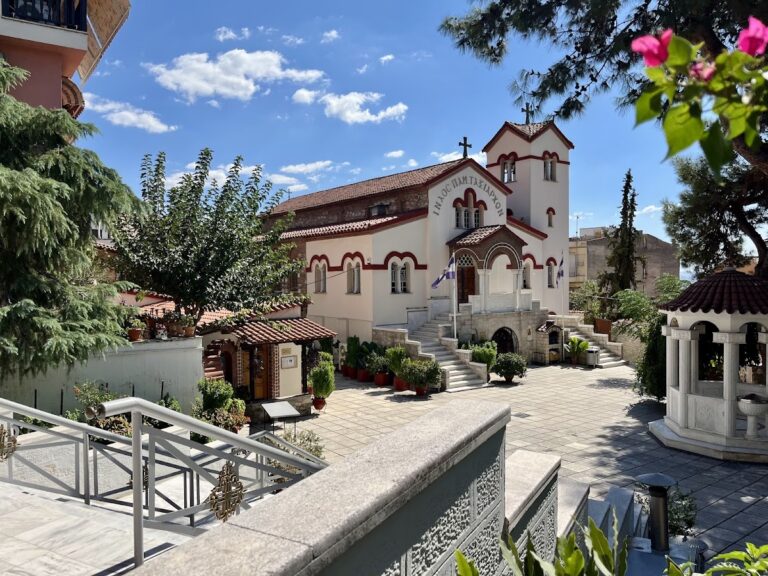
A shrine dedicated to Saint Charalambos stands south of the mausoleum. Saint Charalambos is honored in Eastern Christian traditions, adding a Christian devotional feature to the surviving historical setting around Musa Baba türbe.