Walls of Thessaloniki: Historic City Fortifications
Site at a Glance
- Country
- Greece
- Primary era
- Classical
- Eras represented
- Classical, Medieval
- Civilizations
- Byzantine, Ottoman, Roman
- Site type
- Military
- Remains
- Wall
On this page14 sections
History
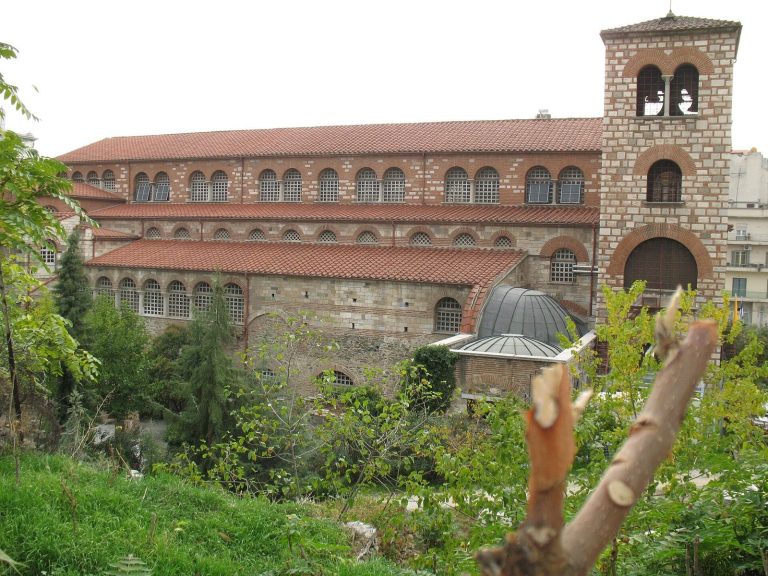
The Walls of Thessaloniki are the historic fortifications of Thessaloniki, Greece; the surviving circuit was built under Roman rule from the late fourth to the middle of the fifth century AD. The city was founded by the Macedonian king Kassandros in the late fourth century BC and had fortifications by the third century BC.
From early defenses to late Roman walls
Rome conquered Thessaloniki in 167 BC. The ensuing period of Roman peace reduced the need for its defenses, and by the middle of the first century BC the walls had fallen into ruin. New defenses were built in the third century AD using material from earlier buildings. They helped the city repel Gothic attacks in 254 and 268. In the early fourth century, the emperors Galerius and Constantine strengthened the fortifications. Late in that century, another wall, marked by triangular projections, was added outside the earlier defenses.
Byzantine defenses and sieges
During the reign of Maurice, emperor of the Eastern Roman, or Byzantine, Empire, Archbishop Eusebius of Thessaloniki supported further fortification while Slavic forces besieged the city. An inscription records an addition to the walls. In the seventh century, another strengthening program was undertaken under Emperor Heraclius as the city faced the Avars, a confederation that challenged the Byzantine Empire, and Slavic peoples.
In 904, Saracens, a medieval European term commonly used for Arab or Muslim forces, attacked Thessaloniki from the sea and captured the city. They entered on the third day of the siege, plundered the city for ten days, and departed with 22,000 captives. The assault prompted work on the seaward defenses. An early tenth-century inscription near Eleftherias Square names Emperors Leo VI and Alexander, Patriarch Nicholas, Archbishop John, and Leo Chatzilakis, a senior court official and military governor of Thessaloniki. Leo VI had sent Chatzilakis to organize the city’s defense. Chatzilakis set aside an underwater barrier proposed by the court official Petronas and directed work instead toward the low, exposed sea walls. The work remained unfinished when it was needed.
Norman forces from Sicily captured Thessaloniki in 1185, an event chronicled by Archbishop Eustathius. Catalan mercenaries, hired soldiers from Catalonia, besieged the city unsuccessfully in 1308. In 1316, a section of sea wall near the White Tower was rebuilt from its foundations with support from a senior official responsible for military administration.
In 1355, Empress Anna Palaiologina ordered repairs to part of the walls and the construction of two gates. An inscription on one gate names castle-warden John Chamaetos, a quaestor, an official with legal and administrative duties. Another inscription records that George Doukas Apokaukos rebuilt a tower from its foundations under Manuel, a despot, a high-ranking Byzantine title.
Ottoman rule and modern changes
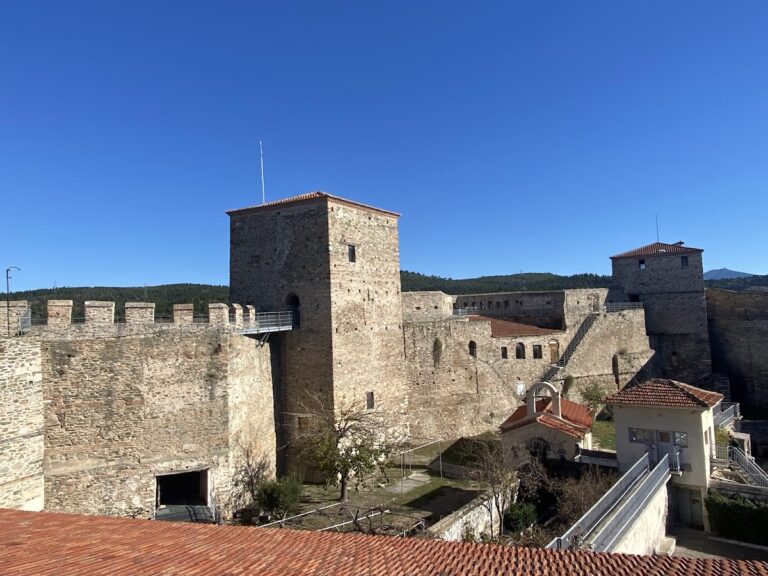
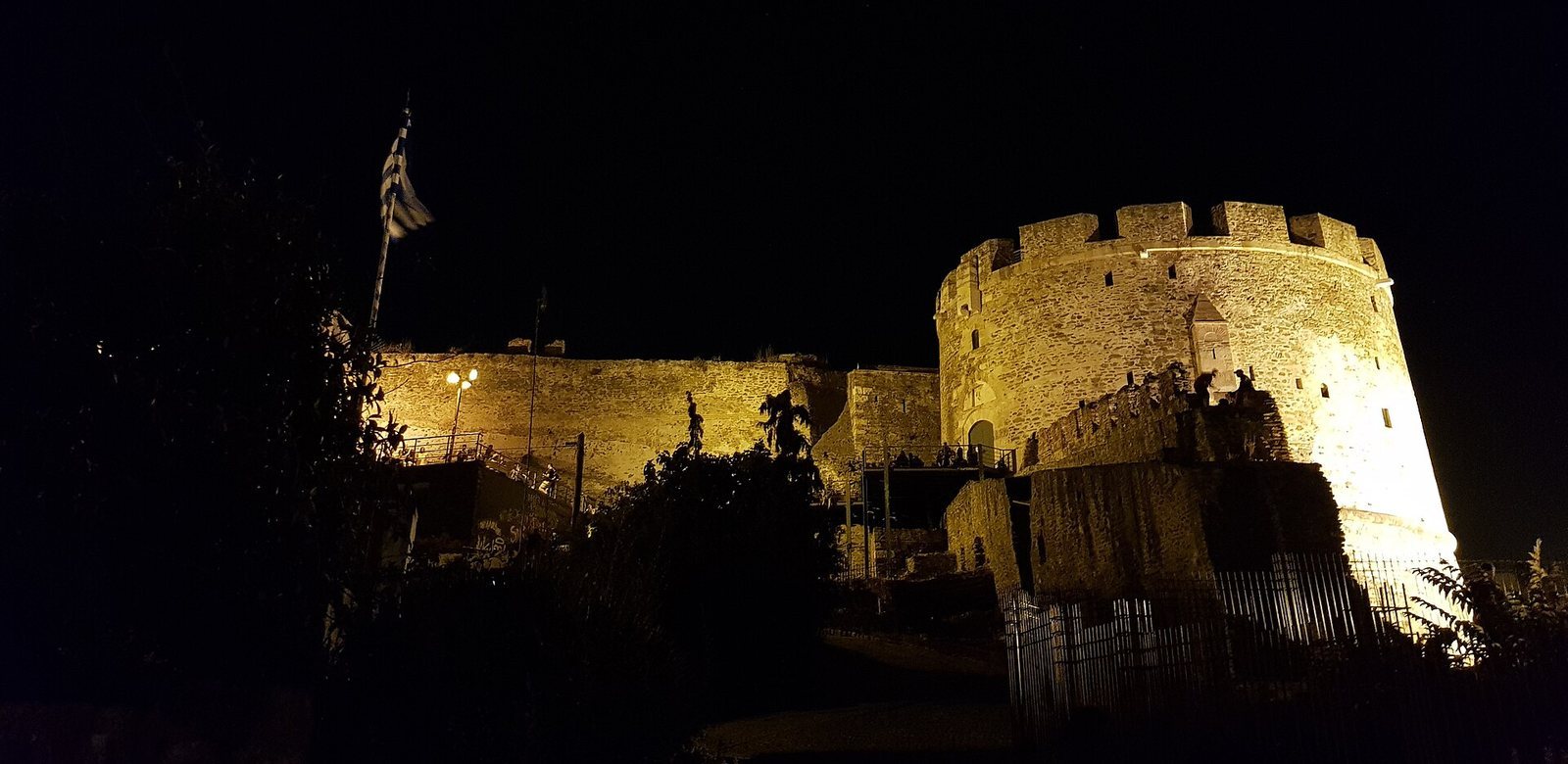
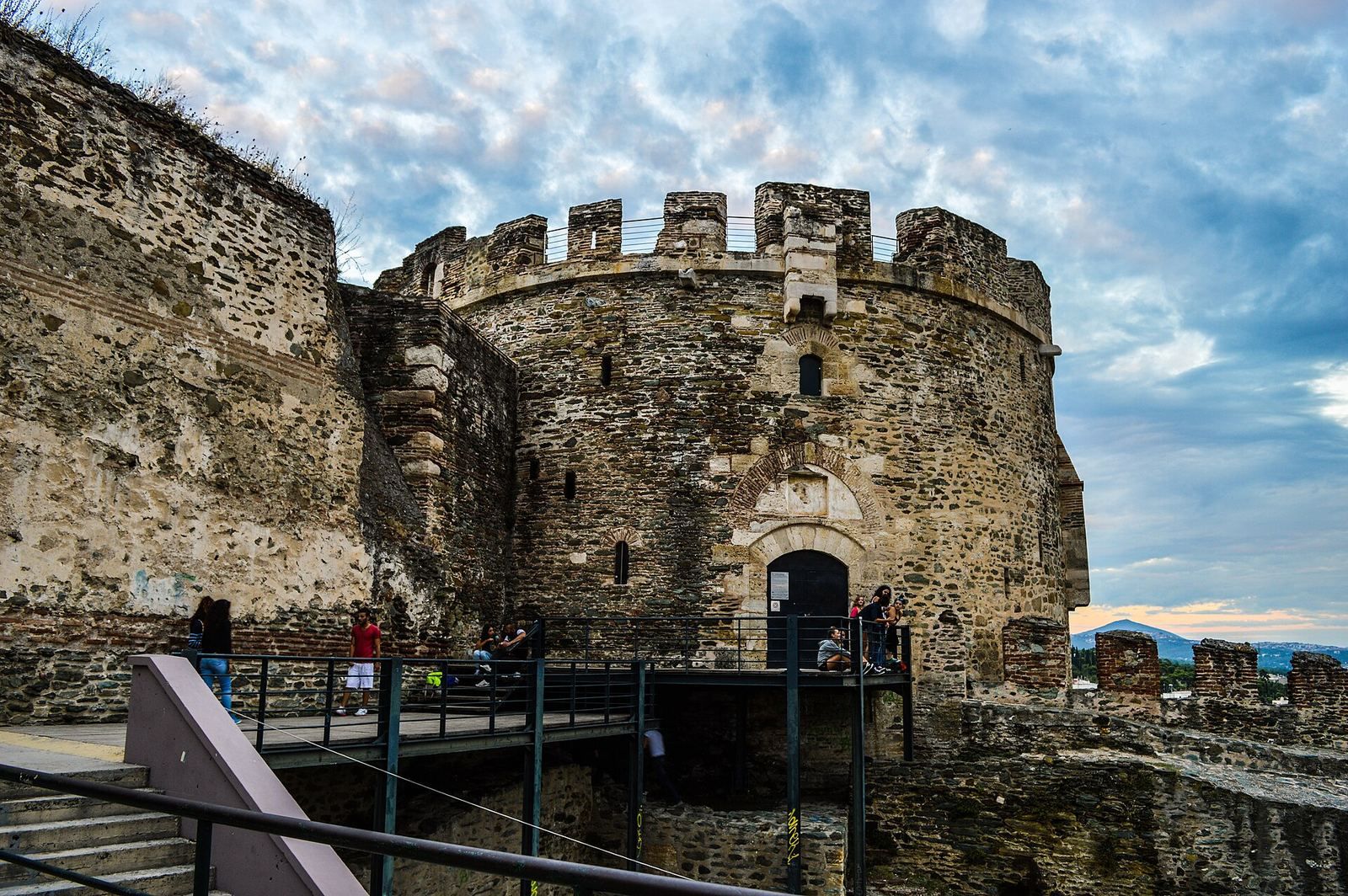
The Ottomans captured Thessaloniki in 1430, entering through the Trigonion Tower. They maintained and extended the defenses during their rule, which lasted until 1912. Their additions included new towers and the Heptapyrgion, or “Seven Towers,” a defensive complex within the acropolis.
In 1874, Ottoman authorities demolished the sea wall and part of the eastern wall, which they considered obstacles to the city’s development. The Walls of Thessaloniki form part of the UNESCO World Heritage property “Paleochristian and Byzantine Monuments of Thessaloniki,” inscribed in 1988 under criteria i, ii, and iv.
Remains
Course and construction
Layout and dimensions
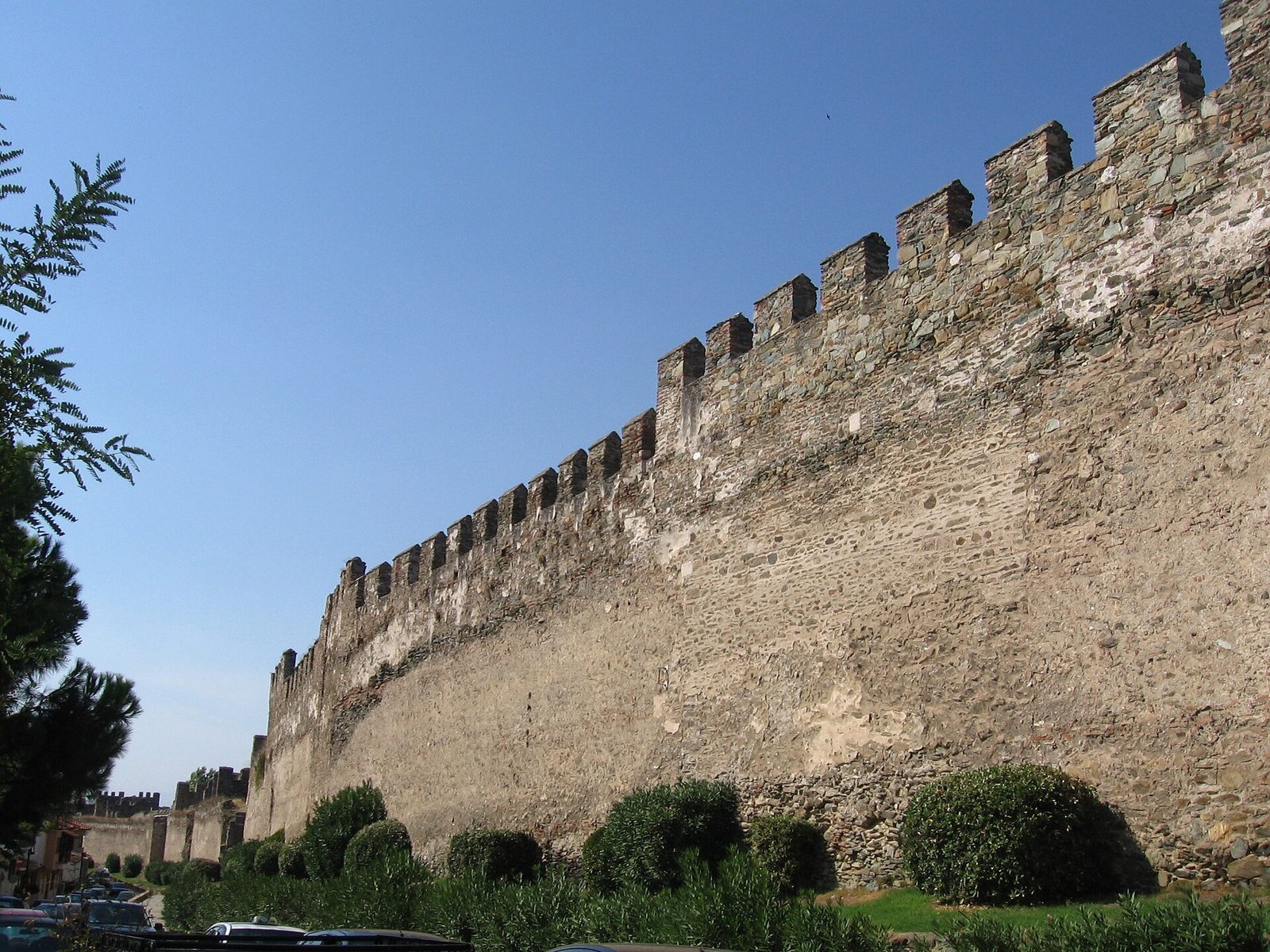
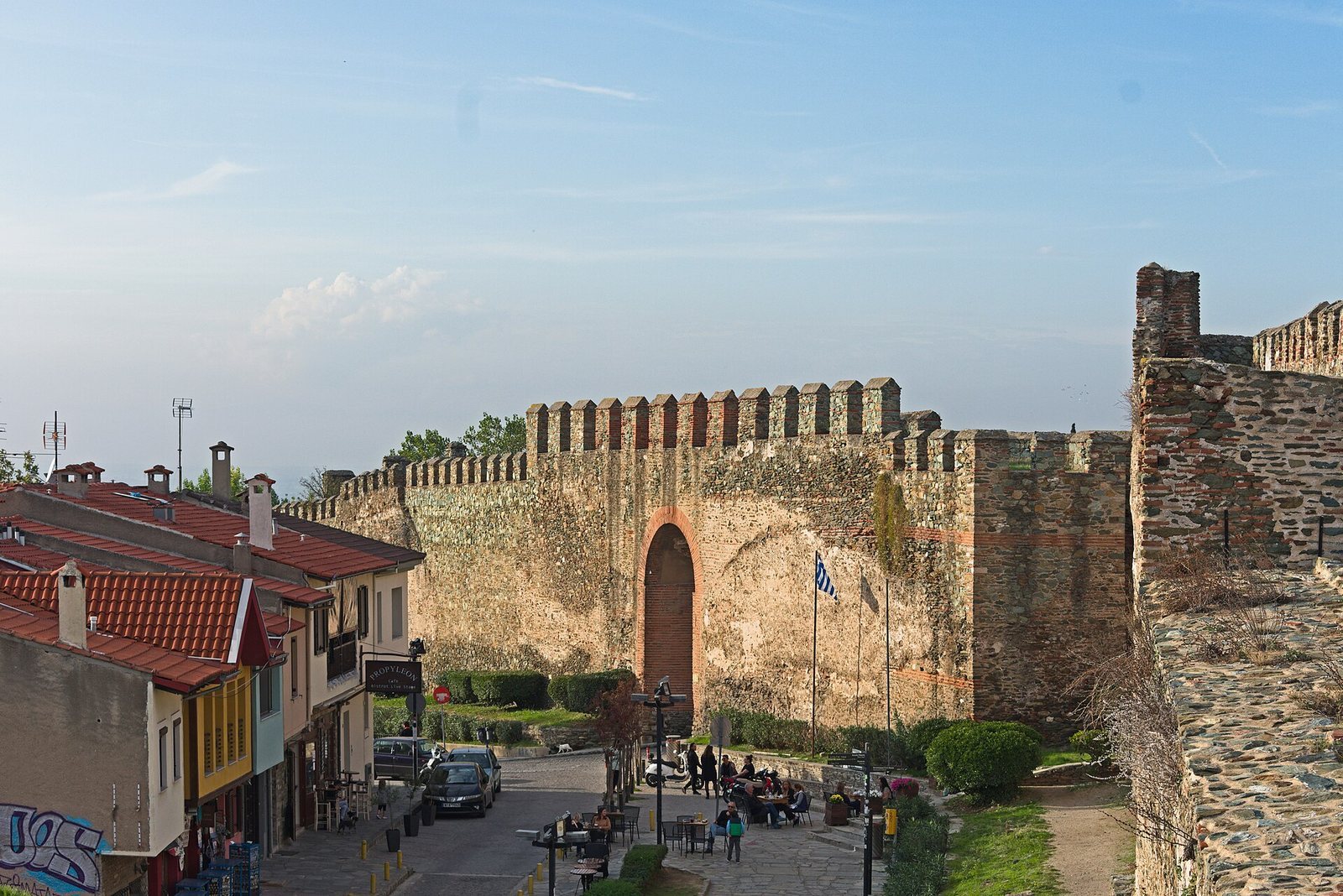
The surviving circuit extends for about 4 km; its original course was about 8 km long. It forms an irregular quadrilateral. The walls generally rise 10–12 m, reaching as much as 15 m at high points of the towers, and measure 2.5–4.5 m thick. Their cross-section is trapezoidal, broader at the base than at the top. The former southwestern sea wall ran toward the Thermaic Gulf. To the north and northeast, the defenses climb toward the acropolis, the city’s elevated fortified area, which has its own enclosing wall and contains the Heptapyrgion. From there, the surviving wall follows uneven ground westward. The route included a gate at Agiou Dimitriou Street and continued south toward the sea. At the southeastern corner, the White Tower stands apart from the wall circuit. Triangular projections extend from the western and eastern walls.
Masonry and patterns
Much of the wall consists of rough stones joined with mortar, with horizontal masonry bands used to strengthen the structure; other stretches are built entirely of masonry. Repeated bands of brickwork combine with stone construction. The northern and western sections feature brick half-arches, zigzag patterns, crosses, and ancient Greek sun and diamond motifs. Overlapping brick arches are especially notable on Claudianou Street. The construction has been compared with the Theodosian Walls, the late Roman and Byzantine fortifications of Constantinople, now Istanbul.
Towers and fortified heights
Byzantine towers
About 50 towers remain along the circuit. Rectangular towers stand at high points, especially along the wall separating the acropolis from the city. Byzantine-period examples include the Tower of Claudianus in the west, the Tower of Anaglyphos in the south, the Tower of Ormisdas in the east, and the northern towers of Andronikos Lapardas and Manuel Palaiologos. The Tower of Ormisdas, opposite the Hospital of Saint Demetrius, is dated to the fifth century. An inscription inside it credits Ormisdas with completing the city’s “unbreakable walls.” The person named may have been a Persian-born commander serving in Thessaloniki under Emperor Theodosius I around 380, or the praetorian prefect of Illyricum, a senior regional official, associated with wall construction around 442/3. His identity and the date of his work remain uncertain.
Ottoman towers
Ottoman-period towers include the cylindrical White Tower at the southeastern end and the cylindrical Trigonion Tower, also called the Tower of the Chain, at the northeastern end. The Trigonion Tower dates to the fifteenth century. At the southwestern end, beside Vardari Fortress, stands the polygonal Top Hane Tower.
Roman alignment and city gates
Roman wall and avenue
The Roman wall was a single barrier 1.65 m thick, reinforced with square towers. The main Roman avenue crossed the city between the western Golden Gate, near Vardari Square, and the eastern Kassandreotiki Gate. The southern wall lay somewhat south of present-day Tsimiski Street.
Gates on the circuit
The walls originally had numerous gates, with the largest on level ground; they were closed at night. The Golden Gate stood in the west at present-day Egnatia Street. The Kassandreotiki Gate, also known as the Kalamaria Gate, stood in the east. At Agiou Dimitriou Street, the western entrance was the Litaia Gate and the eastern one was the New Golden Gate. The Roman Gate stood by the White Tower. Portarator survives as a modest remnant of the former gates.