Vlatadon Monastery: A Byzantine Monastery in Thessaloniki


Site at a Glance
- Rating
- 4.7
- Popularity
- Medium
- Country
- Greece
- Primary era
- Medieval
- Eras represented
- Medieval, Early Modern, Modern
- Civilizations
- Byzantine, Ottoman
- Site type
- Religious
- Remains
- Monastery
On this page8 sections
History
Vlatadon Monastery is a Byzantine-period Orthodox monastery in Thessaloniki, Greece, founded around the middle of the fourteenth century during the late Byzantine, or Palaiologan, period. It is a stavropegic monastery, meaning that it is placed directly under the authority of a patriarch, and it is the only Byzantine-period monastery in Thessaloniki that continues to function.
Foundation in the Byzantine period
The monastery was established by the brothers Dorotheos and Markos Vlatis, monks and students or followers of Gregory Palamas, the Byzantine theologian and monk who became Archbishop of Thessaloniki. The foundation may have occupied the site of an earlier church. Empress Anna Palaiologina is traditionally regarded as the monastery’s founder or patron. She settled in Thessaloniki in 1351 and governed the city until her death, while a patriarchal sigillum, an official document bearing a patriarch’s seal, was issued shortly afterward by Ecumenical Patriarch Neilos.
A local tradition says that the Vlatis brothers descended from a Cretan family that escaped to Thessaloniki after pirates destroyed the settlement of Ligres in the Rethymno region. Their birth in Thessaloniki is securely established, while the more specific connection with Ligres remains traditional. Another local tradition associates the monastery’s site with the place where the Apostle Paul preached or lived during his stay in Thessaloniki.
The monastery was mentioned in 1405 by Ignatius of Smolensk, a Russian pilgrim. Its principal church, the katholikon, was converted into a mosque at some stage after the Ottoman captures of Thessaloniki. The first Ottoman capture occurred in 1387, and the city was conquered again in 1430. After the second conquest, the monastery once more operated as a Christian institution and became locally known as Tsavous Monastery.
Ottoman rule and later changes
Vlatadon Monastery became prosperous under Ottoman rule after Sultan Mehmed II confirmed special privileges in a 1446 firman, an official decree issued by the sultan. A tradition from the sixteenth century attributed this favorable treatment to assistance that the monks allegedly gave during the Ottoman conquest of the city. The monastery also acquired properties in and around Thessaloniki, including the churches of Saint Nicholas of the Orphans, the Panagia Lagoudiani, Saint George of Pylaia, the Apostle Andrew of Pylaia, and Saint John the Baptist and Saint Phanourios at Panorama.
In 1633, a sigillum issued by Patriarch Cyril Loukaris made Vlatadon a metochion, or dependent religious establishment, of Iviron Monastery on Mount Athos. The katholikon was renovated in 1801. A fire in 1870 destroyed part of the monastery, including its library, and the Ecumenical Patriarchate paid for the repairs.
During the Second World War, the monastery’s archive and 93 codices were moved to Iviron Monastery for safekeeping. On 11 June 1986, the bones of Metropolitan Panteleimon I Papageorgiou of Thessaloniki were transferred to the monastery cemetery for burial. In 1988, Vlatadon Monastery became part of the UNESCO World Heritage property known as the “Paleochristian and Byzantine Monuments of Thessaloniki.”
Remains
Monastery setting and principal church
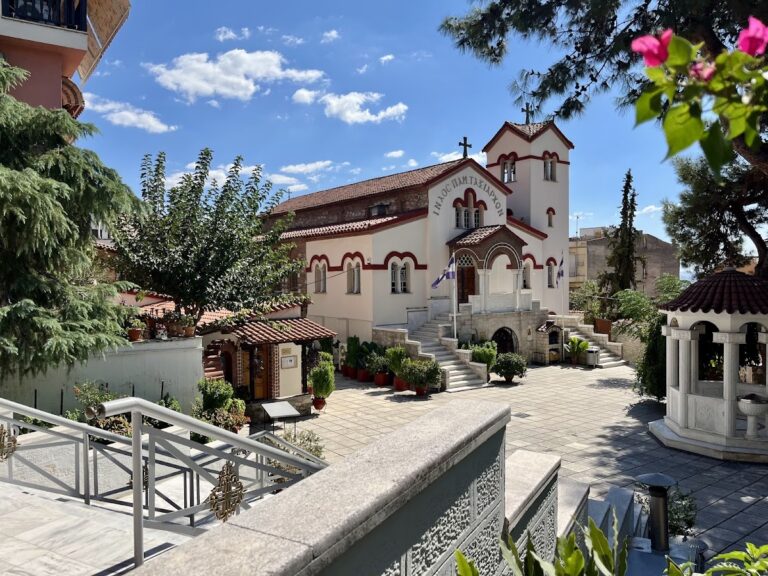
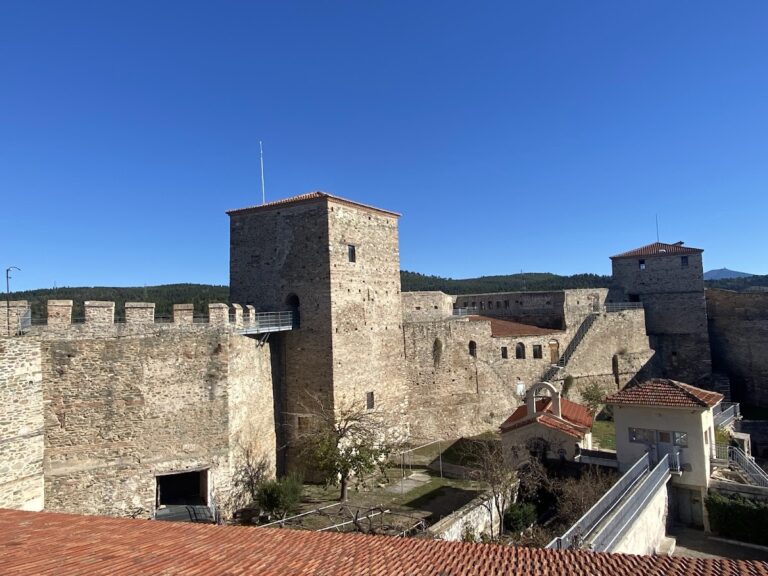
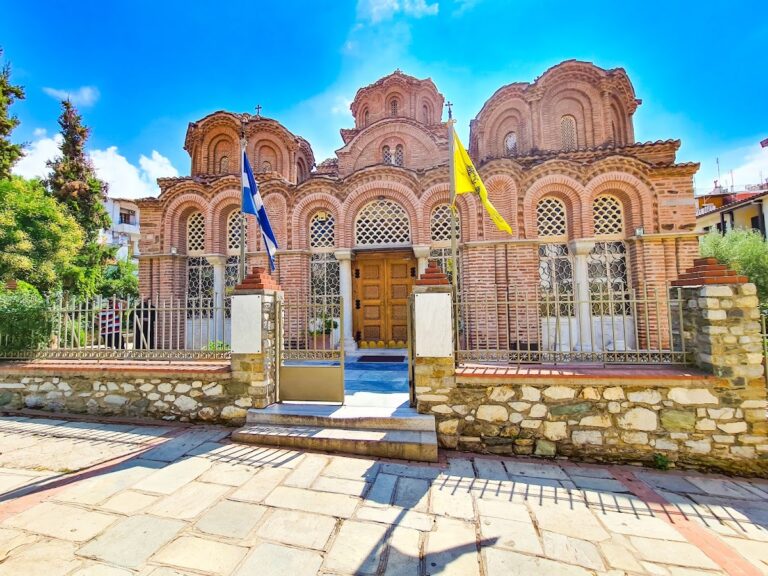
Vlatadon Monastery stands on steep ground in the Upper Town of Thessaloniki, about 80 metres from the walls of the Heptapyrgion and at an elevation of approximately 120 metres. The katholikon is a cross-domed church and the surviving building of the complex associated with its Byzantine and Ottoman history. Its present form differs substantially from the church built in the first half of the fourteenth century, of which the sanctuary and a small number of other architectural elements remain.
The katholikon
An octagonal brick dome rises over the centre of the church. A closed porch runs along the west, north, and south sides and ends in two chapels on the east. The northern chapel, the northern and western sections of the porch, and part of its southern side are later additions, probably dating from the 1801 renovation. An open south porch and a small portico on the west were added in 1907 in a Neoclassical style.
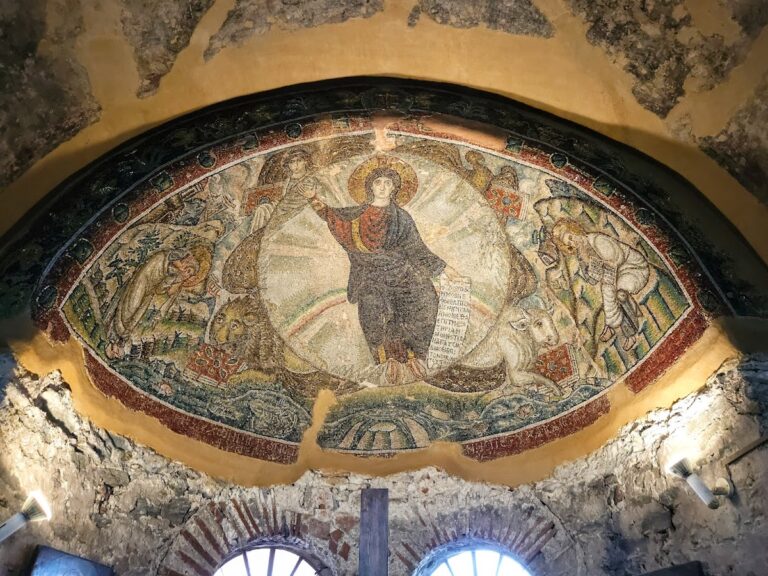
The interior preserves wall paintings created about 1360 to 1380. Their style combines solemnity and restrained emotion with elegant movement. The katholikon is dedicated to the Transfiguration of the Savior, whose feast is celebrated on 6 August.
Fourteenth-century chapel
Near the katholikon stands a vaulted chapel from the fourteenth century. Its interior contains frescoes of the Palaiologan period, the late Byzantine era associated with the Palaiologos dynasty. Together with the surviving sanctuary and other early elements of the main church, the chapel preserves physical evidence of the monastery’s Byzantine foundation.
Icons, relics, and written records
The church contains icons dating from the twelfth through the nineteenth centuries, along with relics and a substantial body of manuscripts and documents. These materials include Byzantine imperial charters authenticated by golden seals, patriarchal documents bearing official seals, and Ottoman firmans. The collection reflects the monastery’s continuing religious life and its connections with Byzantine, patriarchal, and Ottoman institutions.
Nearby sites