Košice Town Hall: A Baroque–Classical Municipal Building in Slovakia


Site at a Glance
- Rating
- 4.6
- Popularity
- Low
- Country
- Slovakia
- Primary era
- Early Modern
- External website
- Open
- Eras represented
- Early Modern, Modern
- Civilizations
- Habsburg, Hungarian
- Site type
- Civic
- Remains
- Town Hall
On this page7 sections
History
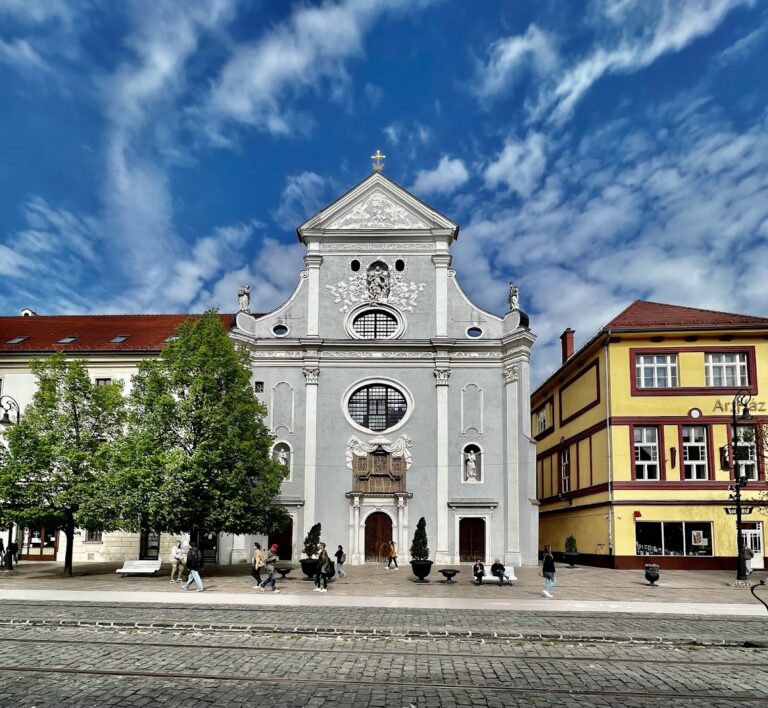
Košice town hall is a Baroque–Classical civic building in Košice, Slovakia, constructed in 1779–1780 as a palace-type town hall. Its style combines the richly ornamented forms of Baroque architecture with the symmetry and classical vocabulary of Classical architecture. The building replaced an earlier town hall complex formed from two wealthy burgher houses and remained closely connected with the city’s municipal and political history.
Medieval houses and the first town hall
By the end of the thirteenth century, two prosperous burgher houses stood on the site. During the fifteenth century, one belonged to Juraj Satmáry, a native of Košice who became chancellor of the kingdom and archbishop-primate of Hungary. The houses were later joined, and from the beginning of the seventeenth century the resulting complex served as Košice’s town hall.
The eighteenth-century palace
The present town hall was built in 1779–1780. Ján Langer designed the project, creating a new municipal building in the palace tradition. Its later history also brought it into contact with major European military events. Mikhail Kutuzov, a Russian military commander and field marshal associated with campaigns against Napoleon, stayed there for five days while returning defeated from a Napoleonic battle. A plaque near the entrance gives the dates of his stay as 30 December 1805 to 4 January 1806.
Political and municipal change
In the politically turbulent year 1919, the building became a center for military parades. From 16 June to 7 July, during the brief existence of the Slovak Soviet Republic, a short-lived communist government proclaimed in Slovakia, it temporarily housed the highest body of the Revolutionary Government Council, that republic’s governing council.
Košice’s municipal administration continued to use the building until 1928, when it moved to a new town hall on Hviezdoslavova Street. The former town hall, including its front section on Hlavná Street, then housed the municipal library until 1995. The city subsequently retained the building for representative purposes and other municipal uses. It was registered as a National Cultural Monument of the Slovak Republic on 16 October 1963, a designation that provides statutory protection for important cultural property.
A cinema was added to the rear wing in 1927. Originally called the Slovan Cinema and now known as Capitol, it underwent comprehensive reconstruction in 1997–1999. Its uses expanded beyond film screenings to include film premieres and festivals, small theatrical productions, theatre festivals, conferences, seminars, fashion shows, and smaller social events.
Remains
Palace facade and interiors
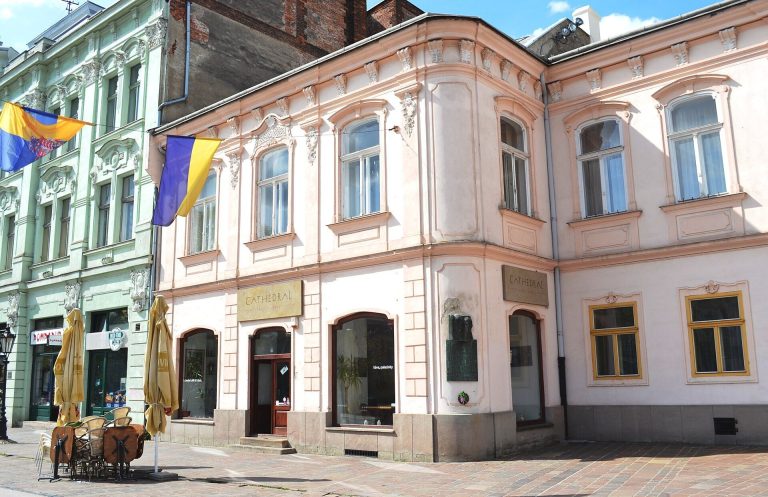
The preserved town hall is a palace-type building on Hlavná Street, near the State Theatre. Its richly articulated facade is crowned by a balustrade, a railing formed from a series of short supporting posts. Sculptures by Anton Kraus depict ancient scenes, while the tympanum, the enclosed area within the pediment, carries Košice’s coat of arms. Several interior paintings were executed by Erasmus Schrött, who also decorated the nearby Church of the Holy Trinity.
Rear cinema wing
The rear-wing addition was designed by the Košice architect Ľudovít Oelschläger. Its entrance is marked by six conically widening columns topped with lanterns rather than capitals. Tall arcade windows illuminate the first floor, and a high attic, a raised upper section crowning the facade, closes the composition with an arched ornament. The design brings together a concentrated range of motifs associated with Oelschläger and bears some resemblance to the work of the Slovenian architect Jože Plečnik. After reconstruction, the building functioned as both a cinema and a theatre hall, as well as a venue for conferences, seminars, fashion shows, and smaller social events.