Archbishop’s Palace, Košice: Seat of the Košice Archdiocese

Site at a Glance
- Rating
- 4.8
- Popularity
- Very Low
- Country
- Slovakia
- Primary era
- Modern
- External website
- Open
- Eras represented
- Modern
- Civilizations
- Habsburg, Hungarian
- Site type
- Religious
- Remains
- Palace
On this page7 sections
History
The Archbishop’s Palace in Košice, Slovakia, is a Rococo-Classical residence built in 1809 for the newly established Diocese of Košice. It stands near Saint Elizabeth’s Cathedral, reflecting the central place of the bishop’s residence in the religious life of the city.
Creation of the Diocese and Palace
Košice formerly belonged to the Roman Catholic Diocese of Eger, a territorial district administered by a bishop and founded in 1001. Its extensive territory became difficult to govern, so the Diocese of Košice was created in 1804. Saint Andrew, one of the Twelve Apostles in Christian tradition, became its patron, and Andrej Szabó served as its first bishop.
A residence was planned close to Saint Elizabeth’s Cathedral. Four houses on Hlavná Street were purchased and gradually rebuilt as a single, separate residence. This work produced the Bishop’s Palace, which was completed in 1809.
Fire, Reconstruction, and Episcopal Use
On 28 May 1841, the palace burned after fire spread from the nearby Vitéz House. Bishop Anton Ocskay directed its repair and later reconstruction. The rebuilt residence subsequently hosted Emperor Franz Joseph I, the Habsburg emperor of Austria and king of Hungary, during visits in 1851 and 1857.
The building later housed the bishop’s library and a portrait gallery of the bishops of Košice, established in 1893. Bishop Jozef Čársky, who served for 30 years, played an important part in completing the library, portrait gallery, and a chapel in the left wing.
Political Meetings and Later Ecclesiastical Role
In 1849, Slovak national leaders Ľudovít Štúr and Jonáš Záborský met at the palace to discuss the Slovak national programme. Štúr was a leading figure in the nineteenth-century Slovak national movement, while Záborský was a Slovak writer, priest, and participant in that movement. A commemorative monument marking their meeting was unveiled in 1972.
After Jozef Čársky died in 1962, the Košice episcopal office remained vacant until the end of socialism in 1989. The building continued to accommodate the ecclesiastical court, chaplains, and nuns. In 1995, during Pope John Paul II’s visit to Košice, Bishop Alojz Tkáč was elevated to archbishop. The Diocese of Košice consequently became the Archdiocese of Košice, a higher-ranking diocese headed by an archbishop, and the former Bishop’s Palace became the seat of the archbishopric. The palace is a protected monumental object of Slovakia.
A white-marble memorial to Jozef Čársky was unveiled on the facade in 1996. It commemorates his work at the palace and identifies him as bishop, apostolic administrator of the Diocese of Košice, founder of the Slovak Catholic Circle in Košice, nationalist, and friend of the poor.
Remains
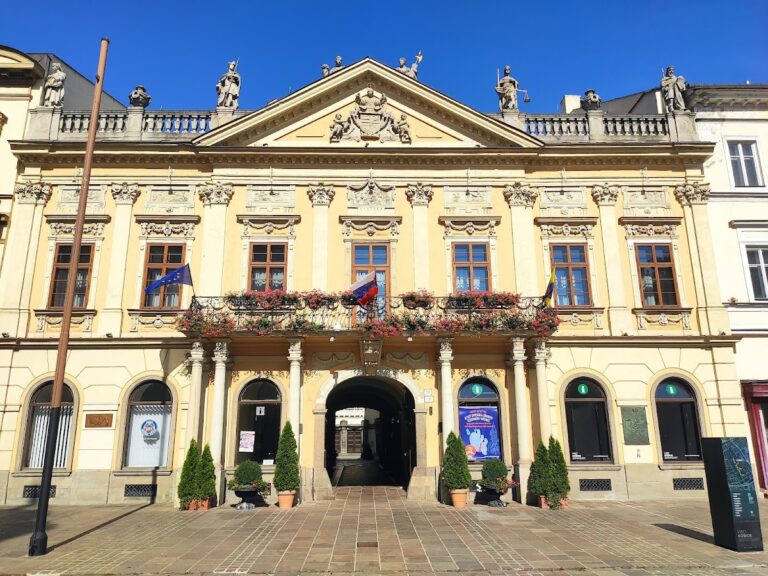
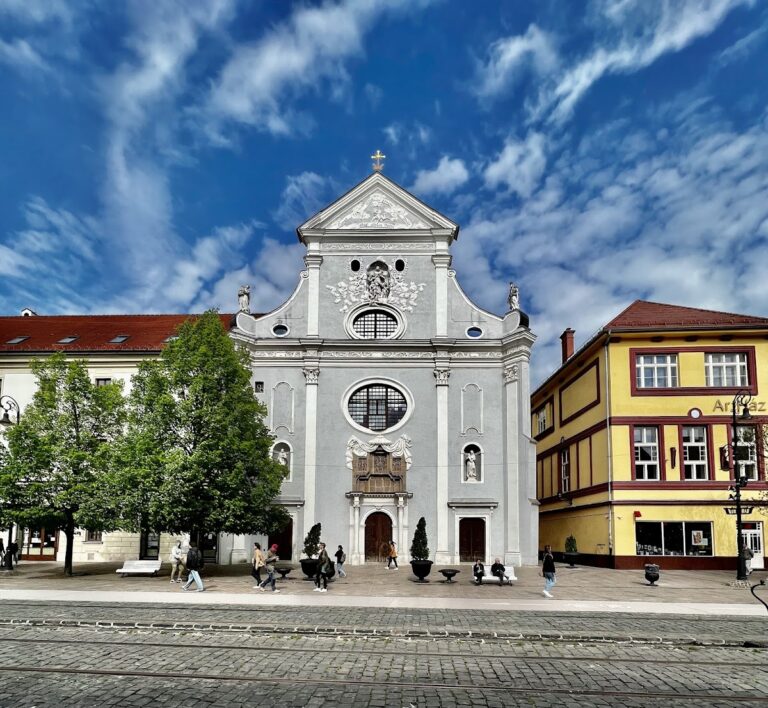
The two-storey palace forms a unified Rococo-Classical building near Saint Elizabeth’s Cathedral in Košice’s Old Town. Its facade is organized by pilasters and finished with a cornice. The palace stands beside the rectory and a bank described as one of Košice’s oldest savings banks.
Facade and Memorials
The central portal projects from the facade and is framed by a curving balcony carried on columns. A wrought-iron railing encloses the balcony, while a raised, curving pediment above the entrance is decorated with sculptures. The facade also bears the Štúr-Záborský memorial, which includes a relief double portrait of the two men. The monument is attributed to academic sculptor Juraj Bartusz. The white-marble memorial to Jozef Čársky was created by sculptor Arpád Račka.
Interior and Chapel
The representative rooms on the first floor have vaulted ceilings richly decorated with Rococo stucco and ornament. The building’s left wing contained a private bishop’s chapel, forming part of the residence’s ecclesiastical interior alongside the library and portrait gallery.
Nearby sites