Kostel svatého Martina: A Medieval Parish Church in Bohušov, Czechia

Site at a Glance
- Rating
- 5
- Popularity
- Very Low
- Country
- Czechia
- Primary era
- Medieval
- Eras represented
- Medieval, Early Modern, Modern
- Civilizations
- Habsburg, Holy Roman Empire, Kingdom of Bohemia
- Site type
- Religious
- Remains
- Church
On this page7 sections
History
Kostel svatého Martina is a Roman Catholic parish church in Bohušov, Czechia, built by the Fulštejn noble family in the Gothic period during the last quarter of the thirteenth century. Dedicated to Saint Martin of Tours, a fourth-century Christian bishop widely venerated in medieval Western Christianity, it remains in regular use within the Ostrava-Opava Diocese and Krnov Deanery.
Foundation and medieval development
The church was probably established through the efforts of Herbord of Fulštejn, founder of Fulštejn Castle, and his sons Jan and Ekerik. It stands on an older burial ground used from the mid-thirteenth century. The existence of an earlier, probably wooden church remains uncertain. The new building was probably consecrated around 1285, and its unusually large scale for a rural church in Moravia and Bohemia expressed the social position of the Fulštejn family in the surrounding region.
The church probably burned during the fifteenth-century Czech-Hungarian Wars, a series of conflicts connected with the struggle for influence and the Bohemian and Hungarian crowns. Reconstruction may have started in 1486 under Jiří Sup of Fulštejn, who then owned Bohušov.
Baroque and later reconstruction
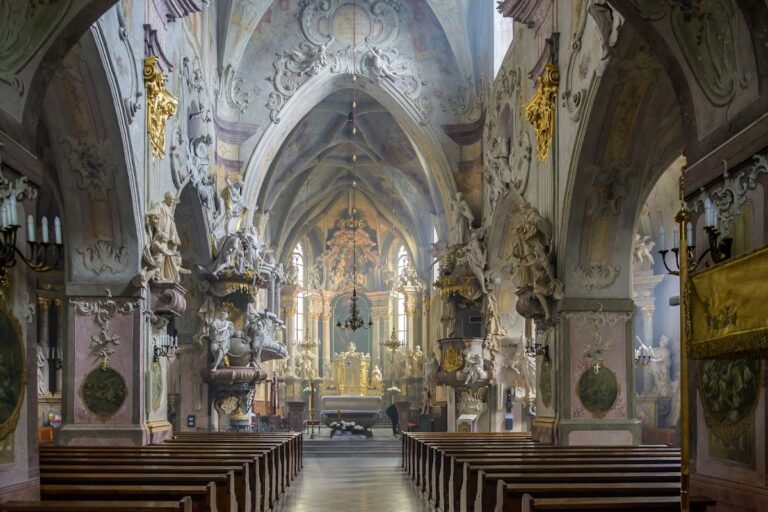
Master mason Johann Kunig of Osoblaha carried out a Baroque rebuilding in 1727–1728. Baroque architecture developed after the Gothic period and favored more dynamic forms and elaborate decoration. During this work, most of the older Gothic windows were replaced.
A major fire on 24 December 1800 killed five people inside the church. Reconstruction followed in 1801–1802 and created the building’s present form, while the surrounding walls survived the fire. In 1907, the old Gothic sacristy was demolished and replaced with a Neoclassical addition, reflecting a later revival of balanced classical forms.
Archaeology and conservation
The church was declared an immovable cultural monument in 1962. After the 1997 floods, increased moisture was probably linked to changed groundwater conditions in the surrounding ground. A building-historical investigation preceded major restoration work, which included structural stabilization, new rainwater drainage, and a ventilation channel beneath the foundations of the perimeter walls.
Remains
Kostel svatého Martina is a single-nave church with an originally Gothic layout. A rectangular presbytery, the part of the church reserved mainly for the altar and clergy, forms its eastern end, while a ground-floor sacristy, a room for preparing and storing liturgical equipment, adjoins the presbytery on the north. Later rebuilding altered the openings and added the present sacristy extension, but important medieval stone elements remain.
Nave
The nave originally had buttresses at its corners, set diagonally to provide projecting support against the walls. Its Gothic fabric was altered during the Baroque rebuilding, when most of the original windows were replaced by Baroque openings. The surviving walls therefore combine the medieval structural core with later changes to the building’s appearance.
Presbytery and sacristy
The large rectangular presbytery had buttresses at its corners and another buttress on the axis of its south wall. Restoration revealed a preserved Gothic stone portal on the south side and the profiled stone surround of the original eastern window, which had later been blocked up. The earlier Gothic sacristy was replaced by the Neoclassical extension in 1907.
Archaeological work beneath the presbytery floor in 1999–2000 uncovered stone tomb slabs belonging to Bishop Jindřich of Fulštejn, Ekrik Sup of Fulštejn, and Václav Sedlnický of Choltice. These burials connect the surviving church directly with members and associates of the medieval and early modern nobility linked to its history.