Saint Michael the Archangel Church, Prudnik: A Late-Baroque Parish Church
Site at a Glance
- Popularity
- Low
- Country
- Poland
- Primary era
- Early Modern
- Eras represented
- Medieval, Early Modern, Modern
- Civilizations
- German, Habsburg, Holy Roman Empire, Kingdom of Prussia
- Site type
- Religious
- Remains
- Church
On this page12 sections
History
Saint Michael the Archangel Church is a Roman Catholic parish church in Prudnik, Poland. Its present late-Baroque building, in a European style associated with elaborate ornament and dramatic effects, was built from 1730 to 1738 after several centuries of parish history.
Parish origins and medieval changes
A wooden church dedicated to the Assumption of the Virgin Mary, the Christian belief that Mary was taken bodily into heaven, was built in Prudnik in the second half of the thirteenth century. Its construction took place during a colonization process overseen by Wok of Rosenberg, a member of a medieval Bohemian noble family. In the seventeenth century, parish priest Maciej Alojzy Scharkow connected the parish’s establishment with 1279, the year he associated with the town’s foundation under German law, a medieval framework for chartering towns, by Henry, Wok’s son. The earliest written references to a church at Prudnik date to 1321 and 1331. Milotha is the first parish priest named.
The church may have been burned around 1420. A cemetery beside it was moved in the sixteenth century because space had become limited.
Religious change and rebuilding
From 1554 the church belonged to Lutherans, members of a Protestant Christian tradition that emerged during the Reformation. Catholics regained it in 1612, and a Renaissance-style rebuilding, in a European artistic style that preceded Baroque, began at the initiative of Maciej Bilicer. A fire in 1627, before the work was complete, destroyed the tower, organ, bells, and roof. The church was usable again by 1638. After a visitation in 1666, it was consecrated under the joint dedications of the Assumption of the Virgin Mary and Saint Michael the Archangel, regarded in Christian tradition as a protector against evil. By 1722 it had six side altars; those named were dedicated to the Savior, Saint Sebastian, the Holy Cross, Saint Henry, and Saint Joseph.
The eighteenth-century church
The present church was built from 1730 to 1738 to a design by an architect from Prudnik. It was solemnly consecrated on 2 July 1752 by Philipp Gotthard von Schaffgotsch, bishop of Wrocław.
Later changes and parish history
Austrian forces attacked Prudnik on 28 February 1779 and damaged the church. Its tower was raised in 1803. Renovation in 1860 brought a new sheet-metal roof and floor, and stained glass depicting Old Testament scenes was installed in 1898 after the presbytery windows had been enlarged. The church’s bells were requisitioned in 1917 and replaced in 1929.
During the Battle of Prudnik on 23 April 1945, an air bomb struck the north vestibule and destroyed a side entrance. The church sustained limited damage in the Second World War. The Dominicans, a Roman Catholic religious order, took over the parish in 1946 and established a monastery in Prudnik. On 16 February 1947, four masked and armed men entered the sacristy during a wedding, threatened those present, and stole a silver-gilt monstrance, a vessel used to display the consecrated Eucharist, from the tabernacle.
The church’s painted decoration was renovated in 1952. During the 1970s, workers renewed the roof and tower covering and carried out a general restoration of the interior. On 13 December 1981, Bishop Wacław Wycisk consecrated a banner for the Solidarity workplace committee at the Frotex textile works. Solidarity was a Polish independent trade union and social movement. Wycisk also consecrated a plaque funded by Frotex employees in memory of shipyard workers who had been killed; it was later installed on the wall of the Gdańsk Shipyard.
In 1998, Opole auxiliary bishop Jan Bagiński informed the parish council of the Dominicans’ intention to leave Prudnik. The order transferred the parish to diocesan priests, who serve within a diocese rather than a religious order, on 1 August 1999. Stanisław Bogaczewicz became the first parish priest after the transfer. The church belongs to the parish of Saint Michael the Archangel, the Diocese of Opole, and the Prudnik deanery, a subdivision of a diocese grouping parishes. It entered Poland’s register of cultural monuments in 1958.
Remains
Building and layout
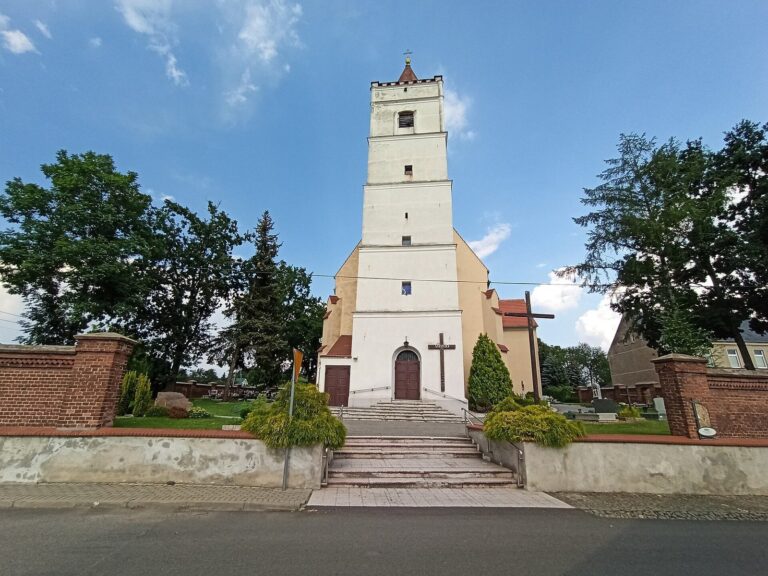
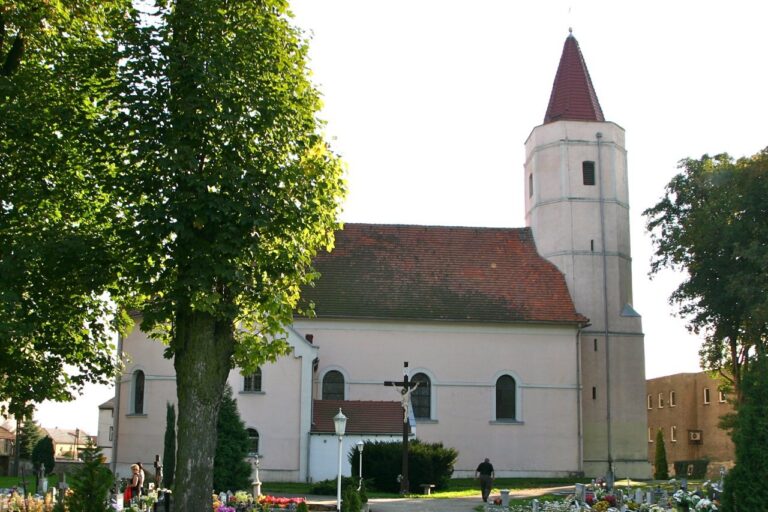
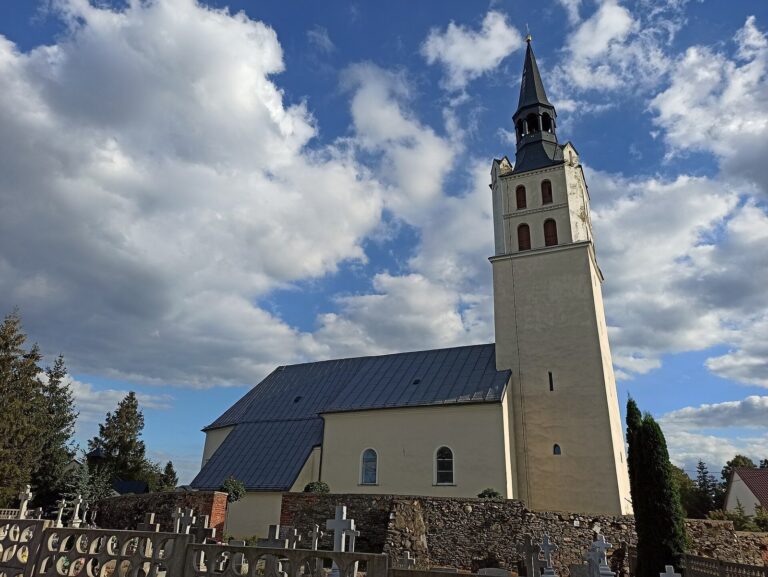
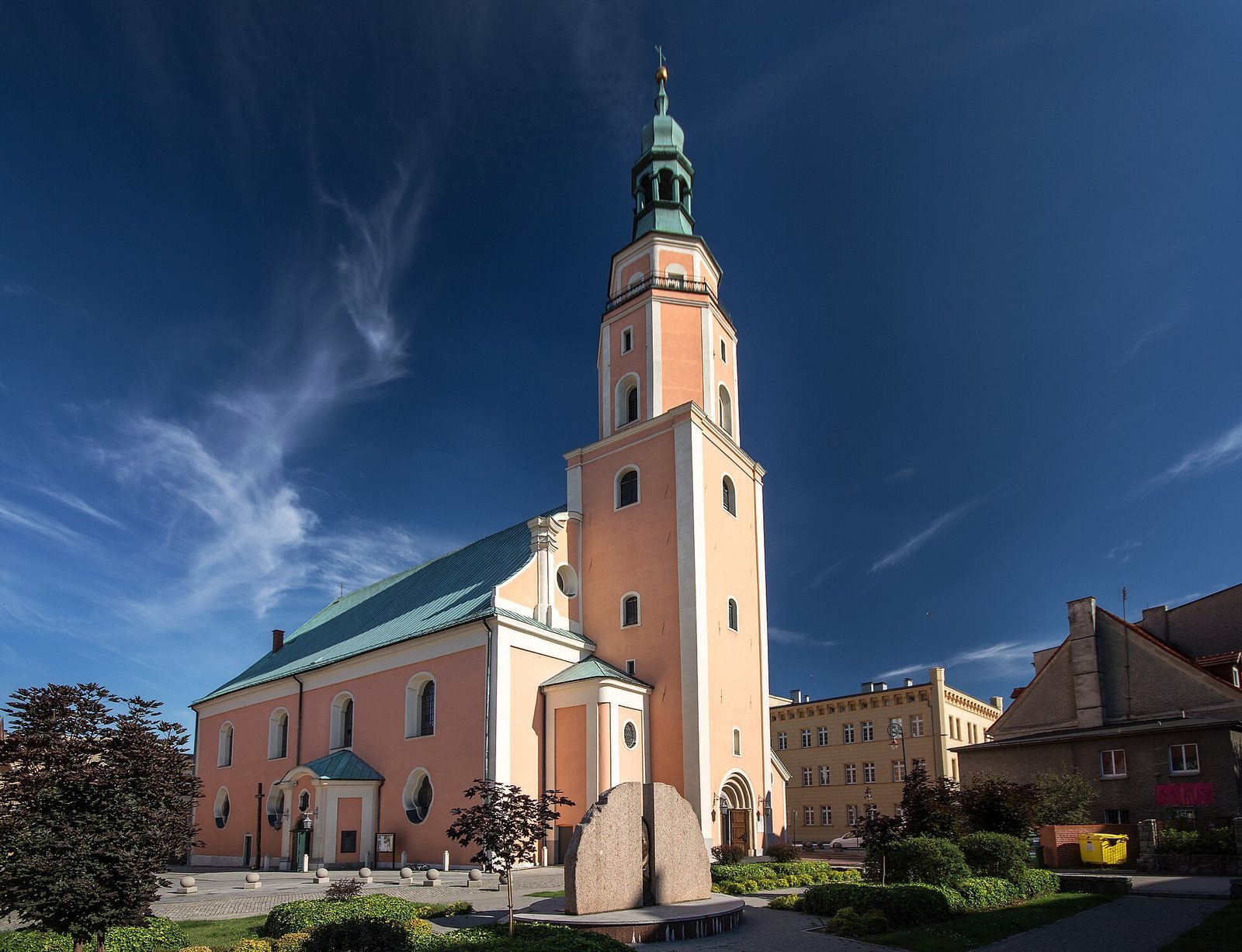
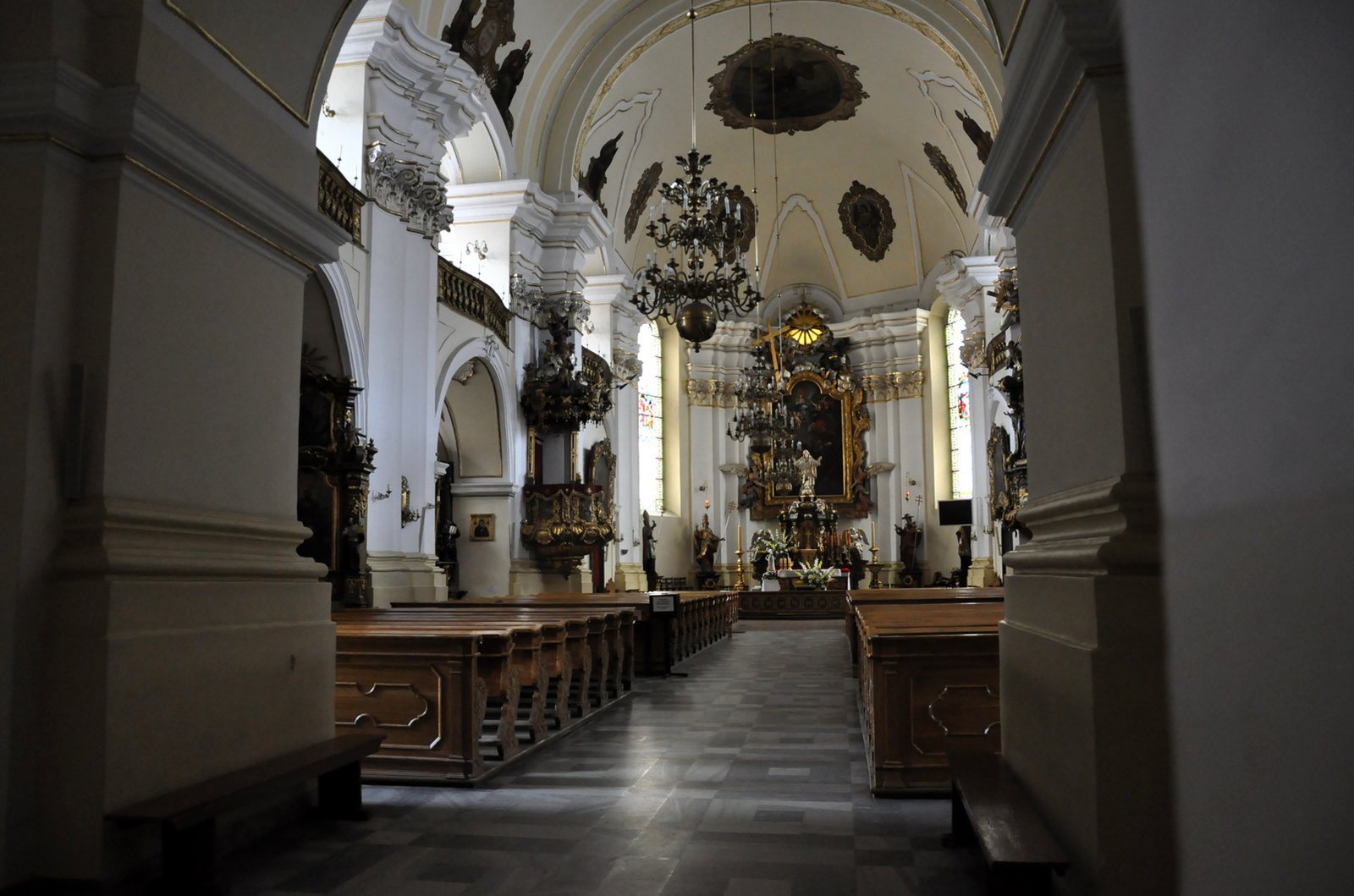
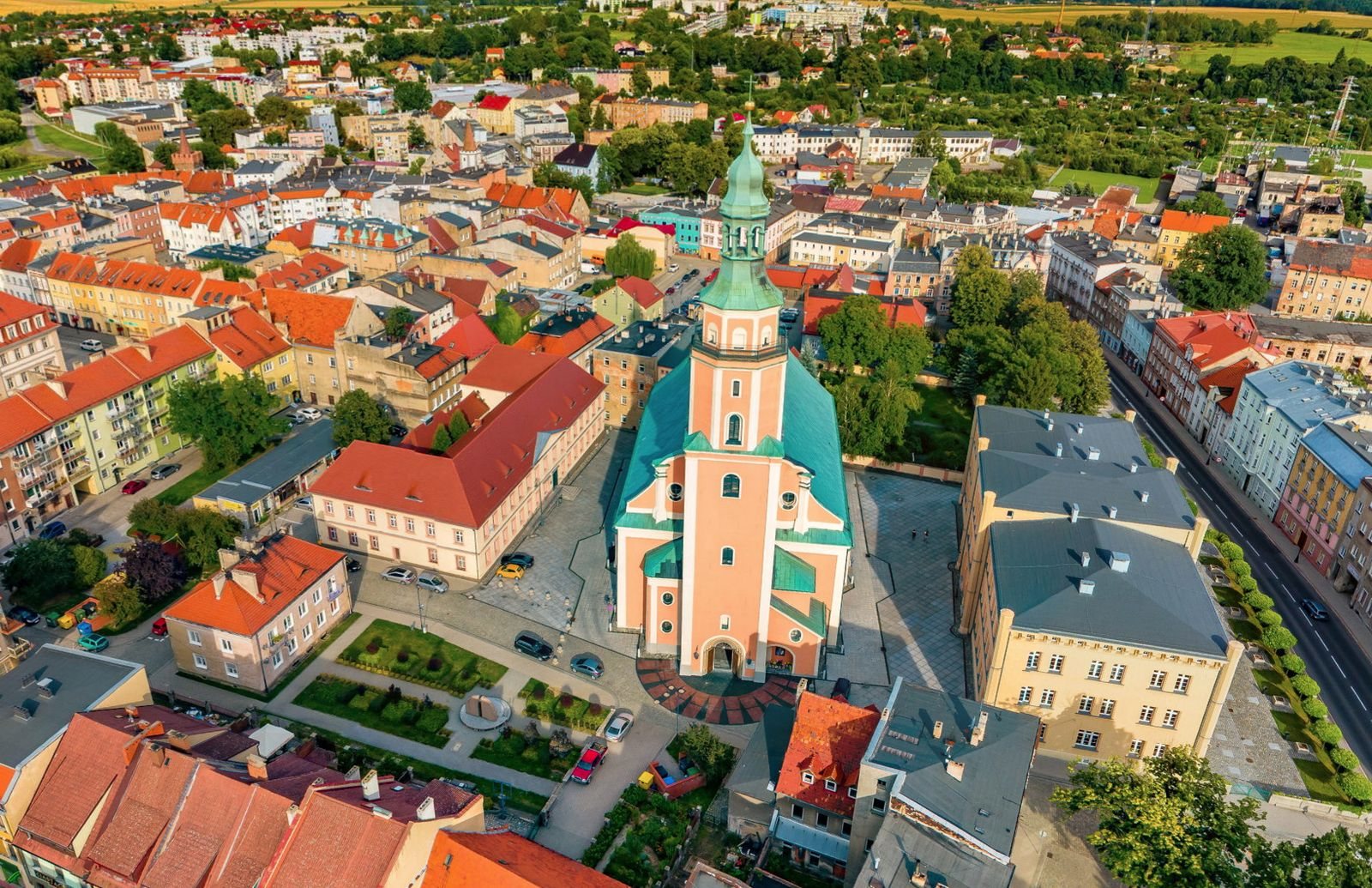
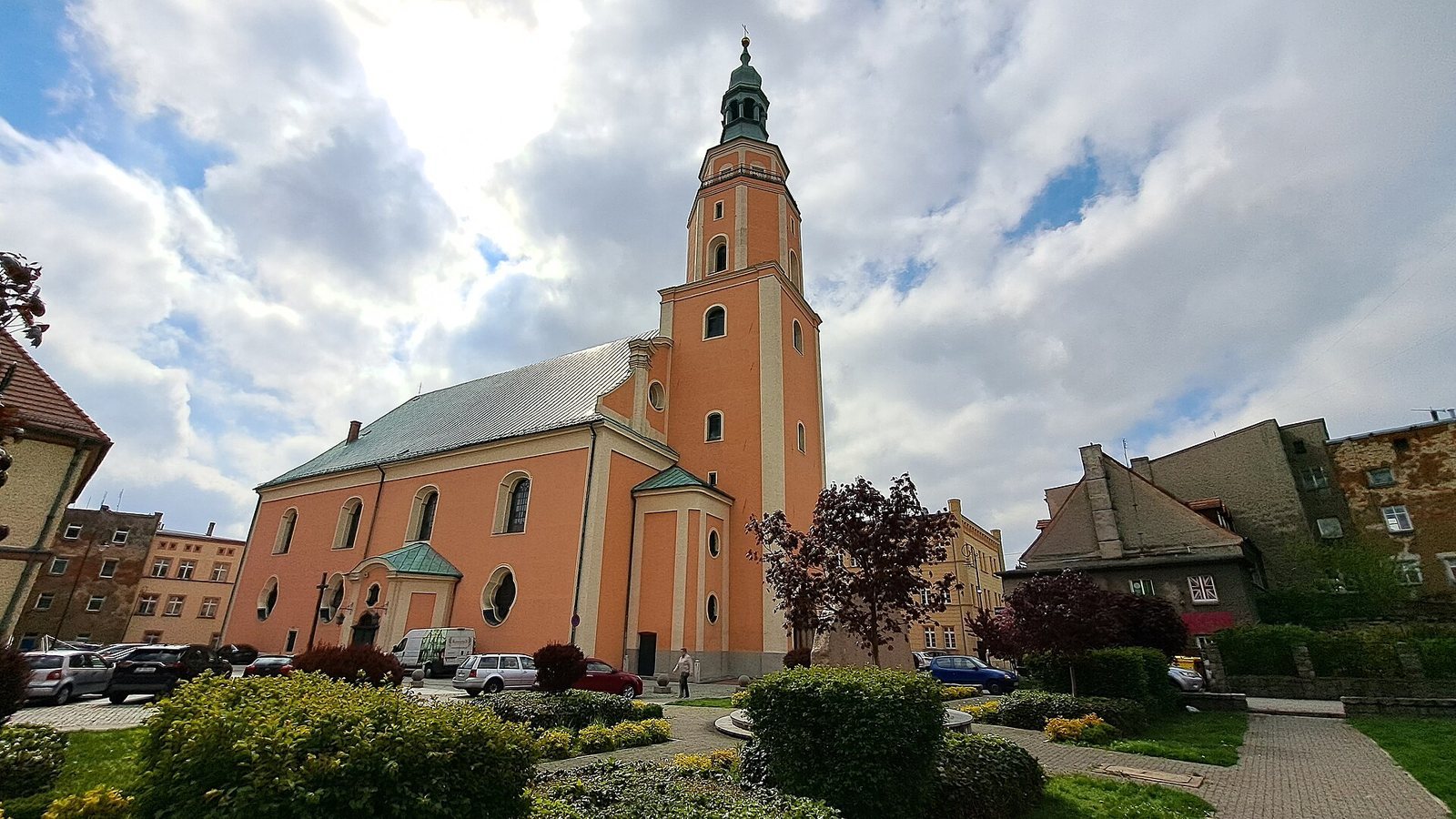
The brick church stands on Farny Square in the southern part of Prudnik’s Old Town, within the grid plan of the thirteenth-century town. Its design was modelled on Saint Nicholas Church in Prague’s Malá Strana district. The exterior is modest, while the interior is arranged around a central nave and side aisles of roughly equal height, beneath a barrel vault, a continuous arched ceiling. The building has a floor area of 1,284 square metres and a height of 62 metres, with a stated capacity of 13,819 people. Its single tower includes a compact belfry for bells. The Prudnik coat of arms appears on the arch separating the nave from the altar area.
There are three principal entrances: the main doorway on the west, a south entrance facing Public Gymnasium No. 1, and a north entrance facing the Catholic House, formerly a seminary. Smaller entrances include one on the south side facing the rectory. A large interior gallery connects with the choir and tower. The organ has three hand-operated keyboards.
Interior furnishings
Main altar and side altars
The main altar is topped by two cherubs and a sculpture of Christ. A life-size Sacred Heart of Jesus statue by Thamm of Nysa stands on it, surrounded by statues of Saint Augustine, Saint Gregory the Great, Saint Jerome, and Saint Ambrose, early Christian theologians and church leaders. A Baroque painting of the Assumption of the Virgin Mary hangs on the rear wall of the altar area. The church also has nine side altars.
Pulpit, choir, and paintings
Sculptures on the wooden pulpit represent the principal functions of the Church in allegorical form. A figure of Saint John of Nepomuk stands opposite it. Felix Anton Scheffler painted the choir paintings in 1735.
Sacristy and burial chamber
The sacristy, a room used to prepare for services and store liturgical objects, contains a painting of Our Lady of Prudnik brought from a Capuchin monastery demolished in 1907, and a painting of the Trinity by Scheffler. Capuchins, a branch of the Franciscan order, are buried in the church’s main crypt, a burial chamber.
Memorials
A bronze-and-marble monument opposite the church was unveiled on 10 September 2010. Made by sculptor Marian Molenda, it depicts newly elected Pope John Paul II raising Cardinal Stefan Wyszyński from his knees as Wyszyński pays homage to him. A plaque commemorating Polish Dominican priest Jan Góra was unveiled on the church wall beside the north entrance on 11 February 2018.