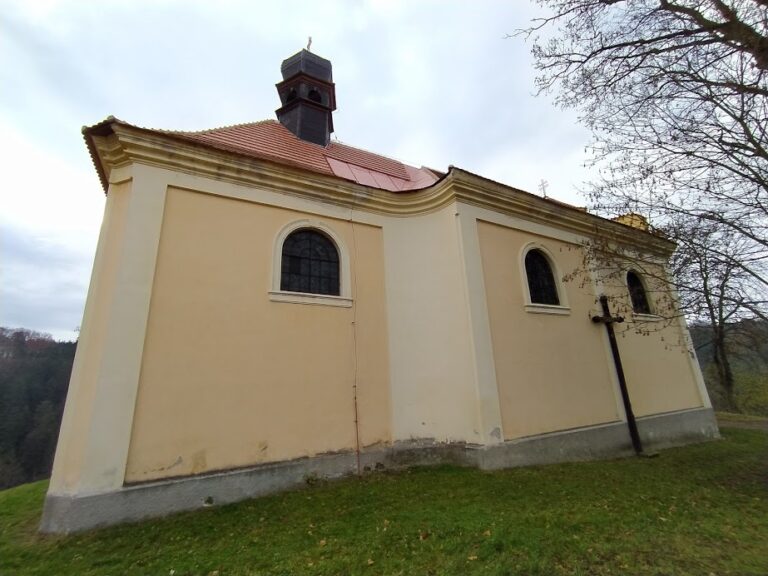
Church of Saint Wenceslas in Hrusice: A Romanesque Parish Church in Czechia


Site at a Glance
- Rating
- 4.8
- Popularity
- Very Low
- Country
- Czechia
- Primary era
- Medieval
- External website
- Open
- Eras represented
- Medieval, Early Modern, Modern
- Civilizations
- Holy Roman Empire, Kingdom of Bohemia
- Site type
- Religious
- Remains
- Church
On this page8 sections
History
The Church of Saint Wenceslas in Hrusice, Czechia, is a Romanesque church built by 1225–1250 at the latest. Its origins lie in the medieval Christian landscape of Bohemia, where an earlier Chapel of Saint Adalbert had already stood in the Hrusice area. The church later became a parish church and has retained evidence of several centuries of religious change.
Medieval foundation and parish history
The church is documented as a parish church in 1359. During the sixteenth century it was rededicated to Saint Nicholas, replacing the dedication to Saint Wenceslas for a time. The original dedication was restored in 1785, when the parish of Hrusice was elevated to a local chaplaincy, an ecclesiastical district served by a chaplain rather than operating as a fully independent parish.
Changes in parish administration
In 1624, the Hrusice parish was incorporated into the parish of Mnichovice. An independent parish was restored in 1856, but after 1953 no resident priest was appointed to Hrusice. Services were thereafter conducted by the priest responsible for the Mnichovice parish.
Damage, discovery, and later identity
A lightning strike hit the church tower in 1853. The impact cracked the church wall and accidentally revealed an earlier portal that had been walled up in the north wall of the nave. This discovery brought an important medieval feature back into view.
The church and its surrounding grounds are protected as a cultural monument of the Czech Republic. Its place in local cultural memory was also reinforced by the work of Josef Lada, a Czech painter, illustrator, and writer known for scenes of village life. As a native of Hrusice, Lada included the church in numerous paintings and illustrations.
Remains
The church stands in the upper part of Hrusice’s village square. Its Romanesque core consists of a single nave, a semicircular apse, a rounded projection containing the main sanctuary, and a prismatic tower. Later Baroque work introduced a portal on the west side of the tower, a roofed portico, and a sacristy used for vestments and liturgical equipment. The nave, originally covered by a flat ceiling, was vaulted, and additional windows were opened.
Romanesque portal
The original north portal of the nave is recessed, meaning that its entrance is framed by successive orders stepping back into the wall. It is considered the most valuable part of the building. The column capitals bear stylized plant ornament, while the archivolt, the decorated arch around the opening, carries carved decoration. The entire portal is made from red sandstone and is probably the work of Benedictine monks from Sázava Monastery, a medieval Benedictine monastery in Bohemia.
The portal’s tympanum, the field enclosed by the arch and lintel, shows two figures on either side of a cross raised on the back of a dragon. Their relatively primitive treatment has been interpreted either as Saints Cyril and Methodius, ninth-century Byzantine missionaries associated with the Christianization of the Slavs, or as Saints Wenceslas and Adalbert. The feature above the portal is not the coat of arms of Abbot Reginhard. It lacks the shield required for a heraldic coat of arms, and the portal was not made during Reginhard’s lifetime. Instead, it is a Christological sign, referring to Christ and Christian belief, with cross and lily attributes that evoke the later familiar Cross of Saint Benedict.
Interior furnishings
The Baroque high altar dates from the second third of the eighteenth century. It includes statues of the Virgin Mary, Saint Adalbert, and Saint Procopius, and was transferred from an unspecified church in Prague. A statue of Saint Wenceslas was placed at the top of the altar in 1809. A large painting of Saint Wenceslas dated 1619 originally stood on the former high altar.
The pseudo-Romanesque side altars, which imitate forms associated with Romanesque architecture, date from the late nineteenth century. The pulpit and the Stations of the Cross paintings by Florian Mašek also belong to that period. The Stations of the Cross are devotional representations commemorating episodes of Christ’s Passion. The church organ dates from 1902.
Churchyard and bells
The church was formerly surrounded by a cemetery. Its enclosure wall and gate have survived, preserving part of the historic boundary around the building.
Two bells currently hang in the tower. The smaller dates from the fifteenth century, while the larger surviving bell was cast in 1579 by the Prague bell founder Brikcí of Cimperk. The tower originally held three bells, but the largest was requisitioned for military use during the First World War.