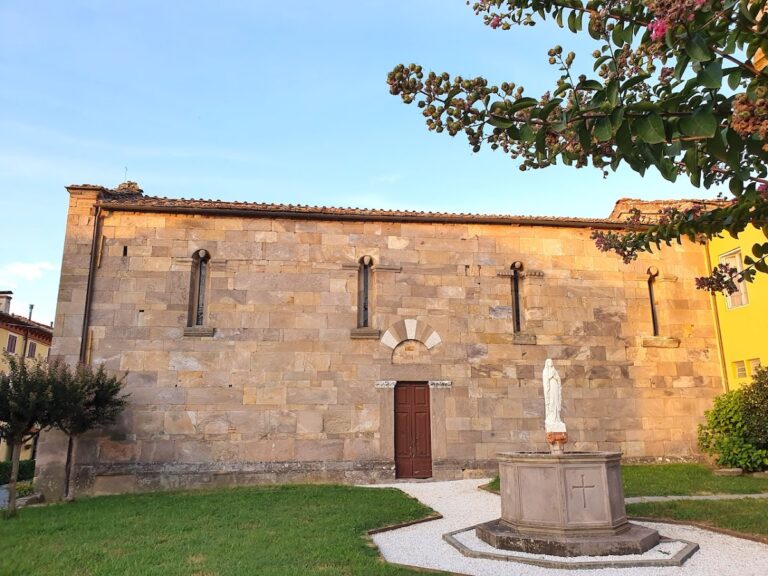
Santi Jacopo e Martino: The Archpriestly Parish Church of Uzzano Castello


Site at a Glance
- Rating
- 4.5
- Popularity
- Very Low
- Country
- Italy
- Primary era
- Medieval
- External website
- Open
- Eras represented
- Medieval, Early Modern
- Civilizations
- Grand Duchy of Tuscany, Republic of Florence, Republic of Lucca
- Site type
- Religious
- Remains
- Fortified Church
On this page9 sections
History
Santi Jacopo e Martino is a Roman Catholic church in Italy and the parish church of Uzzano Castello, at the summit of the medieval village in Valdinievole. Built between the twelfth and thirteenth centuries in the Romanesque style, it now belongs to the Diocese of Pescia. In 1260, it was listed among the churches assessed by Lucca as a subsidiary of the parish church of Santa Maria in Pescia.
From Rectory to Parish Church
The church began as a rectory and acquired the privilege of a baptismal font through a papal bull issued by Urban VI on 17 June 1388. A baptismal font is the fixed vessel used for the Christian rite of baptism. The privilege became definitive in 1443 after a judgment by Baldassarre Magni, Bishop of Lucca.
In 1625, Santi Jacopo e Martino became a pieve, a historic Italian parish church traditionally associated with baptismal rights and a defined territory. In 1729, following the establishment of the Bishopric of Pescia, it was elevated to an archpriesthood, a church institution headed by an archpriest. Giovanni Michele Fratini, who had served as pievano since 1700, became its first archpriest. The church remains an archpriestly parish within the Diocese of Pescia.
Baroque Alterations and Later Devotion
During the seventeenth and eighteenth centuries, substantial Baroque changes altered the church’s interior and façade. Baroque was a later decorative style known for dramatic forms and richer ornament. A major restoration between 1890 and 1910 removed these interventions and broadly returned the building to its earlier appearance.
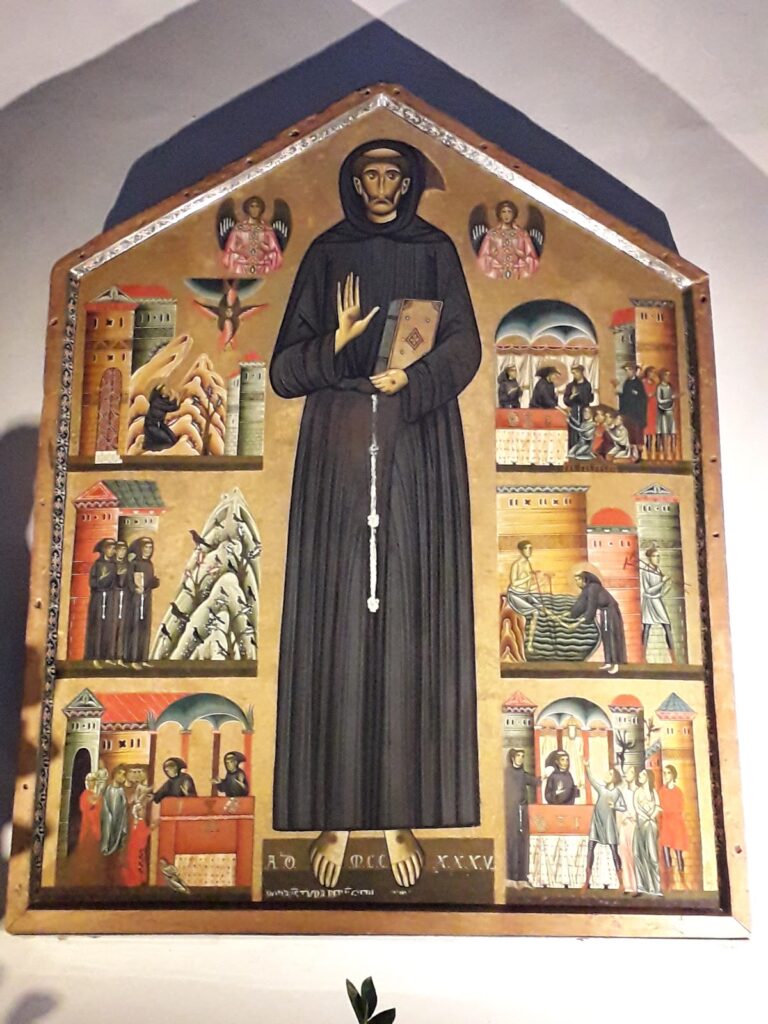
The local Confraternity of Misericordia has regarded the church’s fourteenth-century Crucifix, called the “Fine-Weather Crucifix,” as its patron since the confraternity was founded in 1672. Tradition held that uncovering the image would encourage fine weather, giving the object a continuing place in the religious life of the community.
Remains
The church preserves a Romanesque single-nave plan with a roof carried by timber trusses, triangular wooden frameworks that support the roof structure. Its medieval fabric is combined with later sculpture, paintings, altars, frescoes, and a defensive bell tower, while the façade retains elements restored during the late nineteenth and early twentieth centuries.
Façade and Entrance
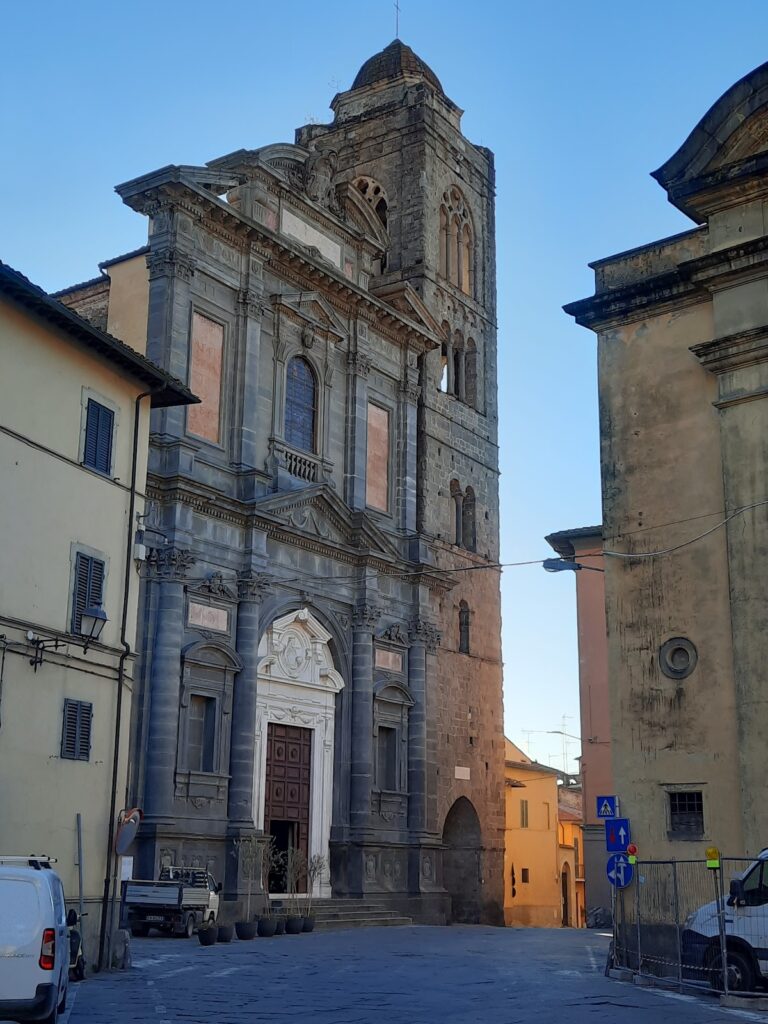
The façade is centered on a portal made of pietra serena, a gray sandstone, and carved with the imperial eagle, the Florentine lily, and the Fire, the emblem of Uzzano. Above the entrance is an openwork marble feature made from white Carrara marble and green Prato serpentine. The same materials appear in the rose window and the decorations of the upper attic. A small blind loggia with columns crowns the façade and was restored during the restoration campaign of 1890 to 1910.
Entrance Galleries and Baptismal Features
An elevated choir gallery, used by singers or musicians, stands on each side of the entrance. Beneath the left gallery is a niche with a statue of Saint Anthony Abbot by Giovanni della Robbia and a finely carved seventeenth-century marble baptismal font with a richly worked wooden cover. Beneath the right gallery is a thirteenth-century Romanesque holy-water stoup.
Frescoes and Paintings
A cycle of sixteenth-century frescoes beneath the choir galleries is attributed to the school of Sodoma, the name commonly used by the Renaissance painter Giovanni Antonio Bazzi. The church also preserves paintings from the sixteenth and seventeenth centuries. They include a Madonna of the Rosary with Saints John the Baptist and Mary Magdalene, attributed to Francesco Brina and dated to the eighth or ninth decade of the sixteenth century; an Annunciation by Giovan Battista Naldini; Saint Francis with the Stigmata and Saint Jerome by the Uzzanese painter Alessandro Bardelli; and a Marriage of the Virgin by Alessio Gimignani.
Side Chapel and High Altar
The church’s only side chapel contains an image of the Madonna del Buon Consiglio, brought from Rome in 1753 by Archpriest Antonio Ansaldi. A painting of Saints Roch and Sebastian frames the image, while a nearby niche holds a sixteenth-century polychrome terracotta statue of the Immaculate Conception. Beside the chapel stands a notable seventeenth-century wooden pulpit.
The eighteenth-century high altar preserves the skeleton of Saint Innocent and is surmounted by a seventeenth-century Crucifix. The apse was built in the sixteenth century and received an eighteenth-century Rococo decoration. Rococo was a highly ornate and delicate decorative style. A wall altar in the apse contains the fourteenth-century “Fine-Weather Crucifix.”
Defensive Bell Tower
The bell tower dates from the thirteenth century and originated as a defensive structure. Its military character is indicated by the imposing pointed arch at its base, which is partly blocked. On the ground floor, a fifteenth-century fresco attributed to Neri di Bicci depicts the Crucifixion between the Virgin Mary, the young Saint John the Baptist, and Saints Martin and James.
The belfry contains five bells. The larger of the two large bells was cast in 1622 by Antonio Ceranino, while the smaller was recast in 1904 by Lorenzo Lera of Segromigno. Among the three smaller bells, one dates from 1661 and another from 1816. The third was cast in 1866 by Luigi Magni of San Quirico di Valleriana and, after being damaged, was recast a century later by the Lera firm of Viareggio.