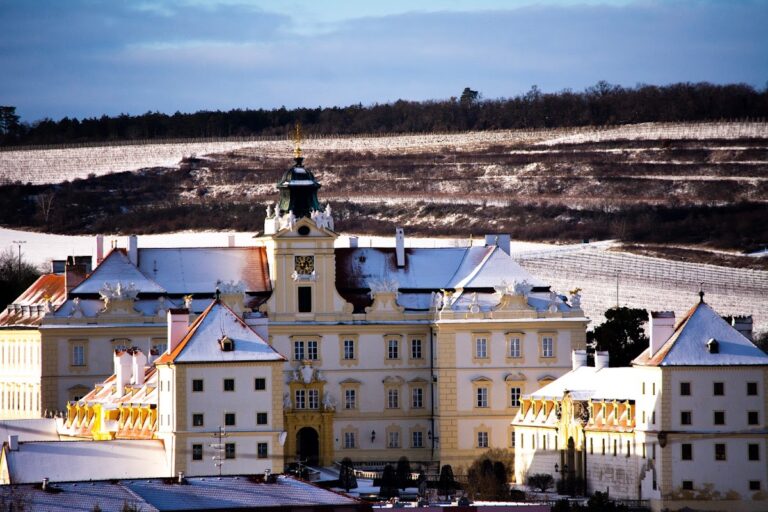
Church of Saint Wenceslaus in Mikulov: Parish and Collegiate Church


Site at a Glance
- Rating
- 4.8
- Popularity
- Low
- Country
- Czechia
- Primary era
- Early Modern
- External website
- Open
- Eras represented
- Medieval, Early Modern
- Civilizations
- Holy Roman Empire
- Site type
- Religious
- Remains
- Church
On this page12 sections
History
The Church of Saint Wenceslaus is a Roman Catholic parish and collegiate church in Mikulov, Czechia, whose present core dates from the fifteenth century. It belongs to the Diocese of Brno and the Moravian ecclesiastical province. Its medieval fabric, later completion, and role as the seat of a collegiate chapter, a body of clergy serving a church through shared liturgical and administrative duties, reflect Mikulov’s long religious history.
Medieval Origins and Destruction
The church stands on the site of an earlier Romanesque building that probably existed by the twelfth century and was first recorded in 1276. It served the original village that formed the nucleus of modern Mikulov and was its oldest church. The core of the present building was raised during the fifteenth century, but work was interrupted in 1426 when Hussite forces invaded Mikulov. The Hussites, followers of the reform movement associated with Jan Hus, looted the church and set it on fire. A provisional repair allowed the building to continue in use, although another fire damaged it in 1584.
Completion and Collegiate Role
The Dietrichsteins, owners of the estate, supported the church’s completion during the sixteenth century and the first half of the seventeenth century. Around 1640, the three-aisled interior received new vaults and stucco decoration. The sacristy and an upper music gallery were added, while the Gothic windows were altered into their present form.
At the initiative of Cardinal František of Dietrichstein, the church became the seat of a distinguished collegiate chapter in 1625. The chapter remains active. Its associated provostry, the residence or office of the chapter’s head, stands in the shared courtyard opposite the church entrance.
Modern Conservation
Repairs carried out between 1995 and 2014 took place through the Architectural Heritage Rescue Programme. The church is protected as a cultural monument.
Remains
The surviving church is a hall church, with aisles approximately equal in height to the central nave. It has three aisles, an elongated pentagonal presbytery, a Renaissance tower on the south side, and later Classicist features. A two-storey oratory and sacristy extend along the north side of the presbytery, while a covered passage links the church with the route leading to Mikulov Castle.
Exterior and Burial Features
Renaissance Tower
The tall Renaissance tower rises on the southern side of the church. Its domed top is finished with an arcaded gallery, and the tower forms a major landmark of Mikulov and the nearby town square. Its prominent position contrasts with the church’s predominantly Classicist appearance, which developed around a medieval core.
Lobkowicz Crypt and Tombstones
An ossuary, a repository for human bones, occupies the Lobkowicz Crypt beneath the church. Tombstones dating from the second half of the sixteenth century and the first half of the seventeenth century are set into the exterior wall. In the presbytery, marble epitaphs, memorials commemorating the dead, honor Václav Vilém Popel of Lobkowicz, who died in 1626, and his wife Markéta Františka, née Dietrichstein, who died in 1617. Their son, František Josef of Lobkowicz, established the foundation that provided the epitaphs after 1784.
Interior Furnishings
Altars, Pulpit, and Organ
The furnishings date mainly from the mid-1740s and were substantially expanded between 1762 and 1775. Ignác Lengelacher’s workshop produced the altars in the recessed chapels. Ondřej Schweigl later made the other altars, the pulpit, and its corresponding Crucifixion composition. The church also contains an organ made by Jan Výmola.
Paintings and Devotional Images
The main altar carries František Adolf of Freenthal’s painting of the Murder of Saint Wenceslaus. The Viennese painter also produced the paintings for the Saint Barbara altar and the Last Supper altar. A wooden statue of the Mikulov Black Madonna and Child, a devotional image of the Virgin Mary with dark coloration, formerly stood in the Loreto Church of Saint Anne.
Baptismal Font
The underside of the baptismal font’s lid bears Josef Winterhalder the Younger’s painting of the Baptism of Christ.